
 Lets Talk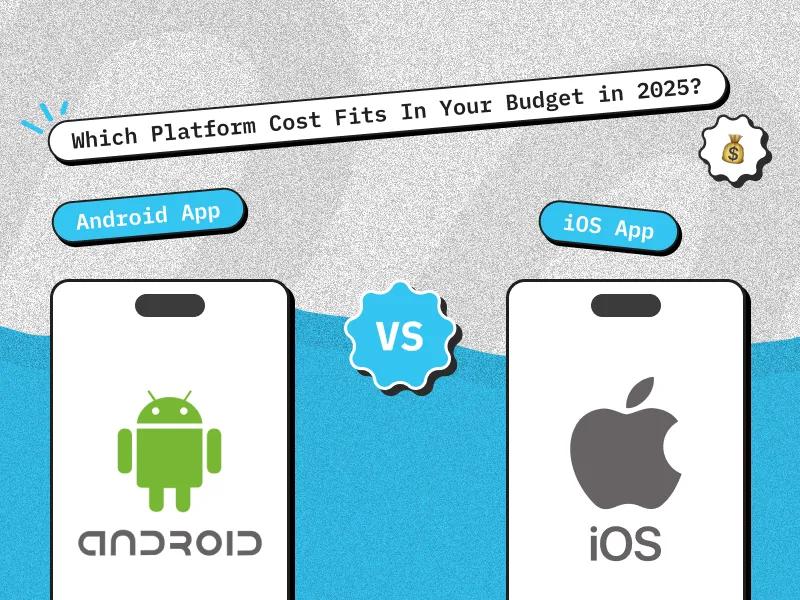
A native iOS or Android app typically starts at $20,000 and can exceed $160,000. Building separate native applications for both platforms may cost $40,000 to $300,000 or more. Android can require broader device testing, while iOS may involve specialist development and Apple-specific release requirements. Neither platform is automatically cheaper. The right choice depends on your audience, features, integrations, device needs, and launch strategy.
TL;DR
- A basic native app may cost $20,000 to $45,000 per platform.
- A medium-complexity app may cost $45,000 to $95,000.
- A complex native product may cost $90,000 to $170,000 or more.
- Android may require broader device and operating system testing.
- iOS offers a more controlled device ecosystem but can involve higher specialist rates.
- Cross-platform development can lower duplicated work when both platforms share similar features.
- Separate native apps suit products with intensive hardware or platform-specific requirements.
- Choose based on verified audience data, not assumptions about which platform is cheaper.
Which Platform Is More Cost-Effective for Your App?
The cheapest approach depends on your users, launch platforms, device functionality, and whether the iOS and Android experiences need to differ.
An iOS-first launch may suit Apple-heavy audiences, while Android can provide better reach in Android-dominant markets. Cross-platform development can reduce duplicated work when both versions share similar features. Separate native apps are usually justified when performance, hardware access, or platform-specific behavior is critical.
Interactive Tool: Which Development Approach Fits Your Budget?
Answer six questions. The tool should recommend iOS-first, Android-first, cross-platform, or separate native development.
1. Where are most of your target users?
- United States, Canada, Western Europe, Australia, or Japan
- India, Southeast Asia, Africa, Latin America, or another Android-heavy market
- Across both ecosystems
- We have not validated the audience
2. Which platforms do you need at launch?
- iOS only
- Android only
- Both
- I am not sure
3. What device functionality is required?
- Login, profiles, content, forms, and dashboards
- Camera, GPS, maps, notifications, or payments
- Bluetooth, NFC, wearables, AR, background processing, or custom hardware
- Requirements are not yet defined
4. How different will the two experiences be?
- The same user journey
- Mostly shared, with some platform-specific components
- Distinct native experiences
- Only one platform is required
5. What is your initial budget?
- Below $25,000
- $25,000 to $50,000
- $50,000 to $100,000
- Above $100,000
6. What is your main objective?
- Validate an MVP quickly
- Reach the largest audience
- Deliver maximum native performance
- Generate subscription or in-app purchase revenue
- Support an existing business workflow
Picker Results
Start with iOS
Recommended when most users are in Apple-heavy markets, one platform is enough for validation, and the business wants to control early testing scope.
Starting with iOS may be the most cost-effective option for your first release.
A native iOS app may provide sufficient market coverage without the immediate cost of building and maintaining an Android version. Review the detailed iOS app development cost breakdown before finalizing the scope.
Start with Android
Recommended when Android adoption is strong, broad reach matters, or the app must support several device price segments.
Starting with Android may provide better value for your target market.
Android can require a broader testing matrix, but it may be the more practical investment when most intended users already rely on Android devices.
Choose Cross-Platform Development
Recommended when both platforms are required, most screens and workflows are shared, and maintaining feature parity is important.
Cross-platform development may offer the best balance of reach and cost.
A shared approach can reduce duplicated work while supporting coordinated features and releases. Select the technology after reviewing performance, integrations, scalability, hardware access, and the long-term roadmap.
Build Separate Native Applications
Recommended when the product needs advanced platform-specific functionality, maximum performance, or significantly different iOS and Android experiences.
Separate native applications may provide better long-term value.
This option costs more initially because each platform has its own codebase, testing process, and release cycle. It also provides greater control over performance and hardware integrations.
iOS vs Android App Development Cost Comparison
| Cost Factor | Native iOS | Native Android | Separate Native Apps |
| Basic MVP | $20,000 to $45,000 | $20,000 to $45,000 | $40,000 to $80,000 |
| Medium app | $45,000 to $90,000 | $45,000 to $95,000 | $85,000 to $170,000 |
| Complex product | $90,000 to $160,000+ | $90,000 to $170,000+ | $170,000 to $300,000+ |
| Initial timeline | 3 to 5 months | 3 to 6 months | 5 to 10 months |
| Main language | Swift | Kotlin | Swift and Kotlin |
| Testing effort | Moderate | Moderate to high | High |
| Codebases | One | One | Two |
| Best fit | Apple-first audience | Broad Android audience | Maximum native control |
These ranges compare applications with similar functionality. Backend services, subscriptions, real-time communication, AI, compliance, and integrations can move a project into a higher band.
For a wider breakdown covering discovery, design, development, infrastructure, testing, and maintenance, review the complete guide to how much it costs to build an app.
How Much Does iOS App Development Cost?
A native iOS app may cost $20,000 to $160,000 or more.
| iOS App Level | Typical Scope | Planning Range |
| Basic | Login, profiles, content, dashboard, notifications | $20,000 to $45,000 |
| Medium | Payments, maps, subscriptions, APIs, admin panel | $45,000 to $90,000 |
| Complex | Real-time features, AI, infrastructure, compliance | $90,000 to $160,000+ |
Apple controls a comparatively focused hardware ecosystem, which can simplify the initial device matrix. Testing is still required across supported devices, iOS versions, accessibility settings, permissions, and network conditions.
Other considerations include App Store preparation, privacy declarations, in-app purchase rules, account deletion, and release review. Apple Developer Program membership is currently $99 per membership year, although regional pricing and fee waivers may apply.
How Much Does Android App Development Cost?
A native Android app may cost $20,000 to $170,000 or more. Costs can increase across multiple manufacturers, screen sizes, operating system versions, tablets, foldables, and lower-specification devices.
| Android App Level | Typical Scope | Planning Range |
| Basic | Login, profiles, content, APIs, notifications | $20,000 to $45,000 |
| Medium | Payments, location, subscriptions, dashboards | $45,000 to $95,000 |
| Complex | Hardware, AI, real-time systems, enterprise controls | $90,000 to $170,000+ |
Android commonly uses Kotlin and Android Studio. The budget depends heavily on the minimum supported operating system version and device coverage policy. Google Play currently charges a $25 one-time registration fee, which is minor compared with engineering, testing, security, and maintenance.
Why Do iOS and Android Development Costs Differ?
Device Coverage
Android supports a wider hardware market. A broad support policy can add responsive design, physical-device testing, manufacturer-specific debugging, and performance optimization. iOS has fewer active device families, although older devices and multiple screen sizes still require validation.
User Experience Requirements
The platforms use different navigation patterns, components, permission flows, and design conventions. Platform-specific interactions require additional design, development, and QA.
Store and Policy Requirements
Both stores require identity verification, privacy information, screenshots, policy compliance, and release testing. Discovering payment, privacy, permission, or account-deletion requirements late can create rework.
Backend and Integrations
The mobile interface is only one layer. APIs, databases, admin panels, cloud infrastructure, authentication, notifications, analytics, and third-party integrations can represent a large share of the budget.
Maintenance
Separate native apps require two codebases, two testing cycles, and coordinated releases. Ongoing work includes operating system compatibility, dependency upgrades, security patches, store changes, performance monitoring, and new features.
Should You Build Native Apps or Choose Cross-Platform Development?
When both platforms are required, compare two native applications with a cross-platform approach that shares a substantial portion of the codebase.
| Factor | Separate Native Apps | Cross-Platform App |
| Codebase | Two | Substantially shared |
| Initial cost | Higher | Usually lower for shared features |
| Platform control | Maximum | High, with native work where needed |
| Feature parity | Requires coordination | Easier to maintain |
| Testing | Separate flows | Shared flows plus platform testing |
| Best suited for | Hardware-heavy products | Similar platform experiences |
Cross-platform development can reduce duplicated interface, business logic, and integration work. It does not remove platform-specific testing, store releases, permission handling, or native extensions.
It often suits marketplaces, booking platforms, fintech interfaces, content apps, internal tools, and standard MVPs. Separate native development may be more appropriate for advanced Bluetooth, NFC, AR, intensive graphics, background services, custom hardware, or deeply platform-specific interactions.
The framework should be selected after technical discovery. Teams considering a shared codebase can review the factors affecting Flutter app development cost as one framework-specific example, not as the default choice for every project.
What Does Creole Studios Project Data Show?
Public Creole Studios case studies show that platform choice is only one budget variable.
| Project | Approach | Public Investment | Timeline | Main Cost Drivers |
| Digihappy | Cross-platform iOS and Android | $50,000+ | 1.5 years | Video calling, multilingual UX, accessibility, backend, device management |
| ITA Connect | Cross-platform mobile plus web | $60,000+ | 2.5+ years | Financial tools, content library, real-time sharing, continuous updates |
First-Hand Experience: What Increased the Scope?
Digihappy required real-time video communication, backend services, multilingual support, senior-friendly accessibility, and Android auto-answer functionality. Its scope extended beyond standard mobile screens.
ITA Connect required consistent mobile and web experiences, interactive financial calculators, risk profiles, content resources, real-time sharing, and ongoing support. A shared approach improved feature consistency, but backend and product complexity still shaped the investment.
The practical lesson is that a shared codebase reduces duplication, but it cannot remove the cost of complex workflows, infrastructure, accessibility, security, testing, and long-term product development.
How Can You Reduce App Development Costs?
Validate the Audience First
Use analytics, interviews, market research, or website device data. Launching where customers already are is more cost-effective than funding both platforms based on assumptions.
Start with a Focused MVP
Separate launch-critical functionality from future improvements. One core user journey, basic administration, analytics, and essential notifications may be enough to validate demand.
Use Cross-Platform Development for Shared Experiences
A shared approach can reduce duplicated work when screens, workflows, and logic are similar. Complete a feasibility assessment first when the product depends on advanced hardware.
Define Integrations Early
Changing payment, mapping, authentication, communication, analytics, or backend providers during development can create rework. Confirm API quality, pricing, security, and sandbox access during discovery.
Plan Maintenance Before Launch
Define supported devices, operating system versions, testing responsibilities, monitoring, release ownership, and dependency updates. A low initial quote can become expensive when long-term ownership is ignored.
For additional methods, review these strategies for reducing app development costs without removing essential functionality.
Not Sure Which Platform to Choose?
Use the free checklist to compare iOS, Android, cross-platform, and native development based on your users, features, budget, and timeline.

Frequently Asked Questions
Is Android app development cheaper than iOS?
Not automatically. Comparable applications often fall within similar initial ranges. Android testing can cost more across a broad device matrix, while specialist rates and Apple-specific requirements can increase iOS costs.
How much does it cost to build for both platforms?
Separate native applications may cost $40,000 to $300,000 or more. Cross-platform development can reduce duplicated work when both versions share most features and workflows.
Is cross-platform development always cheaper?
It is often more cost-efficient than two native builds for a shared experience. Savings may decrease when extensive native modules, hardware integrations, or different platform behavior are required.
Should a startup launch on iOS or Android first?
Start with the platform used by the highest-value target users. When the audience is uncertain, validate demand through research or a focused MVP before funding both platforms.
Can an iOS app be converted into an Android app?
Product requirements, APIs, backend services, and design components can be reused, but native Swift code cannot simply be published on Android. Android implementation, testing, and release work are still required.


 10 min read


