

 Lets Talk
TL;DR
- DevOps CI/CD helps startups replace stressful manual deployments with automated release workflows.
- A CI/CD pipeline allows teams to build, test, and deploy software faster with fewer errors.
- Continuous development helps startups ship small, frequent updates instead of waiting for large, risky releases.
- CI/CD becomes especially important when a startup grows from a small engineering team to a larger product team.
- Startups can begin with simple tools like GitHub Actions, Docker, Terraform, and basic monitoring before scaling into advanced DevOps workflows.
- The best starting point is a 90-day roadmap that covers version control, automated testing, staging deployments, rollback planning, containers, and Infrastructure as Code.
Introduction
In the early days of a startup, speed is usually your biggest advantage. With two or three developers, it may feel easy to manually push code, fix bugs quickly, and deploy updates without a formal process.
But that changes once the startup begins to scale.
You may hire more developers. Your user base may grow. Your product may become more complex. Features become connected. Bugs become more expensive. Investors expect faster progress. Customers expect fewer issues. At this stage, many founders also start looking to hire DevOps engineers who can bring structure, automation, and reliability into the release process.
Suddenly, the same manual release process that worked in the beginning becomes a bottleneck.
This is where DevOps CI/CD becomes important.
A structured CI/CD pipeline replaces manual software delivery with a repeatable and automated workflow. Instead of depending on last-minute fixes, manual commands, and stressful release days, startups can build a system where every code change is automatically built, tested, validated, and prepared for deployment.
What Is DevOps CI/CD?
DevOps CI/CD is a software delivery approach that combines automation, collaboration, testing, deployment, and continuous feedback.
In simple terms, it helps startups move code from development to production in a safer and faster way.
To understand it clearly, break it into three parts.
Continuous Development
Continuous development means building software in small and frequent increments.
Instead of waiting weeks or months to launch a large batch of features, teams continuously improve the product through smaller updates. This helps startups reduce release risk because small changes are easier to review, test, debug, and roll back.
DevOps Pipeline
A DevOps pipeline is the complete workflow that moves code from a developer’s system to the live product.
It usually includes:
- Code commit
- Build
- Automated testing
- Release approval
- Staging deployment
- Production deployment
- Monitoring
- Feedback
For startups that are still formalizing engineering workflows, understanding the broader role of DevOps in software development can help connect automation, collaboration, and release reliability.
CI/CD
CI/CD stands for Continuous Integration and Continuous Delivery or Continuous Deployment.
Continuous Integration means developers frequently merge code into a shared repository. Every code change triggers automated builds and tests.
Continuous Delivery means tested code is always ready for release, usually with a manual approval before production.
Continuous Deployment goes one step further and automatically deploys every validated change to production.
For most startups, Continuous Delivery is the safer starting point because it keeps releases automated while still allowing manual approval before going live.
Why Startups Need DevOps CI/CD to Accelerate Time-to-Market
Time-to-market is the speed at which your team can turn an idea into a live product feature. For startups, this directly affects learning, growth, customer retention, and competitive advantage.
Faster Customer Feedback
Startups grow by learning from users.
If it takes three weeks to release a feature, it also takes three weeks to know whether users actually need it. With CI/CD, startups can release smaller updates faster and collect feedback earlier.
This allows founders, product managers, and engineering teams to make decisions based on real user behavior instead of assumptions.
Lower Release Risk
Large manual releases are risky because they contain too many changes at once.
When something breaks, it becomes difficult to find the exact cause. CI/CD reduces this risk by encouraging smaller and more frequent deployments. If an issue occurs, the team can isolate the problem faster and roll back with less disruption.
Better Engineering Productivity
Manual deployments waste valuable engineering time.
Developers may spend hours preparing builds, checking environments, running scripts, fixing deployment issues, and coordinating release windows.
A CI/CD pipeline automates these repetitive tasks so developers can focus more on building product value.
Creole Studios has seen this impact in real DevOps implementations. In one AWS-based CI/CD project, our team helped a growing web platform move from fragmented manual deployments to an automated, self-healing CI/CD delivery ecosystem using AWS CDK, GitHub Actions, self-hosted runners, and PM2-based monitoring. The result was a more secure release process, reduced infrastructure setup time from hours to minutes, and a backend that could automatically restart services and validate health checks after deployment.
Stronger Startup Execution
Startups that release faster can test ideas faster.
They can improve onboarding, fix product friction, launch customer-requested features, and respond to market changes before slower competitors.
Speed becomes a real business advantage when it is supported by reliable engineering systems.
What Slows Down Startups Without a CI/CD Pipeline?
Many startups do not feel the pain of poor delivery systems until the product starts scaling.
| Startup Challenge | What Usually Happens | CI/CD Solution |
| Manual deployments | Developers run custom terminal commands, which increases human error | Automated deployment workflows |
| Large releases | Teams delay releases until too many changes pile up | Smaller and more frequent releases |
| Environment mismatch | Code works locally but fails on staging or production | Containers and consistent environments |
| Slow testing | Bugs are discovered late or after release | Automated testing inside the pipeline |
| Poor visibility | Teams do not know what failed or why | Monitoring, logs, and deployment tracking |
These issues do not just create technical debt. They slow down product execution, delay customer feedback, and increase engineering stress.
Lean Startup CI/CD Tool Stack
Startups do not need a complex enterprise-grade DevOps setup on day one. The better approach is to start with cost-effective tools that are easy to adopt and scalable enough for future growth.
| DevOps Area | Recommended Tools | Why It Helps Startups |
| Version control | GitHub, GitLab, Bitbucket | Creates a single source of truth for code |
| CI/CD automation | GitHub Actions, GitLab CI, CircleCI | Automates builds, tests, and deployment workflows |
| Containerization | Docker | Keeps application behavior consistent across environments |
| Infrastructure as Code | Terraform, Pulumi, AWS CloudFormation | Reduces manual cloud setup errors |
| Hosting and cloud | Vercel, Heroku, AWS, Google Cloud, Azure | Supports both early-stage speed and future scalability |
| Monitoring | Datadog, Grafana, Prometheus, New Relic | Helps detect production issues faster |
| Security checks | Snyk, Trivy, SonarQube, Checkov | Adds security validation into the pipeline |
If your team is comparing tools, this guide on the best DevOps platforms for startups can help you evaluate practical options for CI/CD, deployment, and automation.
Key Stages of a DevOps CI/CD Pipeline
A strong CI/CD pipeline gives every code change a clear path from development to production.
Plan and Code
The team defines the feature, bug fix, or improvement. Developers write code in small increments and push changes to a shared Git repository.
This creates a reliable source of truth for all code changes.
Build
Once code is pushed, the pipeline automatically creates a build.
This step checks whether the application can be packaged successfully. If the build fails, the issue is caught early before it reaches staging or production.
Test
Automated tests run after the build.
These may include unit tests, integration tests, API tests, regression tests, and basic security checks. Testing inside the pipeline prevents broken code from moving forward.
Release
Once the code passes testing, it is prepared for release.
In a continuous delivery setup, the release may wait for manual approval before going live. This gives startups control while still reducing manual release effort.
Deploy
The validated build is deployed to staging or production.
Deployment automation reduces dependency on manual commands and makes releases more predictable.
Monitor
After deployment, the team monitors uptime, errors, performance, logs, and user behavior.
This is where observability in DevOps becomes important because logs, metrics, traces, and alerts help teams identify failures faster.
What Startups Must Implement First
Startups should avoid over-engineering CI/CD too early. The goal is to build a reliable foundation and improve it gradually.
Continuous Integration
Continuous Integration should be the first priority.
Every code commit should trigger an automated build and basic tests. This helps catch errors early and gives developers faster feedback.
Automated Testing
Automated testing reduces the risk of breaking existing features.
Startups should begin with high-impact areas such as login, payment flows, APIs, onboarding, and critical business logic. The goal is not to test everything at once. The goal is to protect the most important parts of the product first.
Continuous Delivery
Continuous Delivery keeps the application ready for release at any time.
Even if production deployment still requires manual approval, most release steps should be automated.
Containers
Containers such as Docker help ensure that the application runs consistently across development, staging, and production.
For teams trying to reduce environment mismatch, Docker containerization in DevOps pipelines can make deployments more predictable.
Infrastructure as Code
Infrastructure as Code allows teams to define cloud resources using code.
This helps create consistent environments and reduces manual setup errors. As startups scale, Infrastructure as Code helps reduce business risk by making infrastructure more repeatable and easier to recover.
Monitoring and DevSecOps
Monitoring helps detect problems before users complain.
DevSecOps adds security checks directly into the CI/CD pipeline, including dependency scanning, secret detection, vulnerability checks, and code quality scans.
90-Day DevOps CI/CD Roadmap for Startups
| Timeline | Focus Area | Goal |
| First 30 days | Git workflows, CI setup, basic automated tests | Create a safe development baseline |
| Next 60 days | Continuous delivery, staging deployments, rollback process, monitoring | Make releases predictable |
| By 90 days | Docker containers, Infrastructure as Code, security checks, delivery metrics | Prepare the product for scale |
This roadmap keeps implementation practical. Startups should not build a heavy DevOps system before they need it. The goal is to create a reliable foundation that improves with the product.
Common CI/CD Mistakes Startups Should Avoid
Automating a Broken Process
Automation will not fix an unclear development process.
Startups should first define how code should move from development to production, then automate that workflow.
Skipping Tests
A CI/CD pipeline without automated testing is incomplete.
It may help deploy faster, but it can also push bugs to production faster.
Making the Pipeline Too Complex
Startups should avoid stitching together too many tools too early.
In many cases, GitHub Actions, Docker, Terraform, and basic monitoring are enough to build a strong early-stage pipeline.
Ignoring Rollbacks
Fast deployment is useful only when rollback is also fast.
Every startup should have a clear recovery process in case a deployment causes production issues.
Waiting Too Long
Many startups delay CI/CD until delivery problems become serious.
It is better to implement a lightweight pipeline early than to rebuild the entire release process later under pressure.
Build a Faster Release Pipeline
Make your startup’s software delivery faster, safer, and easier to scale with structured DevOps CI/CD implementation.

Final Thoughts
DevOps CI/CD helps startups accelerate time-to-market by turning software delivery into a repeatable, automated, and reliable system.
Instead of waiting for large releases, teams can ship smaller updates more frequently. Instead of relying on manual deployments, they can use automated pipelines. Instead of discovering issues late, they can catch problems early through continuous testing, monitoring, and rollback planning.
For growing startups, this creates a major advantage. You move faster, reduce risk, improve engineering confidence, and respond to customers more quickly.
If your current release process is manual, slow, or unreliable, start with Continuous Integration first. Then gradually add automated testing, Continuous Delivery, containers, Infrastructure as Code, monitoring, and security checks. And if your internal team needs expert support to build or improve these workflows, you can hire DevOps engineers who understand CI/CD implementation, cloud automation, and scalable release pipelines.
Need help setting up a reliable, cost-effective CI/CD pipeline tailored to your startup’s stack? Book a 30 minute free consultation with our DevOps experts.
FAQs
What is a DevOps pipeline in simple terms?
A DevOps pipeline is an automated workflow that moves code from development to production. It helps teams build, test, release, deploy, and monitor software with fewer manual steps.
What is the difference between Continuous Integration and Continuous Delivery?
Continuous Integration automatically builds and tests code whenever developers make changes. Continuous Delivery prepares tested code so it can be released quickly and safely, usually with manual approval before production.
How does CI/CD help startups accelerate time-to-market?
CI/CD helps startups release smaller updates faster. It reduces manual deployment work, catches bugs earlier, and allows teams to collect customer feedback sooner.
How does CI/CD save startups money?
CI/CD saves money by reducing manual deployment effort, minimizing downtime, preventing environment-related issues, and allowing engineers to spend more time building product features instead of fixing release problems.
Should startups use Continuous Deployment from day one?
Not always. Continuous Deployment requires strong automated testing, monitoring, and rollback processes. Most early-stage startups should begin with Continuous Delivery, where production release still needs manual approval.
What is the first step to implement DevOps CI/CD?
The first step is to set up version control, automated builds, and basic Continuous Integration. Once the team has a stable CI foundation, it can add automated testing, staging deployments, release automation, and monitoring.










 30 mins free Consulting
 9 min read
 global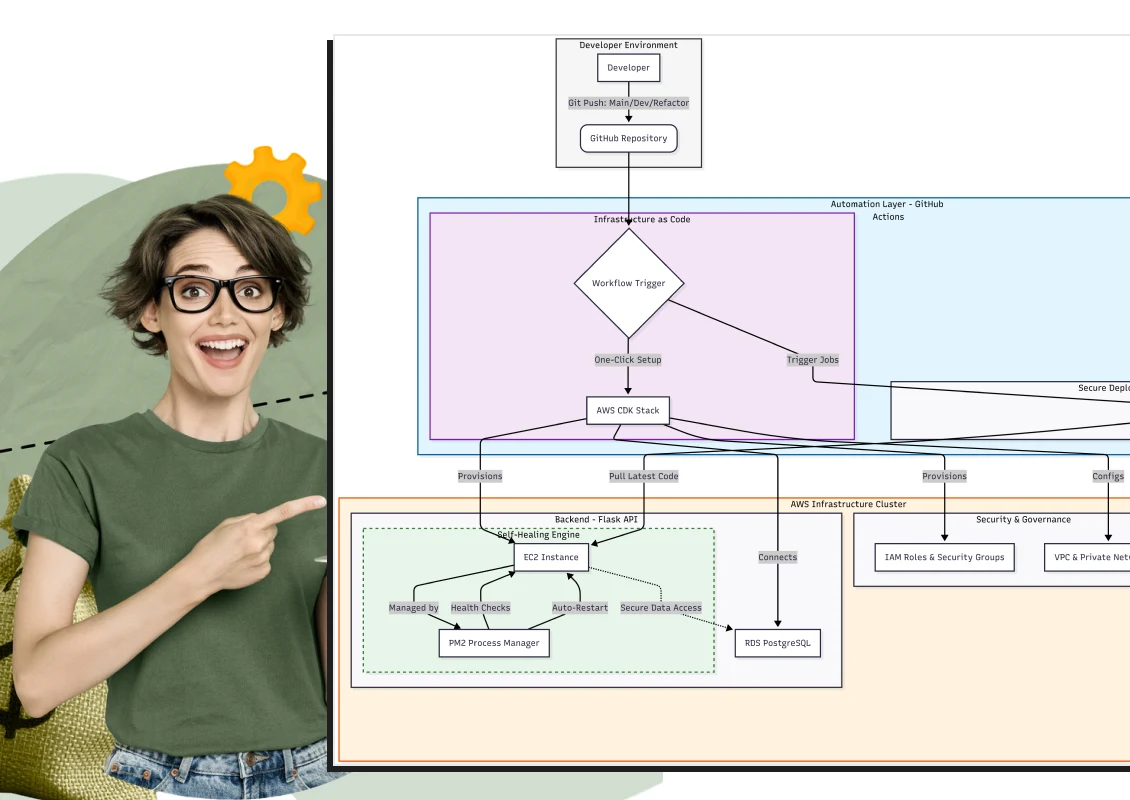







 Love we get from the world