

AWS CI/CD Pipeline Automation
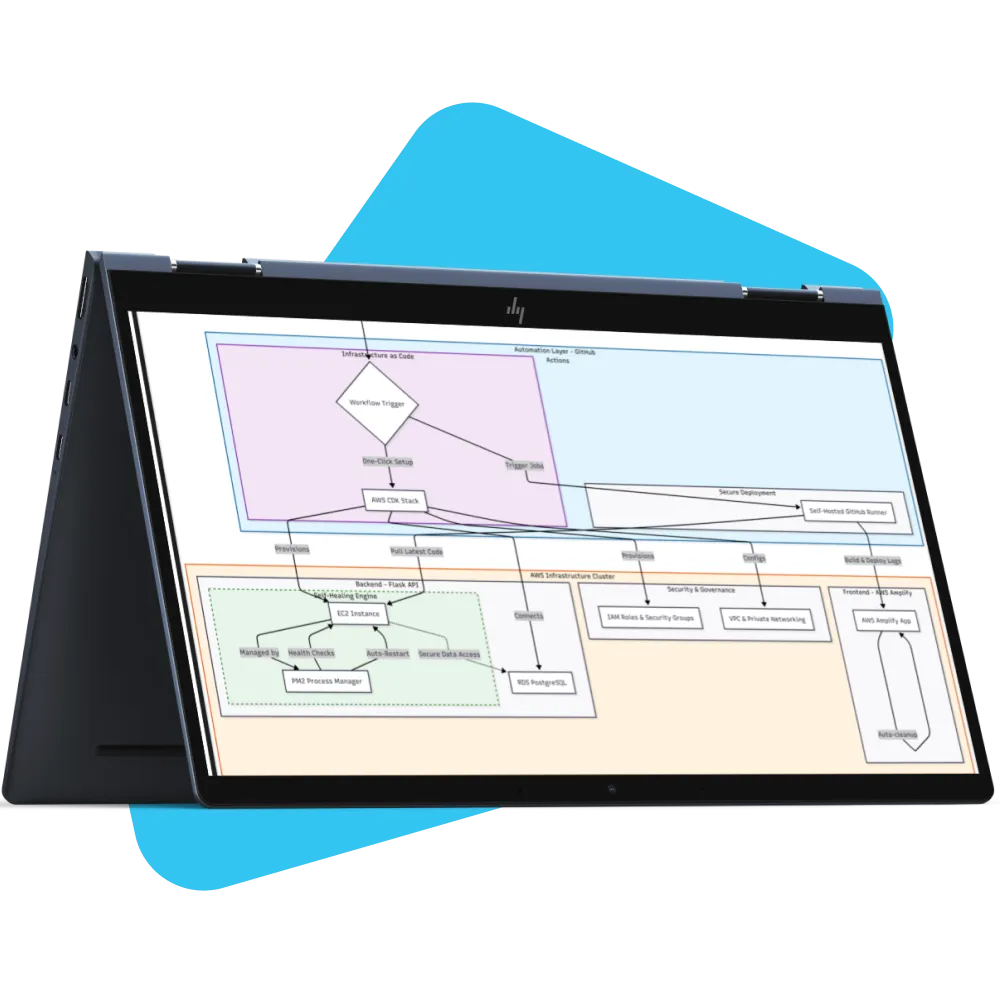
Building a Self-Healing Deployment Ecosystem for Scalable Web Applications. Our team partnered with a growing web platform to transform their manual deployment processes into a cutting-edge, fully automated DevOps environment. By leveraging AWS CDK (Cloud Development Kit) and GitHub Actions, we developed a "one-click" infrastructure readiness setup. We approached the project by first stabilizing the frontend automation before expanding into a complex, secure backend architecture that supports self-healing capabilities and persistent deployment.
 Remote
5K – 10K USD
4 - 5 Months
Web
About the Project
Optimizing Deployment Velocity through Cloud Automation.
The project aimed to eliminate manual intervention in the software delivery lifecycle. By focusing on Infrastructure as Code, we addressed the gaps left by traditional manual server management, enabling the client to understand, monitor, and improve their deployment frequency. The result is a self-healing pipeline that ensures the frontend and backend are always in sync with the latest code changes. For teams exploring the role of DevOps in software development, this case study shows how automation, cloud provisioning, and release visibility can work together to improve delivery speed.

Project Challenges
Building this automated environment posed several unique challenges as it aimed to pioneer a seamless transition from manual to automated cloud management:


Fragmented Manual Deployments : The existing application was manually deployed across different AWS accounts. Transitioning to a unified, code-based infrastructure meant auditing existing assets and replicating them perfectly within AWS CDK to ensure zero downtime during the migration.
Dynamic Backend Requirements : The project requirements shifted mid-development from a containerized ECS (Elastic Container Service) approach to a specialized EC2-based architecture. This required a flexible CI/CD strategy that could handle server-level dependencies while maintaining high security.
Security vs. Automation Trade-offs : Automating deployments often requires sensitive access (SSH). The challenge was to move away from risky direct SSH usage and manual IP whitelisting toward a more secure, "GitHub Runner" based architecture without sacrificing deployment speed.
Complex Multi-Branch Logic : The pipeline had to differentiate between environment-specific branches (Main, Dev, Refactor). Some branches required full builds, while others required instant deployment, necessitating a highly customized GitHub Actions workflow.


How Did We Help?
We approached the development with a phased strategy to ensure each infrastructure challenge was addressed systematically.
Infrastructure Discovery
Frontend Automation
One-Click Provisioning
Pipeline Hardening
Backend Self-Healing
Testing Validation
Production Readiness

The outcome
The project emerged as a model for modern DevOps, giving the client full control over their deployment lifecycle in a previously manual-heavy environment. This shift also reflects progress in the DevOps maturity model, where teams move from manual deployments to automated, measurable, and scalable delivery workflows.
- Deployment Speed: Reduced environment setup time from hours to minutes via CDK.
- Enhanced Security: Eliminated manual SSH dependency by implementing secure, self-hosted deployment runners.
- High Reliability: The self-healing nature of the PM2-managed backend ensures that the API remains online even after complex updates.
- Scalable Architecture: The transition from CLI-based manual steps to a full CDK-driven approach allows the product to scale globally while sustaining growth.

Sophia Bennett
“The team transformed our deployment vision into a powerful, automated reality. The platform is now intuitive, scalable, and truly fills the gap we had in our infrastructure management. They worked with precision and delivered a one-click solution that exceeded our expectations.”