
 Lets Talk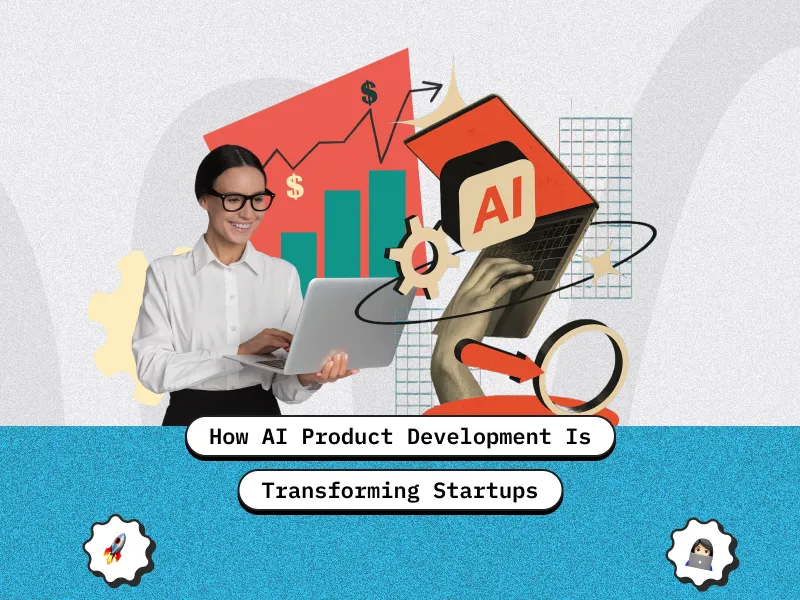
TL;DR
- AI is transforming startups in 2026 by enabling faster development, automation, and smarter decision-making.
- MVPs can now be built 10x faster thanks to AI-generated prototypes, AI coding assistants, and automated testing.
- Small businesses can compete with larger companies using AI-driven customer service, marketing automation, and personalized user experiences.
- AI technologies like generative AI, predictive analytics, and AI agents are shaping modern product development.
- Startups that adopt AI early gain a major competitive advantage with lower costs, higher productivity, and scalable operations.
Introduction
The startup and small business landscape has transformed more in the past 12 months than in the last decade. In 2026, AI adoption across startups has reached record levels, enabling faster product development, smarter decisions, and leaner operations.
What once required large budgets and long timelines can now be achieved by small businesses and emerging tech teams using accessible AI tools and MVP Development Services to validate ideas quickly and efficiently. Traditional product development models slow, resource-heavy, and expensive are rapidly becoming obsolete.
To stay competitive, many founders and small business leaders collaborate with Digital Transformation Company to integrate AI into their workflows efficiently. The question is no longer, “Should I adopt AI?” but “How fast can AI help me build and launch?” AI has become the new growth engine for startups in 2026.
What Is AI Product Development?
AI product development uses artificial intelligence to design, build, test, and scale digital products faster and more efficiently.
Three Types of AI Products:
- AI-Enhanced Products – Existing apps upgraded with AI features.
- AI-First Products – AI is central to the user experience.
- AI-Native Products – Fully autonomous, AI-driven systems.
Examples relatable for startups, small businesses:
- Fitness apps creating personalized workouts
- Fintech dashboards predicting cash flow
- Appointment apps automating scheduling
- AI agents handling routine customer queries
In short, AI product development removes complexity, accelerates execution, and unlocks efficiency for startups, small businesses.
Accelerate Your AI Product Journey Today
Partner with Creole Studios to integrate AI, launch MVPs faster, and scale smarter. Start building smarter solutions now!

How AI Is Transforming Startups in 2026
AI isn’t just improving operations; it’s redefining how modern startups, and small businesses build, launch, and scale products.
Hyper-Speed MVP Development With AI
Startups can launch MVPs up to 10x faster using AI-driven development:
- Auto-generate prototypes and UI designs
- Use AI coding assistants for base code
- Automate documentation, workflows, and test cases
This reduces burn rate, shortens go-to-market timelines, and increases investor and stakeholder confidence.
Massive Reduction in Development Costs
AI helps reduce development costs by 40–70%, making innovation accessible for small teams:
- Less hand-written code
- Pre-trained AI models ready for integration
- Automated testing and deployment
- Streamlined workflows replacing repetitive tasks
Even small businesses can now deliver high-quality products without large engineering teams.
Better Product-Market Fit With AI Insights
AI empowers smarter decisions with real-time intelligence:
- Predicting user behavior
- Analyzing competitors
- Identifying market gaps
- Tracking user sentiment
This ensures ideas are validated early, reducing risk and enhancing product-market fit.
AI-Powered Automation for Lean Teams
AI agents automate critical functions for small teams:
- Customer support
- Marketing workflows
- Sales processes
- Administrative tasks
This allows lean startups and small businesses to scale efficiently without adding headcount.
Real-World Use Cases: How Startups & SMBs Are Scaling Faster With AI
AI is no longer theoretical; it’s driving measurable results for startups and small businesses. Here are the key areas where AI is making a real impact:
- AI-Powered SaaS Dashboards: Streamline operations, automate reporting, and provide actionable insights in real time.
- Customer Service Automation for Local Businesses: AI chatbots and virtual assistants handle queries, bookings, and support without human intervention.
- AI-Driven eCommerce Personalization: Deliver tailored recommendations, dynamic pricing, and customized shopping experiences for higher conversions.
- Back-Office Workflow Automation: Automate invoicing, inventory management, scheduling, and other repetitive tasks, reducing costs and errors.
With AI, startups, small businesses can compete with enterprise-level efficiency and deliver smarter, faster customer experiences.
Top AI Technologies Powering Products in 2026
In 2026, several AI technologies are driving rapid product development, enabling startups and small businesses to build smarter, faster, and more efficient solutions:
- Generative AI (GenAI 3.0): Creates content, designs, code, and more, reducing manual effort.
- Machine Learning-Based Predictions: Provides actionable insights by analyzing user behavior and market trends.
- Autonomous AI Agents: Perform tasks, make decisions, and manage workflows with minimal human supervision.
- Vision & Multimodal AI: Understands and interprets images, video, text, and audio for advanced product features.
- Low-Code/No-Code AI Platforms: Allow non-technical founders to build AI-powered applications quickly and cost-effectively.
Many startups are successfully adopting these technologies by collaborating with digital transformation consulting services providers, integrating AI seamlessly into their workflows to scale smarter and faster.
AI Product Development Workflow:
A modern, founder-friendly AI workflow enables startups and small businesses to build smarter, faster, and more cost-effectively. Even lean teams can now compete with enterprise-level operations using AI-powered tools. Here’s a step-by-step approach:
Step 1 — Ideation
AI helps founders brainstorm product ideas, evaluate feasibility, and refine concepts based on market trends and demand. It can suggest features, identify pain points, and predict potential revenue, making ideation data-driven.
Step 2 — Market Validation
Before development, AI analyzes competitors, assesses customer demand, and detects market gaps. Startups can simulate adoption rates, test pricing strategies, and validate concepts without heavy investment, reducing the risk of failure.
Step 3 — Model Selection
Choose the right AI model based on your product needs:
- Pre-trained models for common tasks like chatbots or recommendations
- Fine-tuned models for specialized business needs
- Custom AI solutions for unique or complex products
Step 4 — Prototyping / MVP
AI accelerates prototyping by generating wireframes, code templates, and feature logic automatically. This allows founders to test concepts, gather feedback, and iterate quickly while controlling costs.
Step 5 — Development
AI copilots assist developers by automating repetitive coding, documentation, and QA tasks. This reduces errors, speeds up development, and helps small teams achieve enterprise-level output.
Step 6 — AI-Led Testing
Automated AI testing identifies bugs, performance issues, and UX gaps faster than manual QA. Predictive analytics also anticipate problems, improving reliability and reducing iteration time.
Step 7 — Launch
AI tools monitor launch readiness, deployment, and early adoption metrics. Startups can deploy confidently, track engagement in real time, and optimize rollout efficiently.
Step 8 — Iterate & Scale
Post-launch, AI continuously tracks user behavior and feedback. Insights guide feature updates, prioritize improvements, and uncover growth opportunities, ensuring products evolve with customer needs.
Benefits of This AI Workflow:
- Faster time-to-market with minimal overhead
- Lower development costs through automation
- Improved product-market fit with AI-driven insights
- Scalable operations without increasing team size
- Data-driven decisions at every stage
By following this workflow, startups and SMBs can leverage AI not just as a tool, but as a strategic partner to build competitive, high-quality products.
Estimate Your AI Product Development Costs Instantly
Use our free Software Development Cost Calculator to plan your AI product budget and roadmap efficiently.
Benefits for Startups & Small Businesses
Adopting AI in product development startups, small businesses with significant competitive advantages. Here’s why AI is becoming essential:
- Faster Time-to-Market: AI accelerates prototyping, coding, and testing, allowing products to launch up to 10x faster than traditional methods.
- Major Cost Savings: Automation, AI coding assistants, and pre-trained models reduce development and operational expenses, making innovation affordable for small teams.
- Better Personalization & User Experience: AI analyzes user behavior and preferences to deliver hyper-personalized experiences, improving engagement and retention.
- Higher Productivity: Repetitive tasks, such as customer support, data entry, and reporting, are handled by AI, freeing teams to focus on strategy and growth.
- Scalable Operations from Day One: AI allows lean teams to operate like large enterprises, scaling efficiently without expanding headcount.
With these benefits, AI levels the playing field, enabling small businesses and startups to compete with larger competitors while maximizing efficiency, speed, and customer satisfaction.
Challenges Startups Face With AI Product Development
While AI can transform startups, small businesses often face hurdles in adopting AI-driven products. Addressing these challenges strategically is key to success.
- Data Limitations: AI models need quality datasets. Use synthetic data or pre-trained AI models to speed up development and reduce costs.
- Talent Shortage: Skilled AI developers are scarce. AI coding assistants and automation tools help startups implement AI without large teams.
- Model Reliability: AI may produce errors or biases. Combine human supervision with rule-based checks to ensure accuracy.
- Compliance & AI Regulations: Privacy and industry rules must be followed. Adopt secure AI frameworks and adhere to data protection standards.
- Budget Concerns: AI development can be expensive. Start small with MVPs and scale AI modules gradually to maximize ROI.
By proactively tackling these challenges, startups can build reliable, cost-effective, and scalable AI products that compete with larger enterprises.
Future Trends: What AI Product Development Will Look
The next wave of AI innovation is set to redefine how startups build, manage, and scale products. Key trends shaping the future include:
- AI Copilots Replacing Full Teams: Intelligent AI assistants will handle coding, analysis, and decision-making, reducing dependency on large teams.
- Autonomous Product Managers: AI systems will plan, prioritize, and manage product roadmaps with minimal human input.
- Continuous AI-Led QA: Automated quality assurance will detect and resolve issues in real time, improving product reliability.
- Voice-First & Agent-First Applications: AI-powered voice and conversational agents will drive intuitive user experiences.
- Self-Evolving Software: AI systems will adapt, update, and optimize themselves continuously without manual intervention.
These innovations make the future AI-driven, highly efficient, and extremely startup-friendly, giving lean teams the tools to compete with enterprise-level operations while scaling faster and smarter.
How Creole Studios Helps for AI Product Development
Startups, and small businesses can accelerate their AI product journey by partnering with Creole Studios. With expertise as a digital transformation company and digital transformation consulting services provider, Creole Studios helps businesses:
- Integrate AI Technologies: Seamlessly implement AI agents, generative AI, predictive analytics, and automation tools into product workflows.
- Accelerate MVP Development: Use AI-powered prototyping, wireframe generation, and coding assistance to launch products faster and cost-effectively.
- Automate Operations: Streamline customer support, marketing, sales, and administrative tasks with AI-driven automation.
- Ensure Reliability & Compliance: Implement secure frameworks, adhere to AI regulations, and maintain model accuracy for scalable products.
- Drive Scalable Growth: Leverage AI insights to improve product-market fit, enhance user experiences, and expand operations efficiently.
By collaborating with Creole Studios, startups and small businesses can transform ideas into AI-powered products quickly, reduce development risk, and stay ahead of the competition.
Conclusion
Startups, small businesses, and family offices now have a unique opportunity to leverage AI in product development to build faster, reduce costs, and deliver smarter, more personalized user experiences. By adopting AI, lean teams can implement scalable, automated systems, leveling the playing field against larger competitors.
Startups that embrace AI early gain a significant first-mover advantage and position themselves as industry leaders. Many businesses are successfully integrating AI by partnering with Creole Studios as a trusted tech partner and digital transformation consulting services provider, helping them plan and implement AI solutions that accelerate growth while minimizing risk.
The future of product development is AI-driven, and 2026 is the perfect time to act, innovate, and scale smarter.
FAQS
1. What is AI product development for startups?
AI product development uses artificial intelligence to design, build, test, and scale products faster, smarter, and cost-effectively, helping startups compete with larger companies efficiently.
2. How can AI speed up MVP development?
AI tools generate prototypes, UI designs, and base code automatically, reducing development time and cost, allowing startups to launch MVPs up to 10x faster than traditional methods.
3. Which AI technologies are most used in 2026?
Startups use generative AI, machine learning, autonomous AI agents, vision & multimodal AI, and low-code/no-code platforms to build smarter, scalable products.
4. How does AI improve product-market fit?
AI predicts user behavior, analyzes competitors, detects market gaps, and monitors sentiment, enabling startups to validate ideas and optimize features before heavy investment.
5. What challenges do startups face in AI product development?
Startups face data limitations, talent shortages, model reliability, compliance issues, and budget constraints, but solutions like pre-trained models, AI tools, and MVP scaling help overcome them.
6. Why is 2026 the best time to adopt AI for startups?
AI adoption is more accessible than ever, enabling startups to reduce costs, accelerate launches, and scale efficiently, leveling the playing field against larger competitors.








 30 mins free Consulting
 10 min read
 Canada
 Hong Kong
 Global





 Love we get from the world