

 Lets Talk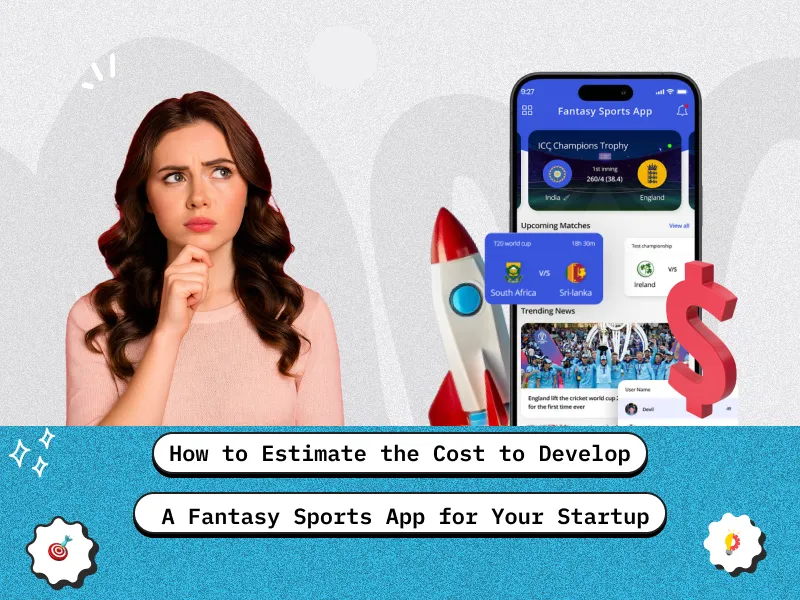
Fantasy sports app development typically costs $30,000 to $300,000+ in 2026. A single-sport, free-to-play MVP may cost $30,000 to $55,000, while a real-money or multi-sport platform can exceed $130,000 because it needs live data, scoring, identity checks, geo-controls, wallet workflows, fraud prevention, load testing, and compliance. Your final budget depends on sport coverage, contest model, platforms, data licensing, peak traffic, and operating markets.
TL;DR
- A lean single-sport MVP usually costs $30,000 to $55,000 and takes 12 to 16 weeks.
- A growth-ready app may cost $60,000 to $120,000.
- An advanced multi-sport or real-money platform may cost $130,000 to $300,000+.
- Sports data, legal advice, licences, prize pools, marketing, and ongoing vendor fees are usually separate.
- The safest cost-control strategy is to launch one sport, one contest format, and one market first.
Planning note: These are directional software-development ranges, not fixed quotations or legal advice. Real-money fantasy products should be reviewed by qualified counsel in every market where they operate.
How Much Does a Fantasy Sports App Cost?
The budget depends first on whether you are building a free-to-play engagement product, a paid contest platform, or a regulated real-money daily fantasy sports product.
| Product scope | Typical functionality | Estimated cost | Timeline |
| Lean single-sport MVP | Registration, team creation, one contest format, scoring, leaderboard, notifications, admin | $30,000 to $55,000 | 12 to 16 weeks |
| Growth-ready app | Multiple contests, live scoring, payments or subscriptions, analytics, stronger operations | $60,000 to $120,000 | 4 to 7 months |
| Advanced multi-sport platform | Multiple sports, wallets, identity checks, geo-controls, fraud controls, high concurrency | $130,000 to $300,000+ | 7 to 12+ months |
These ranges generally include product design, application development, backend engineering, quality assurance, deployment, and an admin panel. They usually exclude sports data fees, legal and licensing costs, post-launch cloud usage, user acquisition, customer support, prize pools, and tax advisory services.
For a broader benchmark, compare these ranges with the complete mobile app development cost guide.
What Is Included in the Cost?
A useful estimate should show the assumptions behind the total.
| Workstream | Typical scope | Planning range |
| Discovery and architecture | Market, contest model, user roles, feature priorities, compliance assumptions | $4,000 to $12,000 |
| UX and UI design | User flows, wireframes, design system, interactive prototype | $6,000 to $18,000 |
| User applications | iOS, Android, web, or cross-platform interfaces | $15,000 to $50,000 |
| Backend and scoring | Accounts, contests, roster rules, live scoring, leaderboards, settlement | $18,000 to $70,000 |
| Admin and operations | Contest setup, support, scoring corrections, reports, configuration | $8,000 to $30,000 |
| Payments and identity | Wallet, deposits, withdrawals, KYC, geo-controls, transaction logs | $10,000 to $40,000 |
| QA, security, DevOps, and release | Testing, monitoring, scaling, security, store submission | $10,000 to $35,000 |
These ranges overlap and should not be added mechanically. The final estimate depends on shared components, platforms, integrations, and whether the product handles real money.
Estimation formula:
Delivery hours × blended team rate + third-party setup + compliance implementation + contingency
A 10 to 15 percent contingency is useful when sports data behaviour, regulatory interpretation, or peak-traffic assumptions remain uncertain.
Which Features Belong in an MVP?
A fantasy sports MVP should test whether users can understand the game, create a team, join a contest, follow live results, and return for another match.
Core MVP features
- Email, phone, or social registration
- Age confirmation and basic eligibility checks
- Sports, fixtures, teams, players, and line-ups
- Player selection with roster and budget rules
- One or two contest formats
- Team editing before a defined lock time
- Scoring engine and leaderboard
- Match status and live point updates
- Push notifications
- User profile and contest history
- Admin panel for contests, scoring, users, and content
- Basic analytics and customer-support tools
Additional real-money features
- Identity verification and KYC
- Geo-location and geo-fencing
- Wallet, deposit, withdrawal, and payout workflows
- Transaction ledger and reconciliation
- Deposit and contest limits
- Fraud and multi-account controls
- Responsible-play and self-exclusion controls
- Jurisdiction-specific reporting and records
| Feature | MVP | Later phase |
| One sport and one scoring model | Yes | |
| Multiple contest formats | Limited | Yes |
| Private leagues | Optional | Yes |
| Chat and social feed | Yes | |
| AI player recommendations | After validation | |
| Live video streaming | After validation | |
| Multi-sport scoring | After validation | |
| Loyalty and referral engine | Basic | Advanced |
A phased approach similar to the one in this MVP development cost guide helps founders validate engagement before funding the full platform.
What Factors Increase the Budget?
Free-to-play versus real money
This is the biggest cost decision. A real-money product may require licensing support, identity checks, geo-controls, wallet accounting, payment reconciliation, fraud prevention, responsible-play tools, and detailed audit records.
Number of sports and scoring models
Each sport has different roster rules, match structures, substitutions, scoring events, tie-breakers, and data models. Multi-sport support requires configurable scoring, new data mappings, and broader testing.
Sports data quality and latency
Fantasy products rely on schedules, line-ups, player status, live events, corrections, and final results. Costs rise when the app needs low-latency feeds, several competitions, historical data, fallback providers, or event reconciliation.
Peak match traffic
Traffic can spike before contest lock and during major matches. The platform must accept team edits and contest joins without duplicate entries, late changes, delayed leaderboards, or lost transactions.
Platform strategy
Cross-platform development can reduce duplicate mobile work for an MVP. Separate native apps may be justified for deeper optimisation or independent release cycles. Adding a web application and full operations portal also expands scope.
Contest operations
Private leagues, guaranteed pools, head-to-head contests, season-long drafts, cancellations, refunds, and scoring disputes each require rules, administration tools, support visibility, and test cases.
Security and payments
Reward-based and real-money products need stronger account protection, suspicious-behaviour monitoring, payment controls, access restrictions, and audit logs. Payment scope should be designed around the current PCI DSS standard when cardholder data is involved.
How Does Cost Vary by App Type?
| App type | Main complexity | Estimated cost |
| Fantasy cricket app | Playing XI changes, toss and lock times, granular scoring, tournament spikes | $35,000 to $140,000+ |
| Fantasy football app | League coverage, formations, transfers, weekly or season-long history | $35,000 to $130,000+ |
| Daily fantasy sports app | Frequent contests, fast settlement, live scoring, eligibility controls | $70,000 to $200,000+ |
| Season-long fantasy app | Drafts, trades, waivers, schedules, long-term rankings | $45,000 to $120,000+ |
| Multi-sport platform | Multiple data models, scoring engines, sport configurations, extensive QA | $130,000 to $300,000+ |
A fantasy cricket MVP stays near the lower end when it is free-to-play, supports one tournament, uses one contest format, and launches with a cross-platform mobile app. Cash contests, withdrawals, multiple tournaments, referral credits, fraud controls, and major-match concurrency raise the budget.
How Does Real-Time Architecture Affect Cost?
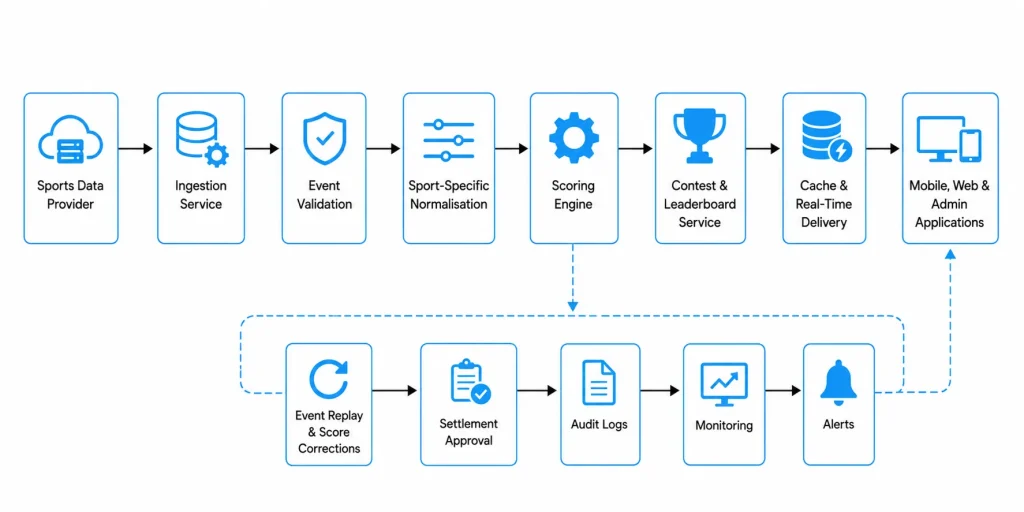
A fantasy app is a rules-driven event-processing system, not only a mobile interface.
The architecture should handle duplicate events, out-of-order data, late line-up changes, official corrections, contest lock times, leaderboard recalculation, settlement reversals, cached reads, and event replay for disputes.
Make scoring rules configurable instead of hard-coding every tournament. This costs more initially but reduces the effort required to change point systems or add competitions later.
What Compliance Requirements Should You Plan For?
Compliance depends on the product model and operating jurisdiction. It should be scoped during discovery, not after development.
The Apple App Review Guidelines state that real-money gaming apps must hold necessary licences and permissions, restrict use to approved locations, and be free on the App Store. The Google Play real-money gaming policy has requirements for eligible daily fantasy sports and gambling apps, including application approval, legal compliance, age controls, geo-restriction, responsible-gambling information, and licences where required. following where applicable:
- Legal classification of the contest model
- Licences or registrations for each market
- Age verification and underage-user controls
- Geo-location, geo-fencing, and spoofing controls
- Identity checks and sanctions screening
- Responsible-play disclosures, limits, and self-exclusion
- Contest rules, privacy notices, and consent records
- Payment, tax, withdrawal, and reporting obligations
- App-store documentation and review evidence
Google identifies missing licences, incorrect geo-gating, inadequate age gates, and missing responsible-gambling information as common rejection reasons. nce as product scope with user flows, edge cases, admin controls, and test plans. A legal opinion without technical implementation does not make an application compliant.
How Long Does Development Take?
| Stage | Typical duration |
| Discovery and compliance scoping | 2 to 4 weeks |
| UX, UI, and prototype | 3 to 5 weeks |
| Core app and backend development | 8 to 24 weeks |
| Data, payment, identity, and notification integrations | 3 to 8 weeks |
| Functional, scoring, load, and security testing | 3 to 6 weeks |
| Store submission and release | 1 to 3 weeks |
Several stages can overlap. A focused MVP may launch in 12 to 16 weeks. A real-money or multi-sport platform generally needs 6 to 12 months because scoring validation, operations tooling, compliance, and peak-load testing add dependencies.
How Can You Reduce Development Cost?
- Launch one sport and one market. Every additional sport adds scoring, data, content, and testing. Every market can add legal, payment, and reporting requirements.
- Validate free-to-play engagement first. Test team creation, contest participation, retention, and scoring comprehension before adding financial workflows.
- Use cross-platform development where appropriate. React Native or Flutter can reduce duplicate interface work. A capable mobile app development company should explain the trade-offs.
- Make rules configurable. Store scoring, roster limits, lock times, contest capacity, and tie-breakers as versioned configuration.
- Use licensed sports data. Scraped data may be delayed, incomplete, or difficult to reconcile.
- Defer expensive features. Live streaming, advanced social feeds, AI recommendations, and multiple sports can wait.
- Replay historical matches. Compare expected scoring outcomes before live users and payouts are affected.
- Model cost before finalising scope. Use the software development cost calculator to compare platform, feature, and integration assumptions.
What Do Sample Budgets Look Like?
These examples are illustrative planning scenarios, not client quotes.
Free-to-play fantasy cricket MVP: $42,000
- Discovery and architecture: $4,000
- UX and UI: $6,000
- Cross-platform app: $12,000
- Backend, data, and scoring: $11,000
- Admin panel: $4,000
- QA, DevOps, and release: $5,000
Scope: One cricket tournament, one contest format, team creation, live points, leaderboard, notifications, and admin controls. No cash wallet or multi-sport support.
Real-money single-sport app: $98,000
- Discovery, compliance mapping, and architecture: $9,000
- UX and design system: $10,000
- Mobile applications: $24,000
- Backend, scoring, and operations: $25,000
- Identity, geo-controls, wallet, and payments: $15,000
- QA, security, load testing, and deployment: $15,000
Scope: Multiple contest formats, live scoring, deposits, withdrawals, identity checks, geo-controls, transaction records, responsible-play functions, and enhanced administration.
Custom Versus White-Label Development
| Decision factor | Custom platform | White-label platform |
| Launch speed | Slower | Faster |
| Upfront cost | Higher | Usually lower |
| Differentiation | High | Limited by vendor |
| Source ownership | Usually available by contract | Often restricted |
| Scoring flexibility | High | Depends on configuration |
| Ongoing fees | Hosting and third-party services | Licence, support, usage, or revenue share may apply |
| Best fit | Long-term product with a distinct strategy | Early validation or limited-scope launch |
White-label development can reduce launch time, but compare setup, customisation, data, hosting, licence, support, revenue-share, migration, and exit costs. A low setup price can become expensive when the platform limits scoring changes, ownership, or market expansion.
Final Takeaway
Fantasy sports app development cost ranges from about $30,000 for a focused free-to-play MVP to $300,000+ for an advanced multi-sport or real-money platform. The largest cost drivers are scoring reliability, sports data, peak-match scalability, contest operations, compliance, payments, fraud controls, and testing.
Start with the smallest product that can prove engagement and operational feasibility. Define the sport, market, contest model, data source, monetisation plan, and compliance path before estimating the build.
Estimate Your Fantasy Sports App Budget
Describe your sport, platforms, contest model, integrations, and launch market to receive an AI-assisted project estimate.

Frequently Asked Questions
How much does it cost to develop a fantasy sports app?
A custom fantasy sports app generally costs $30,000 to $300,000+. A lean single-sport MVP may cost $30,000 to $55,000, while an advanced real-money or multi-sport platform may exceed $130,000.
How much does fantasy cricket app development cost?
A fantasy cricket app typically costs $35,000 to $140,000+. Cash contests, withdrawals, multiple tournaments, live scoring, fraud controls, and peak-match scaling increase the cost.
How much does a real-money fantasy app cost?
A real-money fantasy app commonly starts around $70,000 and may exceed $200,000 because it requires identity checks, geo-controls, wallet workflows, reconciliation, responsible-play features, fraud monitoring, and stronger testing.
How long does it take to build a fantasy sports app?
A focused MVP can take 12 to 16 weeks. A growth-ready product may require 4 to 7 months, while a multi-sport or regulated platform can take 7 to 12 months or longer.
Are sports data fees included in development cost?
Usually not. Provider pricing depends on sports, leagues, territories, latency, data depth, usage, and commercial rights.
Can one fantasy app support multiple sports?
Yes, but each sport requires its own player model, scoring rules, roster validation, fixture handling, data mapping, and test cases. Multi-sport support therefore increases development and maintenance costs.
What are the ongoing costs after launch?
Ongoing expenses may include cloud infrastructure, sports data, monitoring, security, maintenance, payment fees, identity verification, support, compliance reviews, licences, marketing, and product improvements.









 30 mins free Consulting
 10 min read

 Singapore
 USA
USA 
 Finland





 Love we get from the world