
 Lets Talk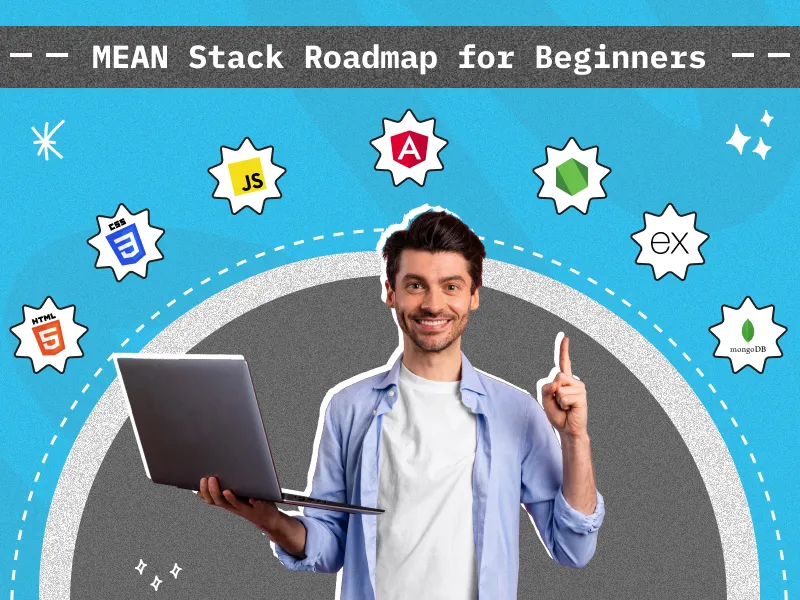
The best MEAN stack roadmap begins with JavaScript and web fundamentals before progressing through Node.js, Express.js, MongoDB, Angular, testing, security, and deployment. A beginner studying 10 to 12 hours per week can use this 12-week learning plan to build three increasingly advanced projects.
The objective is not simply to learn four technologies. It is to understand how the frontend, API, server, and database work together in a complete, deployable web application.
TL;DR
- Learn HTML, CSS, JavaScript, TypeScript, Git, HTTP, and command-line fundamentals first.
- Study Node.js before Express.js because Express runs within the Node.js environment.
- Learn MongoDB through practical data modelling and query patterns, not only CRUD operations.
- Learn Angular after JavaScript and TypeScript, then connect it to your Express API.
- Build a task API, a full-stack task manager, and a production-style capstone project.
- Add validation, authentication, testing, security, logging, and deployment before considering a project complete.
- Measure progress through what you can independently build, debug, and explain.
What Should You Know Before Learning the MEAN Stack?
You do not need professional development experience to begin. However, you should be able to build and debug a small browser-based JavaScript application before learning the complete stack.
If these concepts are new to you, start with this beginner’s guide to web development before moving into framework-specific learning.
Use the following prerequisite checklist:
- HTML and CSS: Semantic HTML, forms, responsive layouts, selectors, the box model, Flexbox, and Grid.
- JavaScript: Variables, functions, arrays, objects, modules, classes, destructuring, error handling, promises, and async/await.
- TypeScript: Primitive types, union types, interfaces, classes, generics, access modifiers, and type narrowing.
- Web fundamentals: URLs, JSON, HTTP methods, status codes, headers, cookies, CORS, and the request-response cycle.
- Development tools: Git, GitHub, npm, terminal navigation, environment variables, browser developer tools, and a code editor.
Readiness Test
Build a small JavaScript application that:
- Reads data from a form
- Validates user input
- Calls a public API using fetch()
- Handles loading and error states
- Displays the API response
If you can build this application and explain each step without following a line-by-line tutorial, you are ready to begin this MEAN stack roadmap.
What Does Each MEAN Technology Do?
| Technology | Role | What to Learn First | Proof of Understanding |
| MongoDB | Stores application data as BSON documents | Collections, CRUD, schema design, indexes, and aggregation | Design a data model around real query patterns |
| Express.js | Organizes API routes and middleware | Routing, validation, error handling, and authentication | Build a consistent REST API |
| Angular | Creates the browser interface | Components, templates, services, routing, forms, and RxJS | Build a multi-page interface that consumes an API |
| Node.js | Runs JavaScript on the server | Modules, asynchronous I/O, npm, events, streams, and configuration | Build and debug a server-side application |
The practical learning sequence differs from the order of the MEAN acronym.
Learn Node.js before Express.js because Express operates on Node.js. Next, learn enough MongoDB to store and query backend data. Once the API is working, study Angular and integrate the four technologies.
You can also review this guide to web development frameworks to understand how Angular and Express compare with other frontend and backend options.
What Is the Recommended MEAN Stack Learning Order?

Follow this sequence:
- Web and JavaScript fundamentals
- TypeScript and development tooling
- Node.js runtime concepts
- Express.js API development
- MongoDB data modelling
- Angular application development
- Full-stack integration
- Testing, security, performance, and deployment
This order connects each new concept to something you already understand.
For example, Express middleware becomes easier to understand after learning the Node.js request lifecycle. Angular services also make more sense when you already have a functional API for them to call.
How Can You Learn the MEAN Stack in 12 Weeks?
This learning plan assumes 10 to 12 hours of focused study each week. If you have less time, maintain the sequence but extend the schedule.
Weeks 1 and 2: Strengthen JavaScript, TypeScript, and Web Fundamentals
Learn modern JavaScript syntax, modules, promises, async/await, error handling, DOM events, fetch(), Git, npm, HTTP, and TypeScript fundamentals.
Build a browser-based task tracker using typed task objects and local storage.
Begin with a short feature list instead of copying a completed tutorial. Consult documentation when you encounter a specific blocker.
By the end of week two, you should be able to:
- Trace a browser request
- Explain JSON serialization
- Resolve a basic Git merge conflict
- Diagnose a failed network request
Weeks 3 and 4: Learn Node.js and Express.js
Start with Node.js modules, npm scripts, the event loop, asynchronous I/O, environment configuration, and error handling.
Then use Express.js to create:
- Routes
- Middleware
- Controllers
- Request validation
- Centralized error responses
Build a task API with these endpoints:
- GET /api/tasks
- POST /api/tasks
- PATCH /api/tasks/:id
- DELETE /api/tasks/:id
Keep routes lightweight. Place business rules in service functions and return consistent error responses.
Code Example:
router.post("/tasks", validateTask, async (req, res, next) => {

  try {

    const task = await taskService.create(req.body);

    res.status(201).json(task);

  } catch (error) {

    next(error);

  }

});
By the end of week four, you should be able to explain:
- Why middleware order matters
- How to choose suitable HTTP status codes
- How request validation works
- How asynchronous errors reach the error handler
Weeks 5 and 6: Learn MongoDB Through Data Modelling
Learn:
- Documents and collections
- BSON data types
- CRUD operations
- Query operators
- Projections
- Indexes
- Aggregation
- Schema validation
- Embedding versus referencing
Do not treat MongoDB as a relational database with renamed tables.
MongoDB recommends organizing data around application access patterns in its official data modelling documentation.
Start by listing the questions your application must answer. Design the documents and indexes required to support those queries.
Add MongoDB to your task API and include:
- Users
- Tasks
- Task ownership
- Due dates
- Status filters
- Pagination
- An aggregation such as tasks completed per week
You should be able to justify whether information should be embedded or referenced. You should also understand how an execution plan can confirm whether an important query uses an index.
Weeks 7 and 8: Build the Angular Frontend
Use the current Angular documentation to learn:
- Components
- Templates
- Data binding
- Dependency injection
- Routing
- Reactive forms
- HTTP services
- Route guards
- Application state
Learn RxJS operators as you encounter stream-based problems. Avoid memorizing operators without understanding where they are useful.
Create an Angular interface for your task API with:
- Login and registration
- A task list with loading, empty, error, and success states
- Create and edit forms with client-side validation
- Filtering, sorting, and pagination
- A responsive layout
- Keyboard-accessible controls
The official Angular tutorials provide a current learning path covering components, services, routing, forms, and HTTP integration.
By the end of week eight, you should be able to explain:
- Where application state is stored
- Why a component or service owns that state
- How the interface responds when the API is slow or unavailable
Weeks 9 and 10: Add Authentication, Testing, and Security
Connect Angular, Express.js, and MongoDB into one complete application.
Add:
- Authentication
- Resource-level authorization
- Request validation
- Secure password storage
- Rate limiting
- Restricted CORS settings
- Security headers
- Safe configuration management
Test the application at three levels:
- Unit tests for isolated business rules
- API integration tests for routes, validation, and database behaviour
- End-to-end tests for important user journeys
For more detail on test planning, test levels, and release validation, use this as a practical reference: web application testing guide
Never commit passwords, access tokens, private keys, or other secrets to the repository.
Validate input on the server even when Angular already validates the form. Client-side validation improves usability, while server-side validation protects the application.
Use the official Express production security guidance as a review baseline.
Before completing this stage, confirm that:
- One user cannot access or update another user’s tasks
- Invalid payloads produce predictable responses
- Critical workflows pass automated tests
Weeks 11 and 12: Deploy and Operate the Application
Prepare your application for deployment by:
- Creating production builds
- Separating environment-specific configuration
- Configuring a managed MongoDB deployment
- Automating tests
- Deploying the Angular frontend and Express API
- Adding application logs
- Adding health checks
Review:
- Error logging without passwords, tokens, or personal information
- Database backup and recovery requirements
- Dependency and container scanning
- HTTPS and secure cookie settings
- Pagination, indexes, and caching
- Angular bundle size
- A README covering architecture, setup, testing, and deployment
A new developer should be able to clone the repository, follow the README, run the tests, and understand the main architectural decisions.
How Does a MEAN Application Work End to End?
Consider what happens when a user creates a new task:

- Angular validates the form and sends a POST request.
- Express routes the request through authentication and validation middleware.
- A controller passes the validated input to a service.
- The service applies business rules and writes the data to MongoDB.
- MongoDB returns the saved document.
- Express sends a JSON response with an HTTP 201 status code.
- Angular updates the interface and displays success or error feedback.
For a broader explanation of architecture, planning, development, and deployment, read the complete guide to web application development.
Which MEAN Stack Projects Should You Build?
Your portfolio should contain progressively more challenging projects instead of several versions of the same basic application.
Project 1: Task API
Build a tested Express.js and MongoDB API with:
- Request validation
- Filtering
- Pagination
- Logging
- Centralized error handling
This project demonstrates your backend fundamentals.
Project 2: Full-Stack Task Manager
Add an Angular frontend with:
- Authentication
- Resource-level authorization
- Responsive forms
- Route guards
- End-to-end tests
This project demonstrates your ability to integrate frontend, backend, and database technologies.
Project 3: Production-Style Capstone
Choose a problem involving multiple user roles and non-trivial workflows.
Suitable ideas include:
- Appointment scheduling platform
- Inventory management system
- Team knowledge base
Include:
- A documented data model
- Role-based permissions
- File upload or notification functionality
- Accessibility checks
- Automated tests
- Continuous integration
- Production deployment
What Mistakes Slow Down MEAN Stack Beginners?
Learning All Four Technologies Separately
Build a small end-to-end feature early so the relationships among Angular, Express.js, Node.js, and MongoDB become concrete.
Starting Angular Before TypeScript
Angular APIs and development tools are easier to understand when you are familiar with types, interfaces, classes, and generics.
Treating MongoDB as Schema-Free
A flexible schema still requires intentional data modelling, validation, indexes, and migration planning.
Putting Business Logic in Routes or Components
Keep HTTP handling, business rules, and database access separate. This makes the application easier to test and maintain.
Ignoring Error and Empty States
A successful demonstration does not prove that an application can handle slow requests, missing data, invalid input, or server errors.
Adding Authentication at the End
Authentication and permissions influence routes, data ownership, interface behaviour, tests, and database design. Plan them early.
Watching Tutorials Without Rebuilding
After completing a guided tutorial, rebuild the feature using only a written requirement. This reveals whether you understand the implementation.
Ignoring Accessibility and Security
Treat accessibility and security as development requirements, not optional finishing tasks.
How Do You Know You Are Ready for a MEAN Stack Job?
You may be ready for junior MEAN stack work when you can:
- Build and deploy a complete application without following a line-by-line tutorial
- Explain the request lifecycle from Angular to MongoDB and back
- Design a REST API and choose appropriate status codes
- Model MongoDB data around access patterns
- Add useful database indexes
- Implement authentication and resource-level authorization
- Write unit, integration, and end-to-end tests
- Debug browser, server, and database failures
- Review basic security, accessibility, and performance risks
- Explain technical trade-offs in a README and during code review
Job readiness does not mean knowing every Angular API or MongoDB operator.
Employers need evidence that you can reason through unfamiliar problems, produce maintainable code, test assumptions, and communicate technical decisions.
Conclusion
A useful MEAN stack learning path is built around technical dependencies and practical deliverables.
Start with JavaScript, TypeScript, HTTP, Git, and npm. Learn Node.js and Express.js to build an API, then add MongoDB with intentional data modelling. Once the backend works, build the Angular interface. Complete the application with integration, authorization, testing, security, and deployment.
If you follow this 12-week MEAN stack roadmap, your strongest outcome will not be a certificate. It will be a portfolio of functional applications demonstrating how you design, build, test, and operate a complete JavaScript system.
If you need experienced support to plan and build a scalable product, explore Creole Studios’ web application development services.
Frequently Asked Questions
How Long Does It Take to Learn the MEAN Stack?
A beginner who already understands JavaScript fundamentals can complete a structured introduction in approximately 12 weeks by studying for 10 to 12 hours per week.
Becoming employable may take longer because you also need independent projects, debugging experience, testing knowledge, security awareness, deployment practice, and code-review feedback.
In What Order Should I Learn the MEAN Stack?
Learn JavaScript, TypeScript, HTML, CSS, HTTP, Git, and npm first.
Then study Node.js, Express.js, MongoDB, Angular, full-stack integration, testing, security, and deployment. Node.js should come before Express.js because Express operates within Node.js.
Can I Learn the MEAN Stack Without Knowing JavaScript?
No. JavaScript is the shared foundation of Node.js and Express.js and is essential for working with the complete stack.
Angular primarily uses TypeScript, which builds on JavaScript. Learn modern JavaScript before beginning the complete MEAN stack roadmap.
Is the MEAN Stack Still Worth Learning?
Yes, particularly when your target projects or employers use Angular with a JavaScript or TypeScript backend.
The stack is suitable for structured web applications and teams that value shared language skills across frontend and backend development. Select it according to project requirements rather than simply because the four technologies work together.
Should I Learn MongoDB or Angular First?
After learning Node.js and Express.js, study enough MongoDB to store and query API data.
Then learn Angular and connect the interface to your working API. This gives the Angular application a functional backend and makes full-stack integration easier to understand.


 8 min read


