
 Lets Talk
TL;DR
- An AI software factory is a structured software delivery environment where AI agents help plan, build, test, review, document, and maintain software.
- It goes beyond AI-assisted software development because agents can execute multi-step engineering tasks rather than only suggesting code.
- Businesses can introduce an AI software factory into an existing engineering team or use it as an end-to-end product development model.
- SaaS products are a strong use case because AI can support requirements, architecture, frontend and backend development, testing, documentation, deployment, and ongoing improvements.
- AI does not make software automatically error-free. Reliable delivery still requires automated tests, quality gates, security controls, code review, and human approval.
- The biggest change is not simply faster coding. It is moving from developers manually executing every engineering task to developers supervising an increasingly automated development system.
Software development is moving beyond developers simply asking AI to generate individual blocks of code. An AI software factory combines AI agents, engineering workflows, development tools, automated testing, quality controls, and human oversight into a repeatable system for building software. Instead of using AI only as a coding assistant, teams can use it across the entire software development lifecycle, from requirements and architecture to testing, deployment, documentation, and maintenance.
What Is an AI Software Factory?
An AI software factory is an engineering model that uses AI agents, automation, development tools, predefined standards, and human checkpoints to move software from requirements to production more systematically.
A conventional software team may require developers to manually move through tasks such as requirements analysis, implementation, unit testing, pull requests, documentation, bug fixing, and deployment.
An AI software factory changes that operating model.
Instead of using AI for isolated coding suggestions, different agents or automated workflows can take responsibility for specific parts of the development process.
For example:
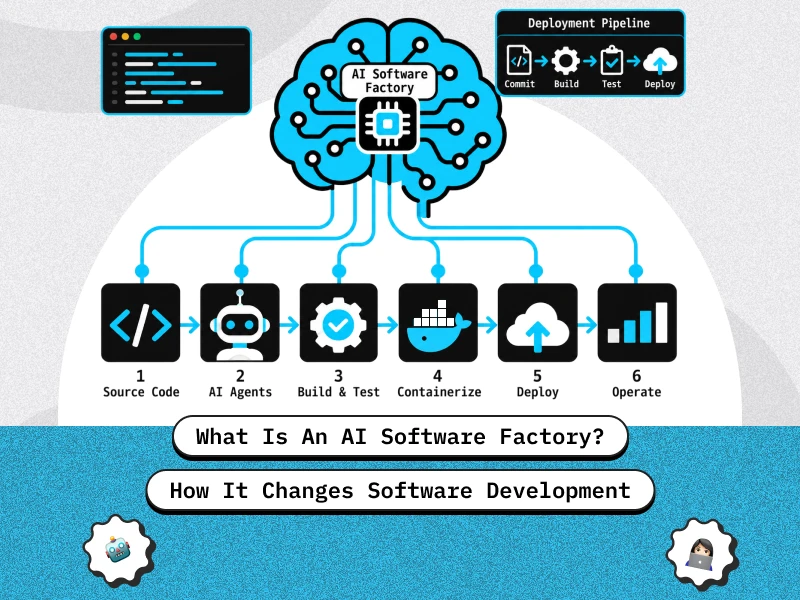
Business requirement → technical specification → task planning → code generation → automated testing → code review → security validation → human approval → deployment
This direction is already visible in modern development platforms. OpenAI describes coding agents that can generate, review, refactor, test, and work across development workflows, while GitHub now supports agentic workflows for tasks such as issue triage, CI analysis, documentation, and repository maintenance. OpenAI
That makes the software factory less about one AI model and more about the system surrounding the models.
How Does an AI Software Factory Work?
A practical AI development workflow usually combines several layers.
1. Requirements become structured instructions
The process starts with a business objective, feature request, user story, product specification, or workflow.
AI can help convert this information into:
- Functional requirements
- Acceptance criteria
- User stories
- Technical tasks
- Dependencies
- Architecture considerations
- Test scenarios
The clearer the input, constraints, and context, the more reliable the downstream development process becomes.
2. AI agents plan the implementation
Instead of immediately generating code, an agent can inspect the application architecture, repository, existing standards, APIs, database structure, and dependencies.
The work can then be divided into smaller engineering tasks.
3. Agents execute development tasks
Coding agents may create features, modify existing modules, write APIs, update UI components, perform refactoring, or fix bugs.
Modern coding agents can already work with repositories, edit files, execute commands, run tests, and iterate on their output. Anthropic
4. Automated quality checks validate the output
Generated code should move through deterministic controls such as:
- Unit tests
- Integration tests
- Static analysis
- Linting
- Type checking
- Security scanning
- Dependency checks
- Build validation
5. Humans review higher-risk decisions
AI can execute significant portions of development, but product owners, developers, architects, security teams, and QA specialists still provide governance.
Human approval becomes particularly important for architecture decisions, sensitive data handling, security changes, production releases, and business-critical workflows.
6. Feedback improves future execution
Coding standards, architecture patterns, repository instructions, test results, review feedback, and recurring issues can be incorporated into the development system.
The objective is to create a repeatable software production process rather than repeatedly prompting an isolated AI tool.
AI Software Factory Flow

AI-Assisted vs Agentic Software Development: What Is the Difference?
These concepts are related, but they are not identical.
| Approach | AI’s Role | Typical Example | Human Role |
| Traditional development | Minimal | Developer manually builds feature | Executes most work |
| AI-assisted software development | Assistant | Suggest code, explain errors, generate tests | Drives each task |
| Agentic software development | Active executor | Agent receives a task and performs multiple development steps | Reviews and governs |
| AI software factory | Coordinated development system | Multiple AI-driven workflows operate across the SDLC | Defines standards, supervises and approves |
With AI-assisted software development, the developer remains responsible for initiating and managing most individual actions.
With agentic software development, an agent can receive an objective and independently perform a sequence of actions to reach it.
An AI software factory adds another layer by connecting those agents with engineering processes, tooling, testing, permissions, CI/CD, security controls, and governance.
How Can Businesses Use an AI Software Factory?
There are two particularly useful models.
Model 1: Integrate It Into an Existing Development Team
A business may already have developers, product managers, QA engineers, and DevOps specialists.
In this situation, the objective is not to replace the team. It is to redesign the development process so AI handles more repetitive and execution-heavy work.
For example:
A developer receives a feature requirement.
The software factory can help:
- Analyze the requirement.
- Inspect the relevant codebase.
- Create an implementation plan.
- Generate or modify code.
- Write tests.
- Run validation.
- Prepare documentation.
- Create a pull request.
- Send the change for developer review.
The engineering team moves from manually performing every step toward supervising, reviewing, and improving AI-enabled workflows.
Organizations exploring this model can also combine it with broader Generative AI development services when AI capabilities need to be integrated into existing applications, processes, or internal systems.
Model 2: Use It for End-to-End Product Development
The second model is useful when a founder or business has a product idea or defined business workflow but does not have a full internal engineering team.
The input may begin with:
Here is the business process, users, functionality, integrations, and outcome the product needs to support.
The software delivery system can then support requirements definition, architecture, UI implementation, backend development, integrations, testing, DevOps, deployment, and future iterations.
Human technical leadership remains responsible for architecture, product decisions, validation, security, and production readiness.
This model is particularly relevant for startups, MVPs, internal platforms, automation tools, and SaaS products.
Can You Build a SaaS Product With AI?
Yes, AI can now participate in a large portion of SaaS product development, but build SaaS with AI should not be interpreted as entering one prompt and receiving a production-ready company.
A SaaS product still requires decisions around:
- User roles and permissions
- Authentication
- Subscription and billing
- Database architecture
- APIs and integrations
- Security
- Multi-tenancy
- Monitoring
- Scalability
- Product analytics
- UX
- Testing
What changes is how much of the execution can be delegated.
An AI software factory can convert approved product requirements into structured engineering tasks and then use specialized workflows to implement and validate them.
For SaaS projects where a browser-based product is the primary interface, Creole Studios’ web application development capabilities can also support architecture, SaaS functionality, integrations, and AI-powered workflows.
How Does AI Change the Software Development Lifecycle?
The AI software development lifecycle still contains familiar stages, but the distribution of work changes.
| SDLC Stage | Traditional Approach | AI Software Factory Approach |
| Discovery | Manual analysis | AI-assisted requirement structuring |
| Planning | Developers create tasks | AI helps decompose requirements |
| Architecture | Architect-led | AI analysis with architect approval |
| Development | Developers write most code | Agents execute defined coding tasks |
| Testing | Tests created manually or later | Tests generated and executed continuously |
| Code review | Human-only review | AI review plus human approval |
| Documentation | Often manual | Documentation generated with development |
| Deployment | DevOps-managed automation | Agent-supported CI/CD workflows |
| Maintenance | Reactive engineering | AI-supported monitoring and issue resolution |
The important change is not eliminating the software development lifecycle. It is making more stages machine-executable while maintaining controls around what can reach production.
Can an AI Software Factory Reduce Development Errors?
It can reduce certain categories of mistakes, but it should not be described as error-free software development.
AI-generated code can still contain:
- Logic errors
- Incorrect assumptions
- Security vulnerabilities
- Incomplete edge-case handling
- Unnecessary complexity
- Incorrect integrations
- Hallucinated APIs
- Architectural inconsistencies
The better objective is controlled quality.
An AI software factory should make quality checks part of the workflow rather than relying on developers to remember them after implementation.
For example:
GitHub’s current agentic workflow architecture similarly emphasizes sandboxing, limited permissions, and controlled outputs rather than unrestricted autonomous changes. The GitHub Blog
This distinction matters when evaluating AI software development services. The value is not simply how much code AI can generate. The stronger question is how generated code is tested, governed, reviewed, secured, and maintained.
What Are the Benefits and Limitations of an AI Software Factory?
An effective AI software factory can improve development in several areas.
Potential advantages include faster execution of repetitive engineering work, parallel task handling, faster prototyping, more consistent documentation, greater automated test coverage, quicker debugging, and better use of senior developers’ time.
There are also clear limitations.
AI agents require good context. Poor requirements can produce poor implementations faster. Large repositories need structured instructions. Security permissions need careful control. Complex architecture decisions still benefit from experienced technical leadership. AI-generated code also requires validation before production use.
The strongest implementation therefore combines AI execution with engineering governance, rather than treating autonomy as the objective itself.
When Should a Business Adopt an AI Software Factory?
An AI software factory is worth considering when software development is important to the business and there is enough recurring engineering activity to justify a structured AI workflow.
Common situations include:
- A development team spends significant time on repetitive implementation tasks.
- A SaaS business needs to release features more frequently.
- An engineering team wants AI adoption beyond individual coding assistants.
- A company wants to standardize how developers use AI.
- A founder needs to move from product requirements to a working MVP.
- Teams want AI involved across coding, testing, documentation, and maintenance.
- Engineering leaders want to scale output without simply adding more manual processes.
For larger organizations, the starting point may be an existing team and repository. For startups, the starting point may simply be a product idea and defined workflow.
How Do You Get Started With an AI Software Factory?
Do not begin by connecting autonomous agents to every repository and production environment.
Start with one controlled workflow.
A practical first implementation could be:
Feature request → AI implementation plan → coding agent → automated tests → pull request → human review
Once that workflow becomes reliable, expand into documentation, test generation, bug resolution, CI analysis, dependency maintenance, and other engineering activities.
Before implementation, define:
- Repository access
- Coding standards
- Architecture rules
- Required tests
- Security policies
- Agent permissions
- Approval points
- Logging
- Rollback processes
- Production access
Teams should also determine what should never be executed without human authorization.
If you are evaluating how AI could fit into your existing development team or want to explore an end-to-end AI-enabled product development model, you can discuss your requirements with Creole Studios.
For projects still at the planning stage, the AI-powered software development cost calculator can also help assess scope, integrations, technical complexity, and an initial development budget.
Frequently Asked Questions
What is an AI software factory?
An AI software factory is a structured software development environment where AI agents, automation, development tools, testing, governance, and human review work together to plan, build, validate, deploy, and maintain software.
Is an AI software factory the same as AI-assisted software development?
No. AI-assisted development usually helps developers complete individual tasks. An AI software factory coordinates AI agents and automated workflows across multiple stages of software delivery.
Can an AI software factory replace a development team?
Not completely. AI can perform more implementation work, but experienced engineers are still important for product decisions, architecture, security, quality assurance, governance, and production approval.
Can I build SaaS with AI?
Yes. AI can support requirements, architecture, frontend and backend development, APIs, testing, documentation, deployment, and maintenance. Production SaaS products still require engineering oversight, security controls, validation, and product decisions.
How does an AI software factory improve software quality?
It can make automated testing, code review, static analysis, security checks, acceptance criteria, and other quality gates part of the development workflow. This can reduce avoidable errors, but it does not guarantee error-free software.
Can an AI software factory work with an existing development team?
Yes. One of the strongest use cases is integrating AI agents into an existing development workflow so developers can delegate repetitive engineering tasks while retaining control over architecture, reviews, and releases.


 11 min read


