
 Lets Talk
Web development frameworks provide reusable structures for routing, rendering, data access, security, testing, and deployment. They help teams build web applications faster, but no single framework is best for every project. The right choice depends on user journeys, SEO needs, integrations, performance targets, security requirements, and the team that will maintain the product.
This guide compares 10 current options and provides a practical way to choose the right framework.
TL;DR
- Use Next.js for React-based public applications where rendering flexibility and search visibility matter.
- Consider Angular for highly structured enterprise interfaces and Vue for adaptable, progressively enhanced user interfaces.
- Use Express or NestJS for Node.js backends, depending on how much architectural structure the team needs.
- Django, FastAPI, Laravel, Spring Boot, and ASP.NET Core serve different backend languages, workloads, and organizational environments.
- Choose according to product fit, team capability, security, maintainability, and total cost. Popularity alone is not an architecture strategy.
What Are Web Development Frameworks?
A web development framework is a set of conventions, libraries, and tools for building browser-based applications.
Instead of creating routing, request handling, authentication patterns, data access, and project structure from the beginning, developers work within an established system.
Frameworks generally fall into three groups:
- Frontend frameworks manage interfaces, forms, navigation, and browser state. Angular and Vue are common examples.
- Backend frameworks handle APIs, business rules, authentication, databases, queues, and integrations. Django, FastAPI, Laravel, Spring Boot, ASP.NET Core, Express, and NestJS fit here.
- Full-stack frameworks connect frontend rendering with server functions, routing, and deployment patterns. Next.js is a widely used example.
A library solves a narrower problem and usually leaves more architectural decisions to the team. React, for example, describes itself as a library. Next.js adds framework-level routing, rendering, data fetching, and build conventions around React.
If you are new to these layers, start with the web development guide for beginners or review the complete web application development guide.
How Do the Leading Web Development Frameworks Compare?
The following is a decision-oriented comparison, not a universal ranking. The “best fit” column describes a common use case rather than a guaranteed outcome.
| Framework | Main Language | Layer | Best Fit | Key Strength | Important Trade-Off |
| Next.js | TypeScript or JavaScript | Full stack | Public React applications, SaaS and ecommerce | Flexible server and static rendering | Rendering and caching choices require discipline |
| Angular | TypeScript | Frontend | Large enterprise interfaces | Consistent and integrated application structure | Larger learning and migration surface |
| Vue | TypeScript or JavaScript | Frontend | Progressive interfaces and mid-sized products | Approachable component model | Large teams must define conventions clearly |
| Express | TypeScript or JavaScript | Backend | Lean APIs and real-time services | Minimal and flexible | The team owns more architecture and security decisions |
| NestJS | TypeScript or JavaScript | Backend | Structured Node.js platforms | Modules, dependency injection and testability | More abstraction and boilerplate than Express |
| Django | Python | Backend or full stack | Admin-heavy products and business platforms | Mature defaults, ORM, admin and authentication | Highly asynchronous workloads require careful design |
| FastAPI | Python | Backend | APIs for data and AI products | Type-driven validation and API documentation | Fewer built-in product features than Django |
| Laravel | PHP | Backend or full stack | Portals, marketplaces and business systems | Productive ecosystem and clear conventions | Best results depend on strong PHP operations skills |
| Spring Boot | Java or Kotlin | Backend | Integration-heavy enterprise systems | Mature Java ecosystem and operational tooling | Greater runtime and platform complexity |
| ASP.NET Core | C# | Backend or full stack | Enterprise APIs and Microsoft-aligned systems | Cross-platform performance and tooling | Strongest fit where .NET skills already exist |
The latest completed Stack Overflow Developer Survey reported a notable rise in FastAPI usage and high developer admiration for Phoenix.
Which Framework Fits Each Type of Project?
1. Next.js
Next.js is a strong option for teams already using React that need server rendering, static generation, route-level data loading, or a combined frontend and server workflow.
It can support content-rich websites, ecommerce platforms, and SaaS products. Teams should define caching, rendering, deployment, and upgrade policies early because those decisions affect performance and operational behavior.
Best suited for:
- Public-facing React applications
- SaaS products
- Ecommerce platforms
- Content-rich websites
- Applications requiring flexible rendering
Important consideration: Using Next.js does not automatically guarantee strong SEO or performance. Rendering, metadata, caching, image handling, and frontend implementation still need to be planned correctly.
2. Angular
Angular suits large, long-lived interfaces that benefit from a consistent structure across development teams.
Routing, forms, dependency injection, testing support, and TypeScript are part of one opinionated ecosystem. That consistency can support enterprise delivery, but teams should account for onboarding time and major-version upgrades.
Best suited for:
- Enterprise dashboards
- Internal business applications
- Complex forms and workflows
- Large frontend teams
- Long-term applications requiring consistent architecture
Important consideration: Angular may introduce more complexity than smaller products require.
3. Vue
Vue works well when a team wants an approachable component system that can be adopted gradually or used for a complete interface.
It is suitable for dashboards, customer portals, and interactive website features. For server rendering and full-stack conventions, teams commonly evaluate Nuxt alongside Vue.
Best suited for:
- Customer portals
- Interactive website features
- Mid-sized web applications
- Progressive frontend modernization
- Teams adopting component-based development gradually
Important consideration: Larger teams must establish consistent conventions for project structure, state management, testing, and reusable components.
4. Express
Express is a minimal Node.js framework for APIs, web servers, and real-time services. Its small core gives experienced teams considerable control.
The same flexibility means the team must choose and maintain patterns for validation, authorization, logging, error handling, project structure, and testing.
Best suited for:
- Lightweight REST APIs
- Real-time services
- Backend-for-frontend services
- Small or focused microservices
- Teams that want architectural flexibility
Important consideration: Express provides limited architectural guidance, so inconsistency can develop as the codebase and team grow.
5. NestJS
NestJS adds an opinionated, modular architecture to Node.js and TypeScript backends.
It is useful for complex APIs, multi-module platforms, and teams that value dependency injection and consistent testing patterns. It can feel unnecessarily heavy for a small service that only needs a few routes.
Best suited for:
- Large Node.js backends
- Multi-module applications
- Enterprise TypeScript platforms
- Microservice architectures
- Applications requiring testable service boundaries
Important consideration: The additional abstraction and structure may slow down very small prototypes.
6. Django
Django provides a mature Python foundation with an ORM, authentication support, administration tools, forms, and security protections.
It is productive for content systems, operational platforms, and products with substantial data-management requirements. Teams building intensive real-time or asynchronous workloads should validate the architecture with a representative prototype.
Best suited for:
- Admin-heavy applications
- Content platforms
- Operational business systems
- Data-management applications
- Python-based web products
Important consideration: Workloads involving extensive real-time communication, streaming, or asynchronous processing may require supporting services and deeper architectural planning.
7. FastAPI
FastAPI is designed for Python APIs and works especially well for AI, machine learning, data, and integration services.
Python type hints drive request validation and OpenAPI documentation. It is less opinionated about complete product architecture, so teams often combine it with a separate frontend and supporting services.
Best suited for:
- AI application backends
- Machine-learning APIs
- Data-processing services
- Integration APIs
- Asynchronous Python services
Important consideration: FastAPI does not provide the same breadth of built-in product features as Django.
8. Laravel
Laravel offers clear conventions and a broad PHP ecosystem for authentication, data access, background jobs, notifications, queues, and testing.
It can be a productive choice for portals, marketplaces, and workflow applications. Evaluate hosting, deployment automation, package quality, and internal PHP expertise before committing.
Best suited for:
- Customer and employee portals
- Marketplaces
- Ecommerce backends
- Workflow-management systems
- PHP-based business applications
Important consideration: Long-term results depend on package quality, deployment practices, dependency maintenance, and the team’s PHP expertise.
9. Spring Boot
Spring Boot is a common choice for Java or Kotlin services in organizations with complex integrations, formal security requirements, and established JVM operations.
Its ecosystem supports APIs, messaging, data access, observability, and distributed systems. Small teams should weigh that capability against its platform complexity.
Best suited for:
- Enterprise platforms
- Financial and regulated systems
- Integration-heavy applications
- Java or Kotlin microservices
- Organizations with established JVM infrastructure
Important consideration: The framework and surrounding ecosystem can introduce more operational and architectural complexity than smaller applications require.
10. ASP.NET Core
ASP.NET Core supports cross-platform APIs, server-rendered applications, real-time features, and cloud deployment using C#.
It is a practical fit for Microsoft-aligned organizations and teams with .NET expertise. Its value comes from the wider ecosystem, so assess identity, hosting, data, and licensing choices together.
Best suited for:
- Enterprise APIs
- Microsoft-aligned organizations
- Azure-hosted applications
- Internal business platforms
- C# development teams
Important consideration: The framework provides its strongest organizational value when the company already has .NET skills and Microsoft infrastructure.
How Should You Choose the Right Web Development Framework?
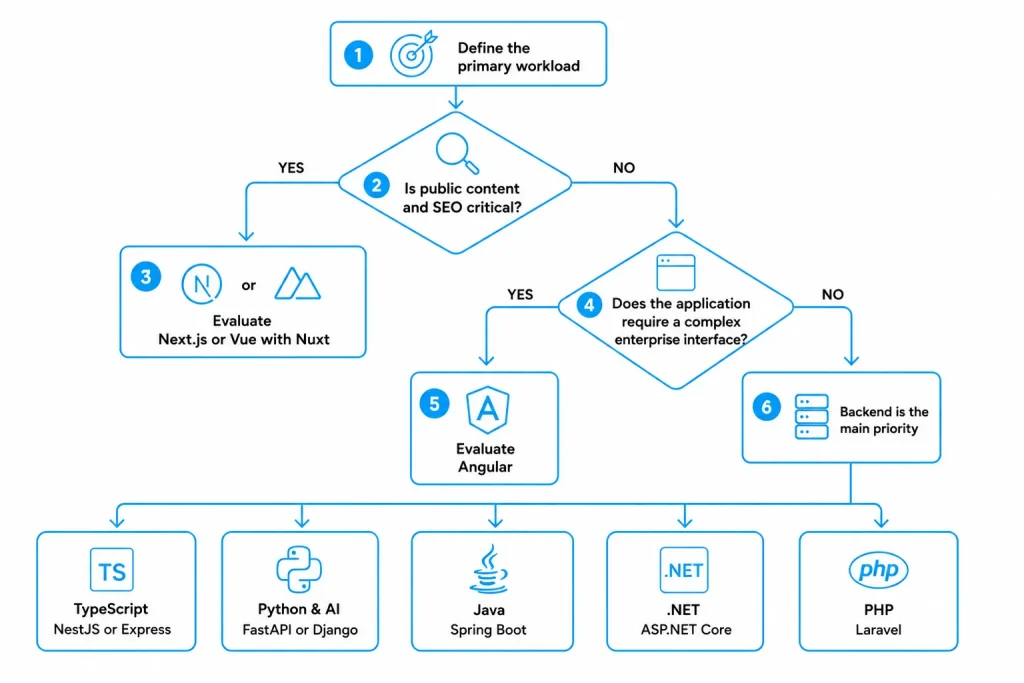
Step 1: Define the Workload
List the critical user journeys, data sensitivity, integrations, SEO requirements, real-time behavior, traffic patterns, and recovery expectations.
A public marketplace and an internal reporting tool should not use the same decision criteria.
Questions to answer include:
- Does the application need public search visibility?
- Will it process sensitive or regulated data?
- Does it require real-time communication?
- Which internal and external systems must it connect with?
- How much traffic and data should it support?
- What happens when an integration or service fails?
Step 2: Assess the Team
Measure current language expertise, production experience, hiring access, ownership expectations, and on-call capability.
A theoretically efficient framework can become expensive when nobody can maintain it confidently.
Consider:
- Existing programming-language skills
- Framework experience in production
- Hiring and training availability
- Code-review capability
- Deployment and monitoring experience
- Long-term ownership responsibilities
Step 3: Check Security and Maintenance
Review the release policy, security advisories, dependency model, supported versions, authentication options, and upgrade process.
Built-in safeguards help, but secure outcomes still depend on implementation and verification against standards such as the OWASP Application Security Verification Standard.
Check whether the framework provides:
- A documented security policy
- Supported release versions
- Regular vulnerability updates
- Authentication and authorization patterns
- Dependency-management guidance
- Migration and upgrade tools
- Active maintenance
Step 4: Build a Representative Technical Prototype
Test one risky workflow instead of building a generic demonstration application.
Include the real identity provider, a difficult integration, representative data volume, logging, deployment, and at least one end-to-end test.
A useful prototype should answer questions such as:
- Can the framework support the most complex workflow?
- How difficult is deployment?
- How does it handle failures?
- Is the team comfortable testing and debugging it?
- What operational visibility is available?
- Does the framework meet performance expectations?
Step 5: Score the Shortlist
Rate each framework from 1 to 5, multiply the rating by the suggested weight, and document the evidence behind every score.
| Selection Criterion | Suggested Weight |
| Product and workload fit | 25% |
| Team capability | 20% |
| Security and maintenance | 15% |
| Ecosystem and integrations | 15% |
| Reliability and performance | 10% |
| Hiring and vendor support | 10% |
| Total cost and exit risk | 5% |
Record the final decision in an architecture decision record. Include the alternatives considered, assumptions, risks, and conditions that would justify reconsidering the framework.
For API-heavy products, use the API development guide to evaluate contracts, security, versioning, testing, and monitoring.
What Has Real Project Delivery Taught Us?
In the LemonAi web platform project, the product needed high-volume API integrations, responsive analytics dashboards, English and Korean support, subscriptions, automated reports, and global deployment.
Creole Studios used ReactJS, Node.js, PostgreSQL, and AWS. The published case study reports a budget of USD 75,000 to USD 85,000 and a delivery period of 7 to 7.5 months.
The practical lesson is that a framework decision sits inside a larger architecture.
User workflows, data processing, integrations, infrastructure, testing, and operational ownership often matter more than whether a particular framework is currently popular.
Which Framework-Selection Mistakes Should Teams Avoid?
Choosing From Trend Lists
Popularity can indicate ecosystem health, community activity, and hiring availability. It does not prove that a framework fits a specific product.
Treating the Framework as the Complete Architecture
Databases, APIs, identity, queues, caching, observability, infrastructure, and deployment still require separate decisions.
Assuming Security Is Automatic
Framework protections must be configured, tested, monitored, and updated. Security depends on the complete implementation rather than the framework name.
Ignoring Upgrade Work
Review the release cadence, long-term support policy, migration tools, breaking changes, and abandoned dependencies before committing.
Optimizing Only for Launch Speed
Include maintenance, cloud operations, hiring, training, support, upgrades, and replacement costs in the decision.
Rewriting Without Evidence
Measure the existing bottleneck before replacing a working technology stack. A rewrite can create new risks without solving the original problem.
Conclusion
The best web development framework is the one that fits the product, team, and operating environment with an acceptable level of risk.
Shortlist two or three options, test the hardest workflow, compare total ownership costs, and record why the final choice was made.
If you need help evaluating a new platform or modernizing an existing stack, explore Creole Studios’ custom web development services.
Frequently Asked Questions
What Are Web Development Frameworks?
Web development frameworks are reusable structures, libraries, conventions, and tools for building browser interfaces, servers, APIs, and full-stack applications.
They reduce repetitive setup and help development teams follow consistent patterns.
Which Is the Most Popular Web Development Framework?
There is no single winner across every application layer and use case.
Industry surveys often group frameworks, libraries, and runtimes together. Use popularity to assess community activity and hiring availability, then choose according to workload, team expertise, maintenance, and security requirements.
Which Framework Is Best for Web Application Development?
It depends on the application.
Next.js suits many React-based public products, Angular supports structured enterprise interfaces, FastAPI fits Python API and AI workloads, and Spring Boot or ASP.NET Core often fit enterprise backends.
Validate the shortlist against real product requirements before making a final decision.
Is React a Web Development Framework?
React describes itself as a library for building user interfaces.
Frameworks such as Next.js add routing, rendering, data-loading, build, and deployment conventions around React.
Can One Web Application Use More Than One Framework?
Yes.
A product may use Next.js or Angular for the frontend and NestJS, FastAPI, Spring Boot, or ASP.NET Core for backend services.
Use multiple frameworks only when the application boundaries and operational benefits are clear.
How Often Should a Company Change Frameworks?
Change when evidence shows that the current choice creates unacceptable security, maintenance, performance, hiring, or delivery risks.
Do not rewrite a stable application only because a newer framework is receiving attention.










 30 mins free Consulting
 10 min read
 Canada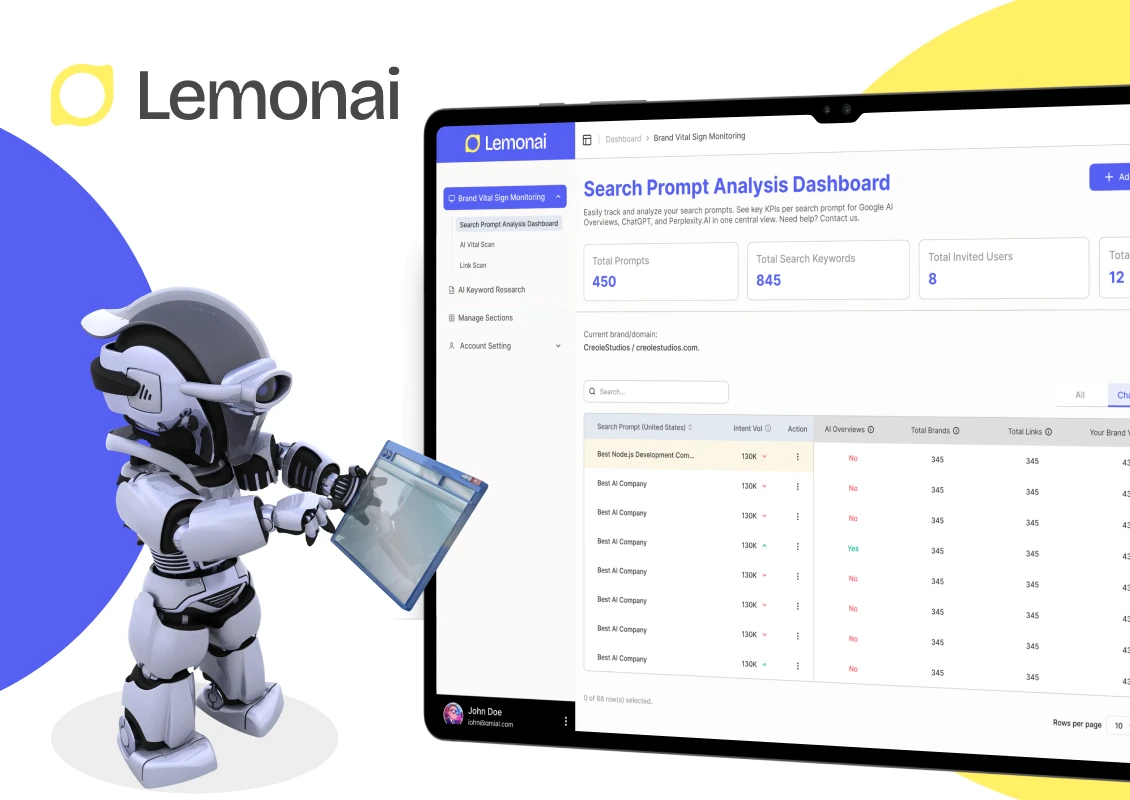
 Hong Kong
 United Kingdom





 Love we get from the world