

 Lets Talk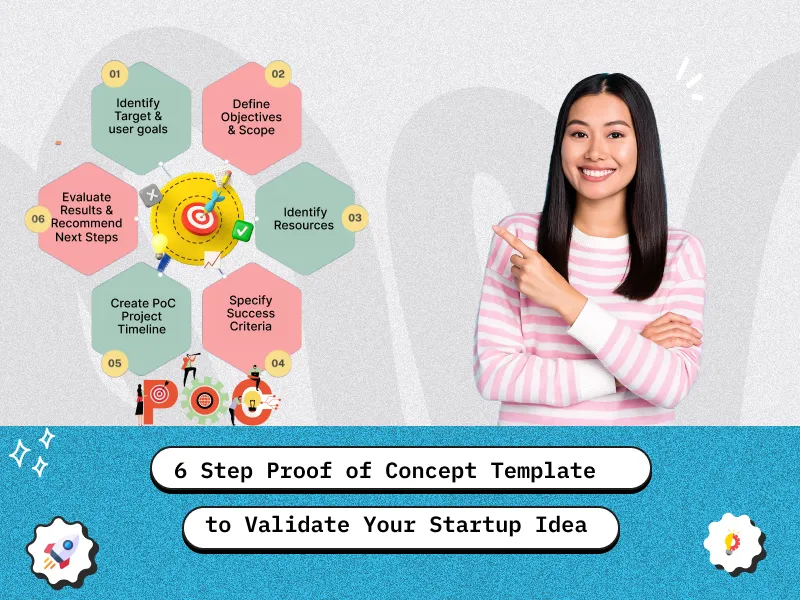
TL;DR
- Identify Problems & Target Users: Research your audience to ensure your solution meets real needs.
- Define Objectives & Scope: Set clear goals and boundaries to keep the PoC focused.
- List Resources Needed: Plan tangible tools and intangible assets like expertise and time.
- Specify Success Criteria: Establish KPIs for functionality, performance, scalability, and cost-efficiency.
- Create Project Timeline: Break tasks into phases with milestones and review points.
- Evaluate Results & Recommend Next Steps: Assess outcomes and decide whether to move to prototype, MVP, or iteration.
Introduction
Launching a startup is exciting—but also risky. Studies show that more than 90% of startups fail, with one of the biggest reasons being lack of market need or technical feasibility. Many founders jump straight into development or fundraising without validating their idea, only to discover later that customers don’t want it or the technology can’t support it.
This is where a Proof of Concept (PoC) comes in. A PoC is a small-scale experiment that tests whether your idea can actually work in real life. It helps you validate assumptions, identify risks, and present evidence to investors or stakeholders before you invest heavily in building a Minimum Viable Product (MVP).
In this guide, we’ll walk you through a 6-step Proof of Concept template that you can start implementing today.
What is a Proof of Concept (PoC)?
A Proof of Concept (PoC) is a structured way to test whether your startup idea, product, or technology is both feasible and valuable. It’s not about building the final product—it’s about proving that the idea is worth pursuing.
Unlike:
- Prototypes – which focus on how the product will look and function,
- MVPs (Minimum Viable Products) – which deliver a basic usable version to real users,
A PoC is purely about validation. Think of it as a reality check before you pour in significant money, time, and energy.
Key Goals of a PoC:
- Demonstrate technical feasibility – Can this solution be built with available tools and technologies?
- Validate customer interest – Is there real demand for this idea in the market?
- Identify risks early – Spot potential technical, financial, or market challenges.
- Support stakeholder buy-in – Provide tangible evidence for investors, partners, or internal teams.
Why You Need a PoC for Your Startup Idea
As a founder, your passion drives your startup but passion alone doesn’t guarantee success. Many startups fail not because the idea was bad, but because they built products nobody actually needed. This is where a Proof of Concept (PoC) comes in.
A PoC helps you validate your assumptions before going all-in, ensuring you’re building something people will actually use and pay for.
Key Benefits of a PoC
- Validate Feasibility – Confirm that your technology works and solves a real customer problem.
- Reduce Risks – Identify value gaps, usability challenges, and technical hurdles early.
- Save Time & Money – Gather actionable insights in weeks, not months, preventing costly missteps.
- Boost Investor Confidence – Strengthen your pitch with evidence that your solution works in the real world.
Bottom line: A PoC isn’t just a checkbox, it’s your safety net. It helps you validate ideas, minimize risks, conserve resources, and win over investors, making it a critical first step before building a full product.
Read More: What is a Proof of Concept (PoC) in Software Development?
Validate Your Startup Idea Today
Don’t wait months or waste resources, get expert guidance to structure and test your Proof of Concept efficiently.

When Should You Create a PoC?
A Proof of Concept (PoC) isn’t required for every idea, but it becomes crucial when you’re dealing with uncertainty, innovation, or unproven assumptions. In these situations, a PoC helps you test feasibility before committing significant time and resources.
Some key scenarios where creating a PoC makes sense include:
- Testing new technology: Use a PoC to confirm whether emerging or complex tech can actually deliver. Example: Validating if your AI fraud detection algorithm can reliably spot anomalies.
- Entering a new market or customer segment: A PoC helps you check whether your solution resonates with a different audience. Example: Testing if enterprise clients will adopt a SaaS tool originally designed for small businesses.
- Exploring new revenue models: If you’re moving from one-time purchases to subscriptions or experimenting with freemium models, a PoC reveals if customers are willing to pay.
- Before seeking funding or partnerships: Investors and partners expect more than ideas they want proof. A PoC provides the validation needed to strengthen your pitch.
💡 Pro tip: If your startup involves new technology, untested markets, or unproven demand, creating a PoC should always be your first step.
Read More: SaaS MVP Development: Step-by-Step Guide for Startups
6-Step Proof of Concept Template
A Proof of Concept (PoC) is more than just an experiment—it’s your startup’s safety net. It validates whether your idea is technically feasible, solves a real problem, and deserves further investment. Here’s a detailed 6-step framework to help you structure your PoC effectively.
Step 1: Identify Problems & Target Users
Every successful PoC starts with a clear problem statement. Ask yourself: What exact pain point am I solving, and for whom?
- Conduct user interviews and surveys to gather firsthand insights.
- Research competitors to see how the problem is currently being addressed (or not).
- Build user personas that capture your target audience’s motivations, frustrations, and goals.
Example: If you’re developing a SaaS collaboration tool, identify whether your target users (e.g., small teams, freelancers, or enterprises) actually feel the pain of inefficient workflows and would adopt a new solution.
The better you define the problem and users, the sharper your PoC will be.
Step 2: Define Objectives & Scope
Without clear goals, your PoC can drift into “mini product” territory. Keep it laser-focused by defining:
- Objectives: What you want to prove (e.g., “Our AI model can detect fraudulent transactions with 90% accuracy”).
- Scope: What’s included and excluded. Limit it to core assumptions you want to validate.
Tip: Think of your PoC as a magnifying glass, not a Swiss Army knife. It should focus on one or two hypotheses, not test everything at once.
Step 3: Identify Resources
Execution requires resources—both tangible and intangible. Mapping them early avoids delays later.
- Tangible resources: Tools, software licenses, hardware, cloud infrastructure, datasets.
- Intangible resources: Team expertise, domain knowledge, time allocation, and external advisors.
Example: If your PoC involves blockchain, you’ll need developers skilled in Solidity, access to test networks, and maybe legal guidance on compliance.
Always account for resource availability upfront. Lack of expertise or tools is one of the top reasons PoCs fail.
Step 4: Specify Success Criteria
Success criteria make your PoC measurable. Define Key Performance Indicators (KPIs) that determine if your assumptions hold true.
Some dimensions to consider:
- Functionality: Does the solution work as expected?
- Performance: Can it handle real-world data or user load?
- Scalability: Could it grow if demand increases?
- Cost-efficiency: Is it affordable to implement at scale?
- User acceptance: Do people actually want to use it?
Example: For a fintech app PoC, success might be defined as “80% of test users complete a transaction without errors and report satisfaction scores above 4/5.”
Step 5: Create a PoC Timeline
A PoC should be quick, not an endless project. Create a timeline with clear phases and milestones:
- Planning & Setup – Finalize goals, scope, and resources.
- Development – Build a stripped-down version of the solution or run the experiment.
- Testing – Validate functionality with real or simulated users.
- Review & Analysis – Measure results against KPIs.
Keep your timeline short—ideally 2–8 weeks. Anything longer risks bloating into a prototype or MVP prematurely.
Step 6: Evaluate Results & Recommend Next Steps
Once your PoC is complete, compare the outcomes against your objectives and KPIs. Document:
- What worked: Strengths, successful validations.
- What didn’t: Gaps, technical challenges, or lack of user interest.
- Lessons learned: Insights that can shape future development.
- Next steps: Decide whether to move forward (prototype, MVP), pivot, or shelve the idea.
Example: If your PoC shows that customers love the concept but the current tech stack can’t scale, the next step may be rebuilding with a different architecture before launching an MVP.
The real value of a PoC lies not in proving everything works perfectly, but in learning enough to make informed, low-risk decisions.
Read More: How Much Does MVP Development Cost
Plan Your PoC and MVP Budget
Use our interactive tool to estimate software development costs for your idea before moving forward.
Free PoC Templates to Use
Here are some ready-to-use templates to simplify your PoC process:
- Aha: Fields for goals, problems, concept features, success criteria.
- Designli: Prove need, map pain points, create prototype, test, and move to MVP.
- Smartsheet: Team info, outcome status, scenario testing, results analysis.
- Atlassian: 7-step process: project definition, prototype, testing, and presentation.
- Mervyn George: 6 components: champions, success definition, collaboration, feedback.
- The Ascent: Complete guide: demonstrate need, ideate, prototype, test, feedback, and approval.
Benefits of Using a PoC Template
Building a Proof of Concept (PoC) without a framework often leads to confusion—teams may miss critical steps, overlook risks, or struggle to present results in a convincing way. A PoC template eliminates that guesswork by giving you a roadmap to follow.
Here are the key benefits of using one:
- Provides structure – A template ensures you don’t miss essential elements like objectives, scope, target users, resources, and success criteria. It guides your team through a logical sequence, making your PoC more organized and actionable.
- Standardizes risk assessment – Every innovative idea comes with risks—technical, financial, or market-related. A structured template helps you consistently evaluate these risks, making it easier to compare multiple ideas or approaches.
- Speeds up execution – Instead of starting from scratch, your team can use predefined sections as a launchpad. This accelerates planning, reduces rework, and helps you move from idea to validation much faster.
- Improves communication – A template makes it easier to document and share findings in a clear, professional way. Whether it’s your internal team, investors, or potential partners, stakeholders will quickly understand the purpose, process, and outcomes.
- Boosts investor and stakeholder confidence – A well-structured PoC shows you’ve thought through every detail. This builds trust, increases credibility, and improves your chances of securing buy-in or funding.
In short: A PoC template saves time, reduces errors, and adds clarity. Instead of focusing on formatting or structure, your team can concentrate on testing assumptions and validating ideas with confidence.
Conclusion
A Proof of Concept (PoC) helps startups validate ideas before heavy investments, ensuring feasibility, solving real problems, and identifying risks early. It reduces costly mistakes, builds investor confidence, and confirms customer needs.
Using a structured PoC template makes it easy to define objectives, track results, and present findings. Once validated, moving forward with expert MVP development services ensures a smooth transition from idea to scalable product.
Validate smart, build fast, and give your startup the confidence to grow successfully.
Frequently Asked Questions (FAQs)
1. What is a Proof of Concept (PoC)?
A Proof of Concept (PoC) is a structured approach to test whether your startup idea, product, or technology is feasible and valuable. It focuses on validation, not building the final product.
2. Why is a PoC important for startups?
A PoC helps startups validate feasibility, reduce risks, save time and resources, and build investor confidence before investing heavily in development.
3. How is a PoC different from a prototype or MVP?
- PoC: Tests feasibility and validates the idea.
- Prototype: Demonstrates design and functionality.
- MVP (Minimum Viable Product): A working version with essential features for real users.
4. When should I create a PoC?
Create a PoC when testing new technology, entering a new market, exploring revenue models, or before seeking funding and partnerships.
5. What are the key steps in a PoC template?
The 6-step PoC template covers identifying problems & users, defining objectives, listing resources, setting success criteria, creating a timeline, and evaluating results.
6. Can I use a PoC template for any startup idea?
Yes, PoC templates are versatile and can be used for software, hardware, or business ideas to structure validation and reduce risks.
7. Where can I find free PoC templates?
You can access ready-to-use templates from platforms like Aha, Designli, Smartsheet, Atlassian, Mervyn George, and The Ascent to simplify your PoC process.


 10 min read


