
 Lets Talk
TL;DR
- Most MVPs fail because teams build too early, validate too late, or add too many features.
- A structured MVP development process helps founders learn first and build only what matters.
- This approach reduces wasted cost, rework, and false confidence.
- It sets realistic expectations for time, budget, and effort at each stage.
- It helps founders decide whether to build alone, use no-code tools, or work with an MVP development partner.
Introduction
Most MVPs don’t fail because the idea is bad. They fail because teams start building too quickly, validate too late, or try to include too many features in the first version. This leads to wasted time, rising costs, and confusion about what users actually want.
This guide explains a structured, validation-first MVP development process that helps founders move from idea to launch with less risk. Instead of guessing, it shows how to learn at each step and make clearer decisions. For many teams, working with a trusted MVP development partner makes this process easier, especially when experience, time, or internal resources are limited.
How a Structured MVP Development Process Reduces Cost, Risk, and Rework
A structured MVP development process means building in the right order instead of rushing straight into development. Teams first check whether the problem and demand are real, then decide what to build, and only after that start development. This follows the same thinking you’ll find in a basic guide to MVP development, but focuses more on practical execution.
This approach helps by:
- Reducing wasted cost by focusing only on features that support validation, not assumptions
- Lowering risk through early testing that confirms real user interest before scaling
- Improving learning by relying on actual user behavior instead of opinions or guesses
- Minimizing rework by avoiding major changes late in development
Compared to ad-hoc MVP building, a structured process creates clearer decisions, faster learning, and more predictable outcomes.
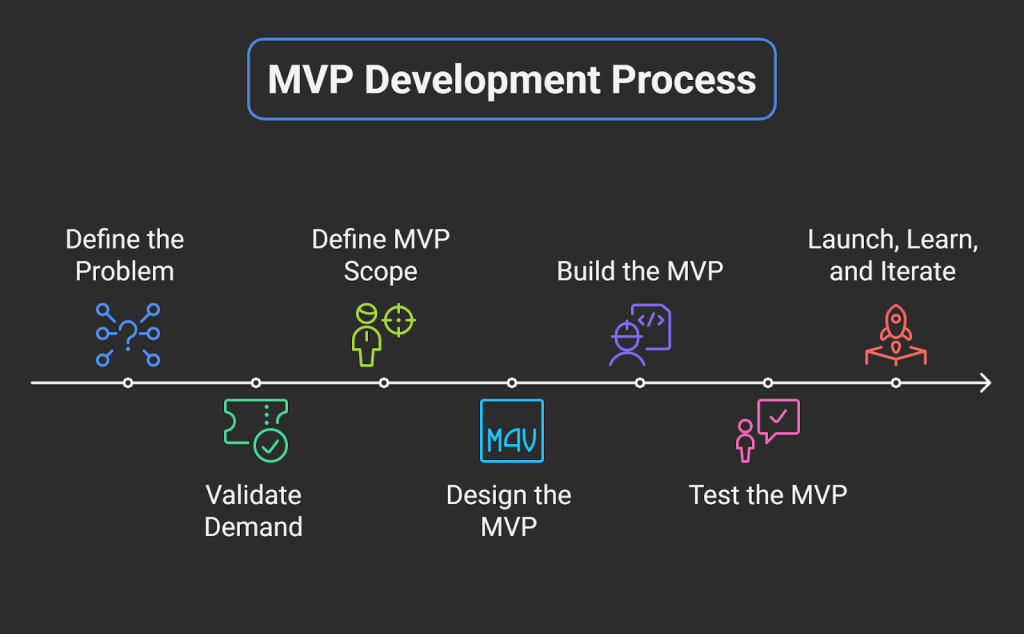
The MVP Development Process (Step-by-Step)
This section explains each step of the MVP development process in simple terms. It shows what to do at every stage, how much time and cost to expect, and what can go wrong if a step is skipped.
Step 1: Define the Problem Before the Idea
This step helps you move away from feature ideas and focus on real user pain. You clarify who the product is for, what problem they face, and why current solutions don’t fully work. By the end, you should be able to explain the problem in a simple way that users would agree with.
- Goal: Ensure you are solving a real, painful problem.
- Output: A validated problem hypothesis
- Time: 1–2 weeks
- Cost: Low (founder time, basic research tools)
- Risk if skipped: You may build features that don’t solve a meaningful problem.
Step 2: Validate Demand Using Real Market Signals
Here you check if real users show real interest, not just polite feedback. Strong validation comes from behavior sign-ups, replies, waitlists, or willingness to try. This step protects your budget by ensuring you don’t build something the market doesn’t want.
- Goal: Confirm people care before you build anything.
- Time: 2–4 weeks
- Cost: Low–medium (ads, tools, small incentives)
- Risk if rushed: Misreading weak signals as real demand.
Step 3: Define the MVP Scope (What to Build — and What to Skip)
This step is about choosing the smallest set of features that lets users experience your core value. You define what the MVP includes and what it intentionally excludes, so development stays focused. A clear scope keeps timelines realistic and prevents feature creep.
- Goal: Build only what proves or disproves your core hypothesis.
- Output: A clear MVP scope definition
- Time: ~1 week
- Cost: Minimal
- Risk: Scope creep, overengineering, delayed launch.
Step 4: Design the MVP for Clarity and Credibility
MVP design should help users understand the product quickly and trust it enough to try. The focus is on clear user flows, simple screens, and reducing confusion—not perfect visuals. This supports better feedback because users can actually complete key actions.
- Goal: Ensure usability without overdesign.
- Time: 1–2 weeks
- Cost: Medium
- Risk: Spending too much time polishing design before learning is confirmed.
Step 5: Build the MVP (Execution Choices That Matter)
This is where you turn the plan into a working product using custom code, no-code, or a hybrid approach. The priority is speed and flexibility, so you can change the product based on feedback. “Good enough to learn” matters more than building for scale on day one.
- Goal: Execute fast without creating long-term technical problems.
- Time: 4–8 weeks
- Cost: Medium–high (depends on approach)
- Risk: Lock-in from poor technical decisions that are hard to change later.
Step 6: Test the MVP With Real Users
Testing means watching how users behave in the product and identifying patterns. One-off opinions can mislead you, but repeated user behavior shows what actually works and what doesn’t. This step helps you decide what to fix, remove, or improve before pushing growth.
- Goal: Learn from real usage, not opinions.
- Time: 2–3 weeks
- Cost: Low–medium
- Risk: Acting on anecdotal feedback instead of clear trends.
Step 7: Launch, Learn, and Iterate
Launching is not the end—it’s the start of deeper learning. You review results against your success criteria and decide whether to iterate, pivot, pause, or scale. The goal is to make the next decision with proof, not hope.
- Goal: Decide the next move based on evidence.
- Time: Ongoing
- Cost: Variable
- Risk: Scaling before validation stabilizes.
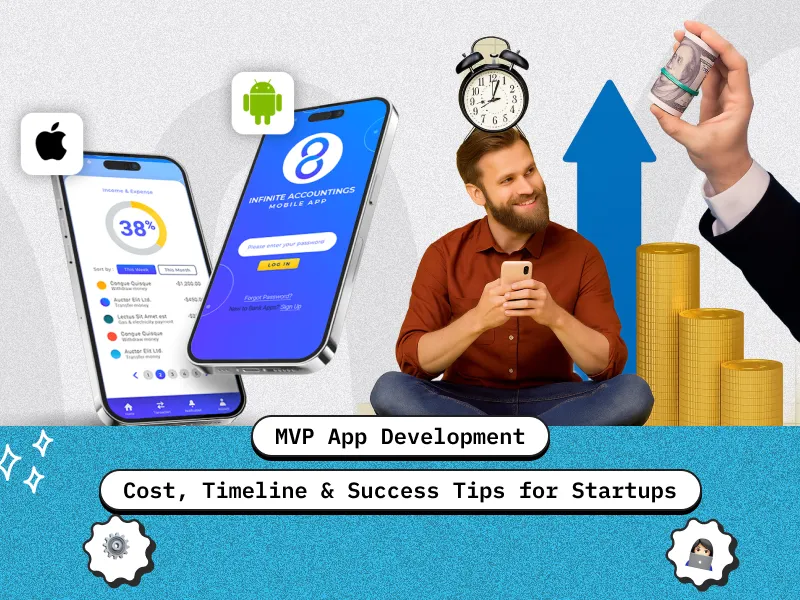
What This MVP Development Process Actually Costs
A structured MVP development process keeps costs predictable by focusing on validation before heavy development.
Typical Total MVP Cost
- $12,000 – $35,000 for most early-stage MVPs
- Simple MVPs may cost less; complex products may cost more
Average Cost by Phase
- Problem Definition & Validation usually costs $0–$3,000 and mainly involves founder time, basic research tools, and small validation tests.
- MVP Scoping & Design typically costs $2,000–$6,000, covering product planning, UX design, and simple prototypes.
- Development & Testing is the largest expense at around $8,000–$25,000, including core development and real user testing.
- Launch & Iteration costs are more flexible, often $1,000–$5,000+, depending on how much feedback leads to changes.
What Affects MVP Cost
- Team Size: Smaller teams cost less but move slower. Larger teams move faster but cost more.
- Build Approach: No-code or hybrid builds are usually cheaper than fully custom development.
- Validation Depth: More testing increases early cost but reduces expensive rework later.
Resources Required to Execute This Process
- Founder involvement is highest early on, especially during problem definition and validation.
- A small team is usually enough, covering basic product, design, and development needs.
- Outsourced support helps during build and design, when speed or skills are limited.
- Different tools are used at each stage, from research and design to testing and analytics.
- Flexibility matters more than scale, so tools and teams should support quick changes.
Who This MVP Development Process Is — and Isn’t — Right For
This process is right for:
- First-time founders who want a clear path and fewer costly mistakes
- Startups testing new ideas, markets, or business models
- Teams with limited budgets that need to learn before investing more
This process is not right for:
- Adding new features to an already proven product
- Enterprise projects with fixed scope and strict requirements
- Teams focused only on rapid growth without time for validation
Common MVP Mistakes That Increase Cost and Risk
Many teams run into the same problems during MVP development when early decisions are rushed or validation is skipped. These mistakes often lead to higher costs, delays, and unclear product direction.
- Skipping validation and building before confirming that users actually need the product.
- Treating the MVP like a final product, which leads to overbuilding and unnecessary complexity.
- Adding too many features too early, making the MVP slower to build and harder to change.
- Choosing complex tech stacks too soon, which limits flexibility and increases future costs.
- Measuring the wrong metrics, such as downloads or sign-ups, instead of real user behavior and learning.
When a Structured MVP Development Partner Makes Sense
Working with a structured MVP development partner makes sense when internal skills are limited or spread too thin. If your team lacks experience in product planning, design, or development or if founders are juggling too many roles a partner can bring focus and structure. This is especially helpful when speed matters but burn rate still needs to be controlled, as the right partner helps avoid rework and costly mistakes.
However, outsourcing is not always the right choice. It usually doesn’t work well when the problem is still unclear, when founders expect fixed outcomes without validation, or when learning is treated as optional. A true MVP-focused partner supports experimentation and decision-making, not just delivery, and should work closely with founders rather than replacing their involvement.
Build Your MVP the Right Way Early
Follow a structured, validation-first MVP development process to reduce risk, control costs, and move from idea to launch with clarity and confidence.

Conclusion
Successful MVPs are built by making the right decisions in the right order, not by rushing to launch. A structured MVP development process helps teams validate ideas early, control costs, and learn from real user behavior before investing heavily in development.
By following a validation-first approach, founders can reduce risk and avoid expensive rework. Whether you build on your own or with the help of a trusted partner, the key is staying focused on learning and using evidence to guide every next step.
FAQs
1. How much does it cost to build an MVP with this process?
The cost depends on how complex your product is and how you build it. This process helps you avoid spending money on features users don’t actually want.
2. How long does the full MVP process take?
Most MVPs take around 8 to 16 weeks from idea to launch. The timeline changes based on your team size and product scope.
3. Can a non-technical founder follow this process?
Yes, you can handle research and validation without technical skills. For building, you can use no-code tools or work with a development partner.
4. What if users don’t like the idea during validation?
That’s a good outcome because it saves you from building the wrong product. You can adjust the idea or stop early without wasting much time or money.
5. Can this process work with no-code tools?
Yes, no-code tools work well for early testing and simple MVPs. You can switch to custom development later if the product grows.







 30 mins free Consulting
 10 min read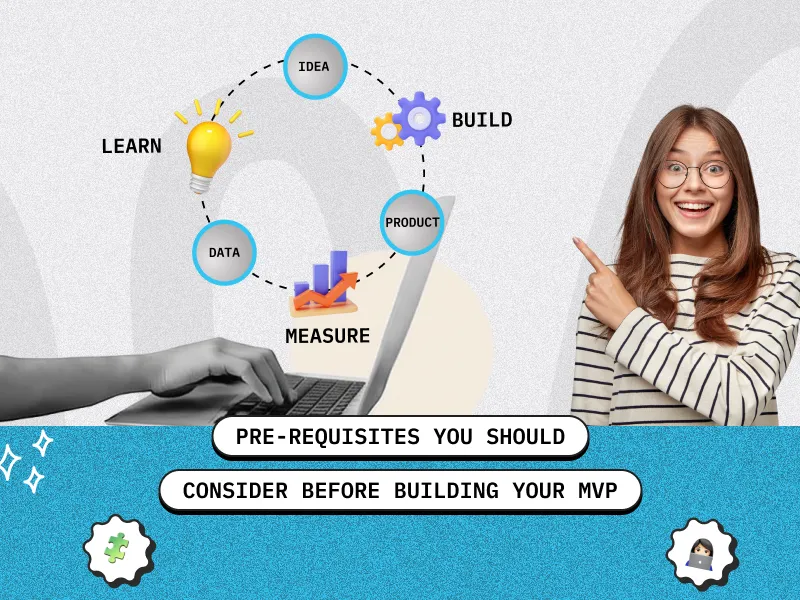
 Canada
 Hong Kong
 India
India 





 Love we get from the world