

 Lets Talk
TL;DR
- Many startups start building without knowing which problem matters most
- MVPs often lack real market validation
- Limited budgets and small teams create pressure
- Time and cost are frequently underestimated
- Speed and quality are hard to balance
Introduction
Building an MVP helps startups test ideas quickly, but the process is rarely simple. Many challenges appear early, often before startups receive meaningful feedback from real users.
This blog explores common MVP development challenges, why these issues arise early, and how unclear decisions affect progress. It also explains the risks of ignoring these challenges while planning the overall MVP development roadmap.
Key MVP Development Challenges Startups Face:
Many startups face problems while building an MVP, especially at the beginning. These problems often show up before they talk to real users. Knowing these challenges helps explain why many MVPs struggle early on.
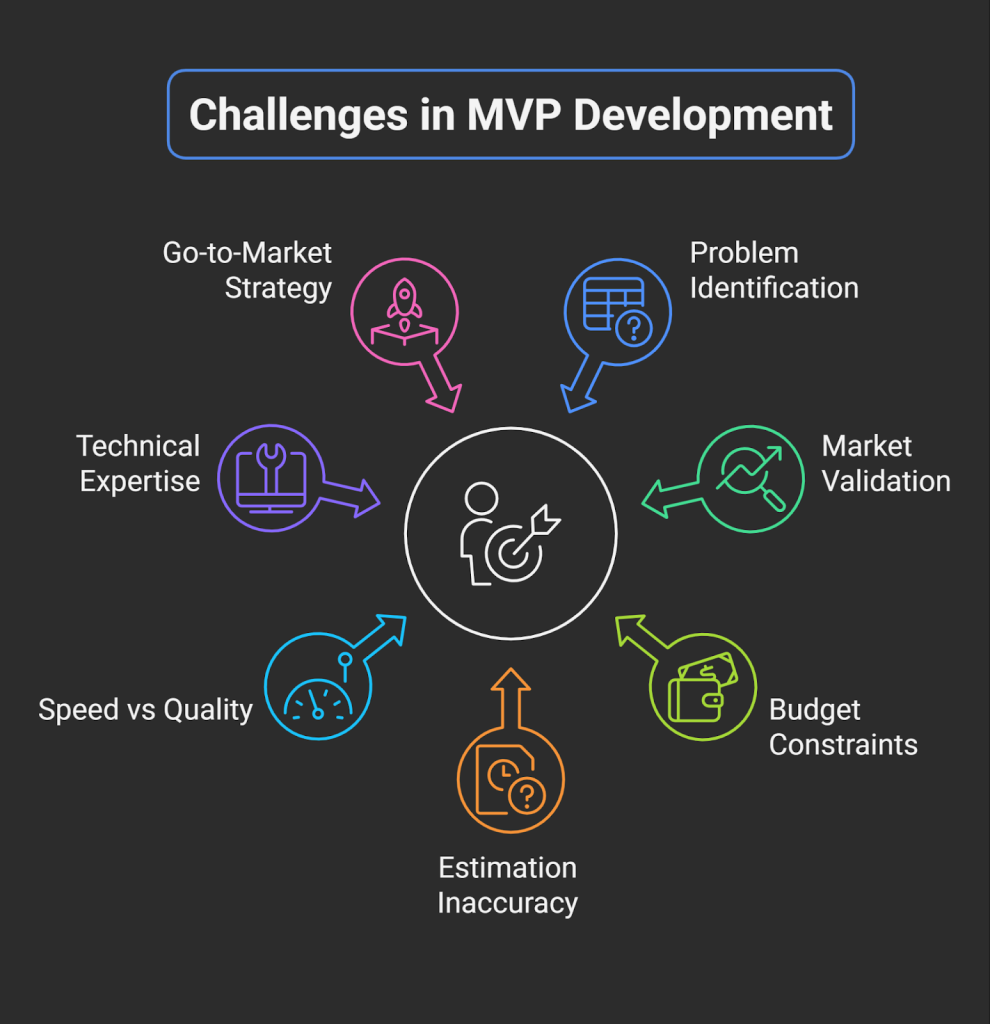
1. Not Knowing What Problem to Solve First
Many startups identify several problems at the same time. Instead of focusing on one clear issue, they try to address multiple needs at once. This behavior is one of the early mistakes in MVP development, where assumptions replace real user understanding. Teams move forward without clearly identifying which problem is the most important.
How this challenge shows up
- The MVP tries to solve too many issues
- Features feel scattered
- Users are confused about the product’s purpose
Impact on MVP success
- Product direction becomes unclear
- Feedback lacks focus
- Early learning is weak
2. Weak or No Market Validation
Some startups rush into development without confirming real market demand. User research is skipped or delayed, and decisions are driven by internal opinions. Without early validation, teams assume users will adopt the product without clear evidence.
How this challenge shows up
- MVP is built without real user interest
- Feedback comes from the wrong audience
- Adoption is lower than expected
Impact on MVP success
- MVP fails to reflect real demand
- Early traction can be misleading
- Iteration becomes harder later
3. Limited Budget and Resources
Early-stage startups usually work with tight budgets and small teams. Team members handle multiple responsibilities, and priorities compete for attention. This creates pressure to move fast while managing limited capacity.
How this challenge shows up
- Development slows down
- Trade-offs affect quality or scope
- Planning becomes uncertain
Impact on MVP success
- Focus shifts away from learning
- Technical issues appear early
- Team stress increases
4. Inaccurate Time and Cost Estimation
Many startups underestimate the effort required to build an MVP. Unknown complexities are ignored, and scope is not clearly defined, often because the typical MVP development process is not fully understood. As development progresses, expectations no longer match reality.
How this challenge shows up
- Timelines slip
- Budgets are exceeded
- MVP development remains incomplete
Impact on MVP success
- Trust in planning decreases
- Momentum is lost
- Decisions are delayed
5. Balancing Speed vs Quality
Startups feel pressure to launch quickly to avoid missing market opportunities. At the same time, teams worry about releasing something unfinished. This creates tension between moving fast and maintaining stability.
How this challenge shows up
- Rushed builds introduce instability
- Over-polishing delays launch
- Validation happens too late
Impact on MVP success
- Poor-quality MVPs distort feedback
- Delayed launches slow learning
- Product direction becomes uncertain
6. Lack of Technical Expertise
Non-technical founders often struggle to make informed development decisions. MVP architecture and feasibility are not evaluated early enough. This creates gaps between vision and execution.
How this challenge shows up
- Requirements are misunderstood
- Development choices create rework
- Technical risks increase
Impact on MVP success
- Time and effort are wasted
- MVP quality suffers
- Future development becomes harder
7. No Clear Go-To-Market Strategy
Some startups focus only on building the MVP and postpone launch planning. User acquisition is not considered early in the process. As a result, the MVP reaches very few real users.
How this challenge shows up
- MVP launches quietly
- Few users interact with the product
- Feedback is limited or unclear
Impact on MVP success
- Real-world validation is weak
- Learning is delayed
- Product decisions lack confidence
Conclusion
MVP development challenges are common for startups, especially in the early stages of building a product. Many of these problems come from unclear priorities, rushed decisions, and limited early knowledge. When these issues are ignored, teams often struggle to gain clear direction and meaningful learning from their MVP.
Understanding these challenges early helps startups approach MVP development with clearer expectations. At this stage, many teams also begin exploring tools commonly used for MVP development as part of preparing for better decision-making later. This awareness supports more focused choices and a smoother early product journey.
FAQs
1. Why do startups face MVP development challenges?
Startups are still learning about their users and the problems they want to solve. This makes early decisions unclear and increases the chance of mistakes.
2. What are the challenges of new product development?
New product development is challenging because teams often work with limited information about users and the market. Unclear goals, changing requirements, and limited resources can slow progress and increase risk.
3. Can MVP development challenges delay the launch?
Yes, challenges like unclear scope and limited resources can slow development. This often causes timelines to extend beyond initial plans.
4. Do MVP challenges affect user feedback?
Yes, when an MVP lacks focus or is rushed, user feedback becomes confusing. This makes it harder to understand what actually needs improvement.
5. Are MVP development challenges normal for startups?
Yes, these challenges are common for early-stage startups. Most teams experience them while learning and building their first MVP.








 30 mins free Consulting
 10 min read

 Canada
 Hong Kong
 India
India 





 Love we get from the world