

 Lets Talk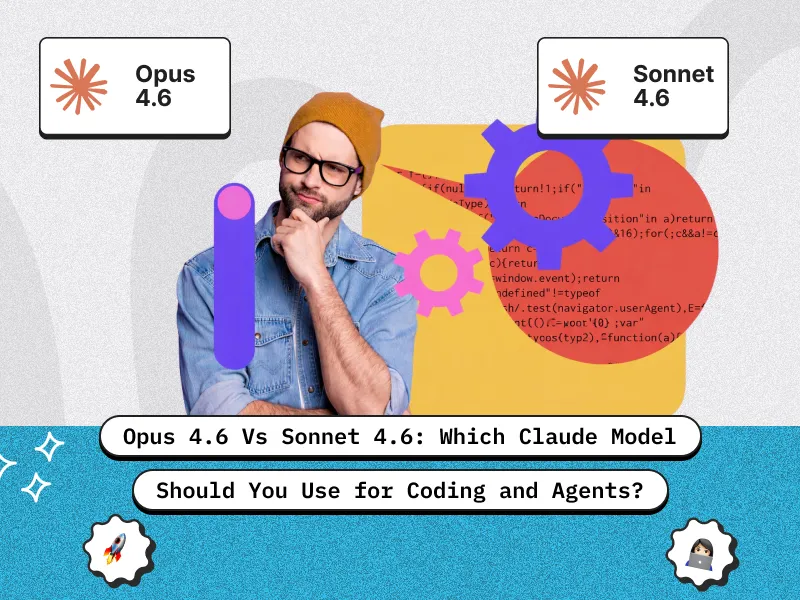
TL;DR
- Pick Sonnet 4.6 as your daily driver if you want strong agentic performance at a lower sticker price: $3/M input, $15/M output.
- Pick Opus 4.6 for deepest reasoning and high-stakes work where getting it right matters more than cost: $5/M input, $25/M output.
- Sonnet 4.6 narrows the gap to Opus on overall intelligence (often described as 51 vs 53 on an intelligence index), and even leads on some agentic tasks (GDPval-AA, TerminalBench in the dataset).
- Hidden cost matters: Sonnet can use more output tokens in max-effort mode, which can shrink real savings versus Opus on long tasks.
- Best practical strategy: use Sonnet by default and route critical tasks to Opus.
Quick positioning: what each model is built for
Claude Sonnet 4.6
Sonnet 4.6 is positioned as the “workhorse” Claude model that became strong enough to handle many tasks that previously required an Opus-class model. It is described as a full upgrade across:
- coding
- computer use
- long-context reasoning
- agent planning
- knowledge work and design
Two big “why this matters” upgrades are:
- 1M context window (beta) so it can hold very large inputs in one session.
- Stronger agent behavior: better context reading before edits, more consistent follow-through, and fewer “false done” claims reported by early Claude Code users.
It is also the default model for Free and Pro users on claude.ai and Claude Cowork, which is a strong signal of where Anthropic wants most users to live day-to-day.
Claude Opus 4.6
Opus 4.6 remains Anthropic’s premium model and is repeatedly framed as the strongest option when:
- reasoning depth is the priority
- the task is high-stakes and needs the cleanest outcome
- you are refactoring large codebases
- you are coordinating multiple agents and need “must be correct” execution
Simple mental model:
- Sonnet 4.6 = high-quality daily driver for coding + agents at lower sticker price
- Opus 4.6 = premium model for deepest reasoning and critical correctness
Read More:
Gemini 3.1 Pro vs Claude Opus 4.6
MiniMax M2.5 vs Claude Opus 4.6
Composer 1.5 vs Claude Opus 4.6
What “coding and agents” means in real workflows
A lot of model comparisons focus on “can it write good code?” That is the easiest part.
In 2026, the real question is:
Can the model finish work end-to-end like an agent, not just produce code snippets?
In practical terms:
Coding workflow success looks like
- produces a fix that compiles
- passes tests or at least moves you closer
- doesn’t break unrelated modules
- requires fewer reviewer edits
Agent workflow success looks like
- reads enough context first (repo structure, conventions, dependencies)
- makes a clear plan
- uses tools correctly (search, fetch, code execution, computer use)
- stays aligned across multiple steps
- doesn’t drift, loop, or “declare success” early
So your choice should be driven by time-to-merge and rework, not by one headline benchmark.
Specs that matter: context, output, and tools
Context and output
- Sonnet 4.6: 1M context window (beta), and 128K max output (as described in your dataset).
- Opus 4.6: also supports 1M context (beta) and is positioned for large outputs and deep reasoning.
What this means:
- Both models can hold large inputs, including big codebases and long documents, without as much chunking.
- Long context is especially helpful for: repo-wide refactors, audits, contracts, research synthesis, and multi-step planning.
Tooling and long-session support
Your Sonnet datasets highlight:
- adaptive thinking and extended thinking controls
- compaction (beta) to summarize older context as sessions get long
- improved web search and fetch flows that can filter and process results using code execution
- programmatic tool calling and MCP connectors (especially highlighted in Excel workflows)
This matters because agent success often depends on tool use quality and long-session stability.
Performance comparison: read benchmarks like a workflow map
Benchmarks can look like a scoreboard, but they work best as a “workflow map.”
Different benchmarks represent different job skills:
- “can it reason deeply?”
- “can it do terminal-driven coding?”
- “can it handle agentic business tasks?”
- “can it use a computer safely?”
Below are the comparisons that matter most for coding + agents.
A) Overall intelligence
One dataset reports:
- Opus 4.6 at 53
- Sonnet 4.6 at 51
The important takeaway is not “2 points.” The takeaway is:
Sonnet is now close enough that the decision becomes workflow- and cost-driven, not simply ‘Opus always wins’.
B) Agentic real-world work tasks
Your dataset claims Sonnet 4.6 leads Opus 4.6 on GDPval-AA:
- Sonnet 1633 vs Opus 1606
Why this matters:
GDPval-AA is framed as agentic real-world work tasks, the kind of work that includes:
- office tasks
- finance analysis
- structured multi-step workflows
So if your “agent work” includes spreadsheets, financial analysis, and multi-step execution, Sonnet being competitive (or leading) here is meaningful.
C) Agentic coding and terminal execution
Your dataset claims Sonnet 4.6 leads Opus 4.6 on TerminalBench:
- Sonnet 53% vs Opus 46%
Why this matters:
Terminal-style execution correlates with:
- running tests
- debugging build errors
- resolving dependencies
- handling scripts and CI issues
If your agent workflows include “build-test-fix loops,” this is one of the most relevant signals.
D) Computer use
Sonnet 4.6 is strongly positioned as improving in “computer use” tasks such as:
- navigating complex spreadsheets
- filling multi-step web forms
- working across multiple browser tabs
This category matters when your organization has tools that do not have clean APIs and requires UI automation.
Your dataset also highlights prompt injection risk and notes Sonnet 4.6 improved resistance and performs similarly to Opus 4.6 in that area, which is important when the model is interacting with untrusted web content.
E) Long-horizon planning
Your dataset claims Sonnet 4.6 performs strongly on Vending Bench Arena, including a distinct strategy: invest early, then pivot to profitability later, finishing ahead.
How to translate this into coding reality:
Long-horizon performance often correlates with:
- staying aligned across many steps
- not forgetting earlier decisions
- not derailing mid-task
This matters for long refactors, migrations, and multi-stage deliverables.
F) Claude Code user preference signals
Your datasets report that early testers preferred Sonnet 4.6 over:
- Sonnet 4.5 about 70% of the time
- Opus 4.5 about 59% of the time
The reasons cited are the kind of things developers actually care about:
- reads context before editing
- consolidates logic instead of duplicating
- less overengineering and less “laziness”
- fewer false claims of success
- fewer hallucinations
- better follow-through on multi-step tasks
This is a strong narrative for why Sonnet 4.6 can be the default choice for coding agents.
Pricing comparison: what you will actually pay
Pricing looks simple on paper, but your real bill depends on two things:
- per-token rates (the sticker price), and
- how many tokens the model actually uses to finish the job (token efficiency).
Here’s the clean breakdown.
Sonnet 4.6 pricing
- $3 per 1M input tokens
- $15 per 1M output tokens
- Anthropic positions this as unchanged from Sonnet 4.5.
This is why Sonnet is marketed as the “daily driver” option: you can run more tasks without hitting premium costs as quickly.
Opus 4.6 pricing
- $5 per 1M input tokens
- $25 per 1M output tokens
This is the “pay more, get the deepest reasoning” tier. Opus is priced for teams that are willing to spend extra when correctness is the priority.
What the price gap actually means
Comparing the sticker prices:
- Input: $3 vs $5 → Sonnet is 40% cheaper
- Output: $15 vs $25 → Sonnet is 40% cheaper
So if both models used the same number of tokens for the same task, Sonnet would clearly be the cheaper option.
The hidden cost: token efficiency
Here’s the nuance your dataset highlights:
- Sonnet 4.6 used 74M output tokens in max-effort mode to run an evaluation suite.
- Opus 4.6 used 58M output tokens in the same mode and suite.
That means Sonnet produced more output tokens to reach its results. So even though Sonnet is cheaper per token, it may consume more tokens on long, reasoning-heavy tasks, which reduces the real savings.
How this shows up in real work
- On simple tasks (short bug fix, small refactor), Sonnet’s lower rates usually win.
- On long tasks (large analysis, long-horizon planning, heavy “thinking”), Sonnet may generate more intermediate reasoning and longer responses, so your bill can move closer to Opus than expected.
Practical budgeting rule
- Use Sonnet 4.6 as your default when you run frequent tasks and want strong agent performance without premium rates.
- Use Opus 4.6 for high-stakes tasks where mistakes are expensive (security changes, compliance, large migrations, critical refactors). Even at a higher token price, Opus can be cheaper per outcome if it reduces retries, broken builds, and reviewer rework.
Bottom line: Sonnet wins on sticker price, Opus can win on “cost per correct result.”
Availability and how to try it
Sonnet 4.6 is described as:
- the default model on claude.ai and Claude Cowork for Free and Pro users
- available via API and major cloud platforms
Free tier detail (from your dataset):
- usage limits depend on demand and reset every five hours
If you want the fastest way to evaluate:
- run a small set of your real coding and agent tasks on Sonnet and Opus
- measure retries, time-to-merge, and reviewer edits
Who should use which model
Use Sonnet 4.6 if you are
- a solo dev shipping daily PRs and needing cost control
- a small team running high-volume agent workflows
- a team doing office/finance workflows where agentic task performance matters
- a team that benefits from computer-use automation but needs a cost-effective default
Use Opus 4.6 if you are
- doing security, permissions, compliance, or high-risk changes
- refactoring large codebases where “getting it just right” is critical
- coordinating multi-agent workflows with high complexity
- producing massive single-turn outputs repeatedly
Best practice: use both with task routing
For many teams, the highest ROI setup is not “choose one forever.” It is routing.
A practical routing rule:
- Sonnet 4.6 for daily agent work: fixes, features, routine refactors, office/finance tasks, tool-heavy workflows.
- Opus 4.6 for premium tasks: security reviews, high-risk refactors, large migrations, multi-agent coordination.
Track for two weeks:
- retries per task
- time-to-merge
- reviewer edits required
- cost per completed task
That will give you a real “which model is better for us” answer.
Conclusion
Claude Sonnet 4.6 is now strong enough to be the default choice for many coding and agent workflows. It gives you near-Opus level capability in a lower price tier, and it is especially practical when you run high-volume tasks where cost and speed matter. Claude Opus 4.6 still earns its place for the deepest reasoning and highest-stakes work, such as security-sensitive changes, large refactors, and complex multi-agent coordination where getting it right is critical.
The most practical setup is not choosing one forever. Use Sonnet 4.6 as the daily driver, and route premium, high-risk tasks to Opus 4.6. If you want help deciding what to route where based on your real repo and workflows, book a 30 minute free consultation here.









 30 mins free Consulting
 11 min read
 Canada
 Hong Kong
 United States





 Love we get from the world