

 Lets Talk
TL;DR
- Many MVP projects fail because teams start building before clearly understanding the real problem.
- Assumptions and guesses often replace real user understanding in early decisions.
- Too many features make MVPs harder to test and learn from.
- Limited time, budget, and small teams increase early pressure and risk.
- Late user feedback causes teams to waste effort in the wrong direction.
Introduction
Many startups build an MVP to test an idea and learn from real users. The goal is to understand what works before spending too much time or money. Still, even after following a beginner’s MVP guide, many startups see their MVP projects fail very early.
Most of the time, this does not happen because of technical problems. It happens because teams make early decisions without enough clarity. When startups rush into building without fully understanding the problem or users, the MVP fails to deliver useful learning.
Common Reasons Why MVP Projects Fail in Early Development
Most MVP projects fail because of early mistakes, not technical problems. Here are the top reasons that cause MVPs to fail before teams get real feedback and learning.
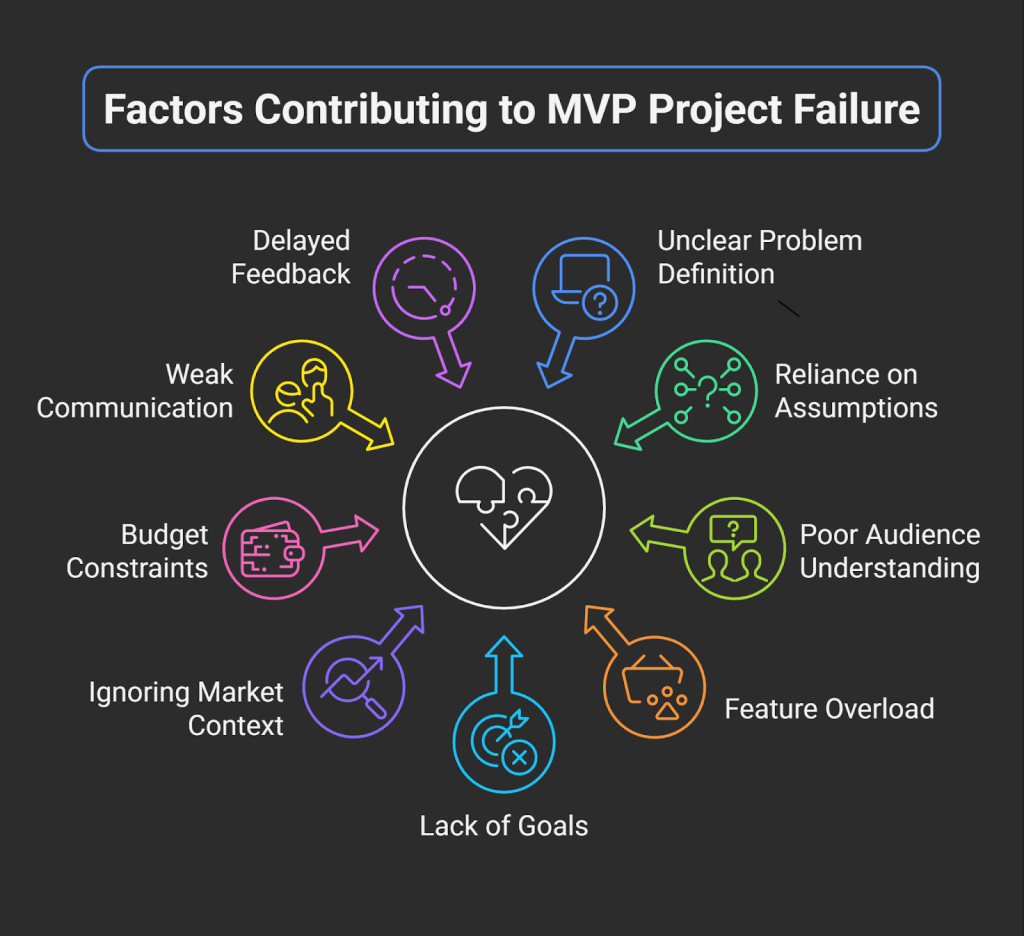
1. Building Without a Clear Problem Definition
Why this happens
Teams often feel pressure to start building quickly. In this rush, the actual problem is discussed only at a surface level. Founders may focus more on ideas and features than on clearly understanding the real pain users face.
How it shows up in MVPs
- Features feel disconnected and don’t clearly relate to one main problem
- Users feel confused about what the MVP is meant to do
- The value of the MVP is not obvious at first glance
Why does it become a serious problem?
- Feedback lacks direction and is hard to act on
- Learning slows down because signals are unclear
- The MVP feels irrelevant to users and their needs
2. Relying on Assumptions Instead of Real User Insight
Why this happens
Early-stage teams often make decisions based on personal opinions or past experiences. Talking to users feels time-consuming, so assumptions are used as shortcuts. Over time, these guesses start guiding important product decisions.
How it shows up in MVPs
- Features don’t match real user needs or expectations
- Usage patterns feel unexpected and hard to explain
- Feedback feels confusing and sometimes contradictory
Why does it become a serious problem?
- Wrong assumptions continue to guide key decisions
- Teams misread results and draw incorrect conclusions
- The overall MVP direction becomes unstable over time
3. Poor Understanding of the Target Audience
Why this happens
Many teams define their audience too broadly in the beginning. They assume different users have similar needs and behaviors. This lack of clarity makes it hard to design with a specific user in mind.
How it shows up in MVPs
- Messaging feels generic and does not speak to a specific user
- Design lacks focus and feels unclear
- Users struggle to relate the MVP to their own needs
Why does it become a serious problem?
- Adoption stays low because users don’t feel connected
- Feedback is inconsistent and hard to interpret
- Learning becomes unreliable and misleading
4. Overloading the MVP With Too Many Features
Why this happens
Teams often fear that a simple MVP will look incomplete or unconvincing. To avoid missing expectations, they add more features than necessary. This usually happens when there is confusion about MVP vs other early product stages, causing teams to treat an MVP like a near-finished product instead of a learning tool.
How it shows up in MVPs
- Development takes longer than expected due to added complexity
- Many features go unused by users
- Feedback becomes noisy and difficult to interpret
Why does it become a serious problem?
- The core value of the MVP becomes unclear
- Learning gets diluted across too many features
- Timelines keep slipping, delaying meaningful progress
5. Lack of Clear MVP Goals and Success Criteria
Why this happens
Teams may agree to “launch an MVP” without defining what they want to learn from it. During the early MVP development process, goals are often discussed casually and not written down clearly. As a result, everyone involved has a different idea of what success looks like.
How it shows up in MVPs
- Results feel hard to judge or compare
- Metrics don’t clearly guide decisions
- Opinions start to dominate team discussions
Why does it become a serious problem?
- Progress feels uncertain and unclear
- Wrong conclusions are drawn from weak signals
- Teams keep moving forward without real direction
6. Ignoring Market and Competitive Context
Why this happens
Founders often focus heavily on their own idea and spend less time understanding what already exists in the market. During early development, researching competitors can feel less urgent than building quickly, which creates blind spots in expectations and positioning.
Research from CB Insights shows that around 35–42% of startups fail because they don’t meet real market demand, and about 20% fail because they get outcompeted. Ignoring this context early makes it harder for an MVP to stand out or deliver clear value.
How it shows up in MVPs
- Users compare the MVP unfavorably with existing options
- The value feels unclear or not strong enough
- User expectations do not match what the MVP delivers
Why does it become a serious problem?
- The MVP fails to stand out in the market
- Adoption slows down as interest drops
- Team confidence drops early in the process
7. Limited Budget and Resource Constraints
Why this happens
Early-stage startups usually operate with limited funding and small teams. People handle multiple roles at once, and priorities change frequently. This makes planning and execution more difficult.
How it shows up in MVPs
- Development moves slowly due to limited time and resources
- Quality trade-offs start to appear in features and code
- Planning feels unstable and keeps changing
Why does it become a serious problem?
- Learning gets delayed and insights arrive too late
- Technical issues grow as shortcuts pile up
- Team stress increases, affecting focus and morale
8. Weak Communication Between Business and Technical Teams
Why this happens
The product vision is not always clearly shared between business and technical roles. Requirements may change without proper explanation. Over time, misunderstandings begin to pile up.
How it shows up in MVPs
- Frequent rework occurs due to unclear or changing requirements
- Development feels misaligned with the original vision
- Progress becomes frustrating for everyone involved
Why does it become a serious problem?
- Time is wasted fixing avoidable issues
- Momentum drops as delays increase
- Trust weakens between teams and stakeholders
9. Delaying User Feedback Until It’s Too Late
Why this happens
Teams often wait until the MVP feels “ready” before sharing it. Fear of negative feedback or limited access to users also causes delays. As a result, learning happens much later than expected.
How it shows up in MVPs
- Feedback arrives late, after key decisions are already made
- Major changes feel costly and difficult to apply
- Insights feel overwhelming because too much comes at once
Why does it become a serious problem?
- Wrong decisions pile up over time
- Effort is wasted on the wrong direction
- The learning value of the MVP drops significantly
Conclusion
Many MVP projects fail not because the idea is bad, but because early decisions are made without enough clarity. When teams rush into building, rely on assumptions, or try to do too much at once, the MVP loses its purpose. Instead of helping teams learn, it creates confusion and wasted effort.
Understanding these common reasons helps teams see where things often go wrong in early development. This awareness makes it easier to spot problems early and avoid repeating the same mistakes as the MVP moves forward.
FAQs
What’s the biggest reason most MVPs fail despite product development?
The biggest reason is unclear problem understanding. Teams focus on building features before fully understanding what users actually need.
What is the risk of creating an MVP?
The main risk is learning the wrong things. If assumptions guide decisions, the MVP can give misleading signals instead of useful insight.
Can MVP failure be avoided completely?
Not always. Early failure is common, but it becomes costly when teams fail to learn or ignore early feedback.
Do small teams face higher MVP risks?
Yes. Small teams have limited time and resources, which increases pressure and leaves less room for mistakes.
Is early MVP failure always negative?
No. Early failure can be useful if it leads to learning. It becomes a problem only when learning is missed or ignored.







 30 mins free Consulting
 10 min read


 Canada
 Hong Kong
 India
India 





 Love we get from the world