
 Lets Talk
TL;DR
- Artificial intelligence is the broad category of systems that predict, classify, recommend, or reason.
- Generative AI is a type of AI that creates or transforms text, images, code, audio, and video.
- Agentic AI is defined by goal-directed action. It can plan steps, use tools, interact with systems, and adapt based on results.
- Use predictive AI for forecasts, scores, recommendations, and anomaly detection.
- Use generative AI for drafting, summarization, knowledge assistance, design, and conversations.
- Use agentic AI when a system must complete a controlled multi-step workflow.
Generative AI is one class of AI that creates content, while agentic AI describes systems that can pursue goals and act through tools. The choice depends on the result: a prediction, a generated response, or a completed workflow.
What Is Artificial Intelligence?
Artificial intelligence refers to software or models that perform tasks such as prediction, classification, reasoning, perception, and decision support. AI includes rules-based systems, machine learning, computer vision, generative models, and AI agents.
Traditional AI commonly analyzes existing data and returns a defined result, such as a fraud probability, demand forecast, recommendation, classification, or alert.
What Is Generative AI vs. AI?
Generative AI is part of the wider AI landscape. The difference between generative AI and AI is therefore a comparison between a broad field and one specialized capability within it.
Google’s machine learning overview defines generative AI as a class of models that creates content from user input. Outputs can include text, images, audio, video, code, summaries, or mixed formats.
Generative AI applications include:
- Drafting marketing content
- Summarizing documents
- Answering questions from a knowledge base
- Generating code and tests
- Producing design concepts
- Translating and adapting content
A generative assistant may prepare a proposal from product data. It creates the draft, but a person still decides what happens next.
Review practical generative AI use cases and generative AI development services before deciding between a public tool and a custom solution.
What Is Agentic AI?
Agentic AI focuses on pursuing goals and taking actions. An agentic system can interpret an objective, gather information, plan steps, use tools, observe results, and adjust its approach.
Agentic systems often use large language models for reasoning and communication. The defining feature is not content generation. It is the ability to act within a controlled environment.
Consider the difference:
- Generative AI drafts a customer follow-up email.
- Agentic AI checks the CRM, drafts the email, requests approval, sends it, updates the opportunity, and schedules a reminder.
Google Cloud’s AI agent overview describes agents as systems that use reasoning, planning, memory, and autonomy to pursue goals and complete tasks. The Torri AI employee builder case study and AI agent development services show this model in practice.
How Do AI, Generative AI, and Agentic AI Compare?
| Comparison area | Traditional or predictive AI | Generative AI | Agentic AI |
| Primary purpose | Analyze, predict, classify, or recommend | Create, summarize, explain, or transform | Plan, decide, act, and complete goals |
| Typical output | Score, label, forecast, ranking, or alert | Text, image, audio, video, code, or summary | Completed task or updated workflow |
| User input | Structured data or automated data flow | Prompt, file, or conversational request | Goal, rules, tools, and approval limits |
| Best data fit | Historical and structured data | Documents, media, code, and multimodal data | Business data plus live system access |
| Example | Predict customer churn | Draft a retention message. | Execute approved retention steps. |
| Human role | Validate predictions. | Review the generated output. | Define permissions and checkpoints |
The categories can overlap. One product may use predictive AI for scoring, generative AI for explanations, and agentic AI for controlled execution.
How Do They Solve Different Business Problems?
Traditional AI for Prediction and Optimization
Choose traditional or predictive AI for forecasts, classifications, rankings, anomaly detection, and recommendations. Typical uses include fraud detection, lead scoring, predictive maintenance, routing, and quality inspection.
Generative AI for Content and Knowledge Work
Choose generative AI when users need to create, retrieve, summarize, or transform information. Examples include support copilots, enterprise search, campaign drafts, code assistance, meeting notes, and design variations. Measure accuracy, review time, acceptance, or adoption.
Agentic AI for Multi-Step Execution
Choose agentic AI when completing the task requires several decisions and actions across tools. Examples include resolving a customer request across billing and CRM systems, preparing an account brief, monitoring inventory, routing incoming documents, or running tests and opening a pull request.
Agentic AI should not be selected merely because it sounds more advanced. A fixed workflow or generative assistant may be more reliable when the process is predictable.
Which Approach Should Your Business Choose?
Start with the required business result rather than the technology label.
| Business requirement | Recommended starting point |
| Forecast a number or probability. | Predictive AI |
| Detect a category or anomaly | Machine learning or rules-based AI |
| Draft, summarize, explain, or create | Generative AI |
| Answer from company documents | Generative AI with retrieval |
| Complete a predictable sequence. | Workflow automation |
| Adapt and act across systems. | Agentic AI |
| Predict, explain, and execute. | Combined architecture |
Use this decision sequence:
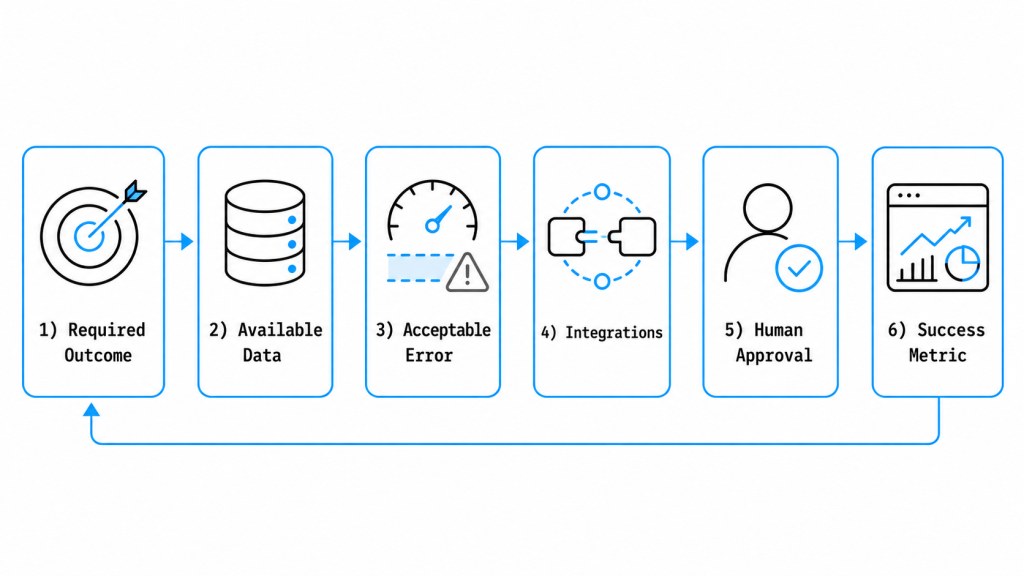
Before building, confirm that the system improves a measurable workflow, uses reliable data, can be evaluated consistently, has defined fallback behavior, and leaves accountability with a named person or team.
How Can AI, Generative AI, and Agentic AI Work Together?
The strongest systems often combine all three.
Consider a customer-retention workflow:
- Predictive AI identifies accounts with high churn probability.
- Generative AI summarizes account history and drafts an offer.
- Agentic AI checks eligibility, requests approval, sends the message, updates the CRM, and schedules follow-up.
- A human reviews exceptions and remains accountable for commercial decisions.
The same pattern can support customer service, sales, supply chains, and software engineering.
Practical implementation insight: In real AI projects, selecting the model is often easier than defining source-of-truth data, permissions, exception handling, and evaluation criteria. Design the complete workflow before deciding that an autonomous agent is necessary.
When the business only needs a reliable answer, autonomy adds unnecessary complexity. Use a scoped agent when the workflow genuinely requires coordination and tool use.
How Should Businesses Implement the Right Approach?
Start with one process that has clear inputs, outputs, users, and a baseline. Use rules for stable logic, predictive AI for forecasts, generative AI for unstructured content, and agents for adaptive action.
Define approval and escalation points. Measure accuracy, completion, review effort, adoption, cost, and business impact.
The NIST AI Risk Management Framework provides a structured reference for incorporating trustworthiness into AI design, deployment, and evaluation.
Conclusion
AI vs generative AI is not a choice between two equal categories. AI is broader. Generative AI specializes in creating and transforming information. Agentic AI extends AI into goal-directed planning and action.
Use predictive AI for forecasts and classifications, generative AI for content and knowledge work, and agentic AI for controlled multi-step execution. Many products combine them, but the architecture should follow the workflow rather than the latest terminology.
Start with a measurable problem, use the simplest suitable approach, and expand autonomy only when the expected value justifies the complexity.
Frequently Asked Questions
What is the main difference between AI and generative AI?
AI is the broad category of systems that perform intelligent tasks. Generative AI is a type of AI designed to create or transform text, images, audio, video, code, and summaries.
Is generative AI better than traditional AI?
Not universally. Generative AI is better for content and knowledge-based tasks. Traditional or predictive AI is often better for forecasts, classifications, recommendations, and anomaly detection.
What is the difference between agentic AI and generative AI?
Generative AI primarily creates or transforms content. Agentic AI can plan, use tools, take actions, observe results, and adapt its steps to achieve a goal.
Is agentic AI a type of generative AI?
Many current agentic systems use generative models for reasoning, language, and planning. Agentic AI is distinguished by goal-directed behavior and tool use rather than content generation alone.
Can generative AI and agentic AI work together?
Yes. A generative model can create an answer or plan, while an agentic layer uses tools and business systems to carry out approved actions.
Which type of AI should a small business start with?
Start with the simplest technology that solves a measurable problem. Many small businesses can begin with generative AI for support, document work, marketing, or internal search before investing in agentic automation.










 30 mins free Consulting
 11 min read
 Canada
 Hong Kong
 United States





 Love we get from the world