
 Lets Talk
TL;DR
- Most MVPs fail not because of missing features, but because users don’t trust them.
- MVP credibility comes from clarity, focus, and reliability—not feature quantity.
- A credibility-first MVP helps teams validate faster and avoid costly rework.
- Fewer, well-chosen features lead to better user feedback and learning.
- Structured MVP development makes it easier to build trust early and reduce risk.
Introduction
When building an MVP, many startups believe adding more features will make the product more appealing. The idea is to show everything the product could do. In reality, early users don’t look for completeness, they look for clarity and confidence. If an MVP feels confusing or unreliable, people hesitate to use it, no matter how many features it has.
This is where credibility becomes critical. A focused MVP built by an experienced MVP development team feels more trustworthy because it solves one clear problem well. That trust leads to better engagement, more useful feedback, and faster learning things that matter far more than a long feature list in the early stages.
What MVP Credibility Actually Means
MVP credibility is not about polished design or advanced features. It’s about whether users trust that the product understands their problem and can solve it reliably. A credible MVP has a clear value proposition, one focused user journey, and predictable behavior ideas commonly shared in a simple guide to building an MVP. When users feel this trust, they are more likely to use the product and share helpful feedback.
How the Credibility-First MVP Approach Works
- Start by building trust signals instead of listing features
- Validate the problem before investing in development
- Design the product for clarity and ease of use
- Build only the features needed to test core assumptions
- Use the MVP primarily as a learning and validation tool
Key Steps Teams Should Follow
- Clearly define one core user problem to solve
- Design a simple, believable solution for that problem
- Launch early to real users, not internal testers only
- Collect feedback from real usage and behavior
- Improve the product step by step based on insights
How a Credibility-First MVP Is Built
A credibility-first MVP is not built all at once. It follows a short, focused execution path designed to validate trust early.
Week 1: Problem & Trust Validation
Founders validate the core problem through user interviews, market signals, and early assumptions. Scope is intentionally limited to one primary use case.
Week 2: UX & Core Flow Design
The team designs one clear user journey that feels reliable and easy to understand. Trust signals such as clarity, consistency, and predictability are prioritized over feature depth.
Week 3–4: Lean Build & Early Testing
Only essential features are built and released to real users. Teams focus on observing behavior rather than opinions by using effective MVP testing strategies, such as early user testing, usage tracking, and feedback loops, to validate assumptions quickly.
Why MVP Credibility Is More Important Than Feature Count
Before users look at features, they first decide whether they trust the MVP. If the product doesn’t feel clear or reliable, they usually stop exploring and move on.
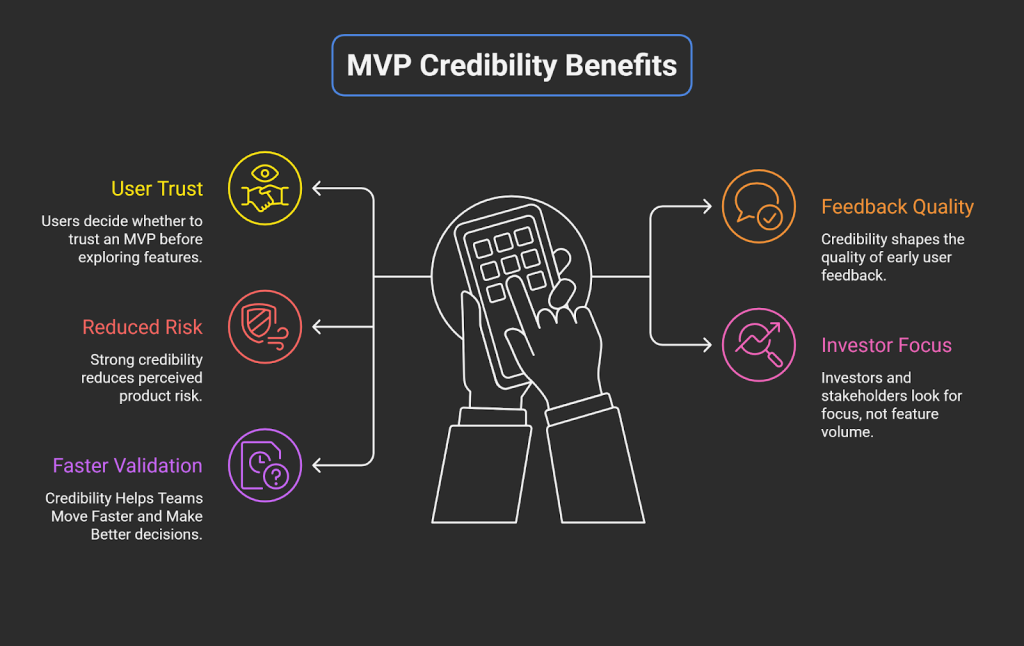
Users Decide Whether to Trust an MVP Before Exploring Features
Users form their first impression of an MVP very quickly. If the product feels confusing or unfinished, they lose confidence. Most users will not explore deeper features if the basic experience does not feel trustworthy. A clear and focused MVP encourages users to stay and try more. Trust is what opens the door to feature discovery.
Credibility Shapes the Quality of Early User Feedback
When users trust an MVP, they are more willing to share honest feedback. They tell you what works, what feels confusing, and what problems they face. This is one of the key benefits of building an MVP, because it helps teams learn from real users early. Without trust, feedback is often very limited or missing. Clear trust leads to better learning and better product decisions
Strong Credibility Reduces Perceived Product Risk
A credible MVP feels safe to use. Users do not worry as much about wasting their time or effort. This confidence encourages them to test the product properly and explore key flows. When risk feels low, engagement naturally increases. Credibility helps users take that first step.
Investors and Stakeholders Look for Focus, Not Feature Volume
Early-stage investors and stakeholders value clarity and focus. A focused MVP shows that the team understands the problem and has made smart decisions. Too many features can signal confusion or lack of direction. A clear MVP builds confidence in the team’s ability to execute. Focus often matters more than quantity.
Too Many Features Slow Validation and Learning
Adding too many features makes it hard to understand what users really want. Teams spend more time managing features instead of learning from real users, which is one of the common reasons MVPs fail early. Feedback becomes confusing because many things are tested at the same time. A smaller, focused MVP makes it easier to see what works. This helps teams move faster and make better decisions.
Credibility-First MVP vs Feature-Heavy MVP
| Aspect | Credibility-First MVP | Feature-Heavy MVP |
| Scope | Focused on one core problem | Broad and feature-packed |
| Time to Launch | Faster due to limited scope | Slower because of complexity |
| Development Cost | Lower and more controlled | Higher due to overbuilding |
| User Feedback | Clear and actionable | Mixed or unclear |
| Learning Speed | Faster validation and insights | Slower learning cycles |
| Rework Risk | Low, fewer rebuilds | High, frequent rebuilding |
| Decision Confidence | High, data-driven choices | Low, assumption-driven |
Execution Reality — Cost, Time, Resources, and Risk
Cost Implications
Credibility-first MVPs typically cost 20–40% less than feature-heavy MVPs because fewer features are built and less rework is required. More time is spent on UX and validation early, which reduces expensive changes later. Feature-heavy MVPs often appear cheaper at first but become costly due to rebuilds and maintenance.
Time to Market
Most credibility-first MVPs launch within 3–6 weeks, depending on scope and feedback cycles. Delays usually happen when discovery is rushed or decision-making is unclear. Feature-heavy MVPs often take months before learning begins.
Team and Skills Required
This approach works with small, focused teams.
- UX and product thinking are needed early
- Development stays lean and iterative
- Founders are typically involved a few hours per week, not full-time
Large teams are not required at this stage.
Risks and When This Approach Can Fail
Credibility-first MVPs can fail if teams skip validation, rely on assumptions, or avoid uncomfortable feedback. In markets where trust alone does not validate demand (for example, some marketplaces or hardware products), additional signals may be required. Discipline and honest learning are critical.
How to Decide If a Credibility-First MVP Is Right for You
This approach works best when trust and fast learning matter more than building many features.
Good fit if:
- Users need to trust the product early
- Feedback shapes what you build next
- Speed of learning matters more than polish
Not ideal if:
- Network effects are required early
- Validation needs large user volumes
- Full features are needed before launch
Who This MVP Approach Is Best For — And Who It’s Not
Best For
- Early-stage startups validating their idea
- B2B and SaaS founders testing a clear problem
- Non-technical founders with limited resources
- Pre-funding teams looking to reduce risk
- Early-funded startups that need fast learning
Not Ideal For
- Feature-heavy marketplaces needing many interactions
- Hardware-first MVPs requiring physical testing
- Late-stage products focused on scaling, not validation
- Teams with a fixed feature list that cannot change
- Products that already have strong market demand
Why Structured MVP Development Builds Credibility Faster
Many founders understand the idea of building a credibility-first MVP, but execution is where most teams struggle. Without structure, it’s easy to lose focus, add unnecessary features, or chase assumptions instead of real feedback. This often leads to confusion, delays, and weak validation.
A structured MVP development process helps teams stay focused on clear validation goals. It prevents scope creep, aligns design and development with user feedback, and reduces guesswork. As a result, teams learn faster, build trust with users earlier, and make better product decisions.
When an MVP Development Partner Helps Build Credibility Faster
- When founders are unsure how to properly validate their idea before investing in development
- When teams struggle to decide which features are essential and which can wait
- When building user trust through clear UX and flows is critical to early adoption
- When timelines are tight and delays could slow down learning or funding plans
- When technical choices feel risky and long-term impact is hard to predict
- When early user feedback needs to be quickly translated into product improvements
- When avoiding rework and wasted development effort is a top priority
Build an MVP Users Trust Early
Focus on credibility over features to validate faster, reduce risk, and build an MVP that earns real user trust and meaningful feedback from day one.

Conclusion
Building an MVP is not about adding as many features as possible. It’s about earning trust early by showing users that the product understands their problem and can solve it reliably. A credible MVP creates better engagement, clearer feedback, and faster learning, which are far more valuable than a long feature list at the early stage.
By focusing on credibility first, startups can reduce risk, control costs, and make smarter product decisions. Whether building in-house or with an MVP development partner, choosing a structured and trust-focused approach early increases the chances of building a product that users actually want.
FAQs
1. Can an MVP succeed with very few features?
Yes. An MVP only needs enough features to solve one clear problem. When users trust the product, even a small feature set can generate strong engagement and valuable feedback.
2. Is a credibility-first MVP cheaper than a feature-heavy MVP?
In most cases, yes. Building fewer, focused features reduces development time, rework, and maintenance costs, especially in the early stages.
3. How long does it take to build a credibility-first MVP?
Timelines vary, but credibility-first MVPs often launch faster because the scope is smaller. Many teams can release and start learning within weeks instead of months.
4. Can no-code MVPs still feel credible to users?
Yes, if they are designed clearly and solve a real problem. Credibility comes from focus and usability, not the technology used to build the MVP.
5. When should founders involve an MVP development partner?
Founders should consider a partner when validation feels unclear, timelines are tight, or mistakes would be costly. The right partner helps reduce risk and build trust faster.







 30 mins free Consulting
 10 min read
 Canada
 Hong Kong
 Global





 Love we get from the world