
 Lets Talk
TL;DR
- Investors want proof that people need your product, not more features.
- A nice demo is not enough investors want to know what users did.
- The best proof is when users come back and use it again.
- Keep your MVP small and focused on one main problem.
- Build smart, don’t overspend, and show clear progress each sprint.
Introduction
In 2026, the best way to impress investors is by showing real user engagement. A polished demo is great, but what truly matters is whether users find value in your product and keep coming back. Today’s MVPs make it easier than ever to learn quickly and focus on what really works.
Founders who succeed track meaningful actions, not just basic metrics like visits or signups. Seeing how users return, complete key tasks, or move toward paying provides clear proof that your product makes a difference. This insight helps teams grow confidently and make smarter decisions.
Using a guided MVP development process helps turn these insights into results. By improving the product in small, focused stages and measuring real impact, founders can show steady progress, build momentum, and inspire investor confidence at every step.
7 Core Investor Expectations From MVPs
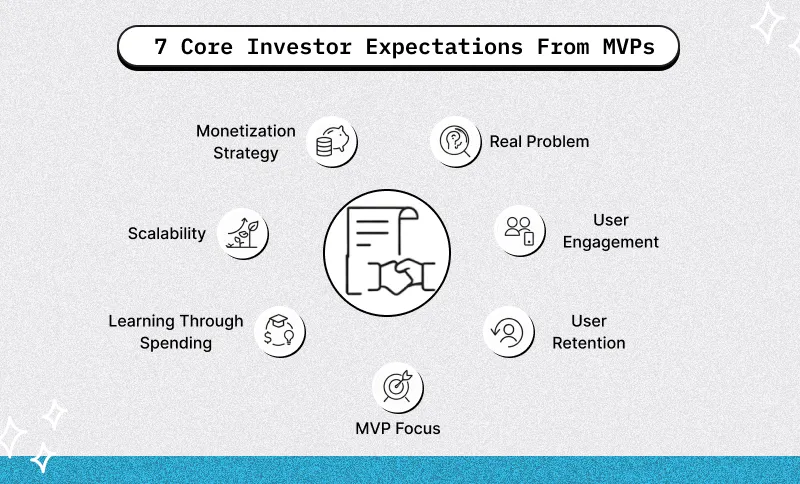
Use this as a simple checklist. If you can’t show clear proof for each point, investors will see more risk and slow down. Many founders struggle here because they repeat the same mistakes startups make when building an MVP, like adding features before proving real user behavior.
1. The Problem Must Be Real
Investors want to know you are solving a real, common problem not a “maybe” problem. They expect you to show that real people face this pain often and it causes time loss, money loss, or frustration. You can prove this with repeated user interviews, repeated complaints, or clear examples of people using workarounds today. If the problem looks small or rare, investors assume the market will be small too.
2. Real Users Must Actually Use the MVP
It’s not enough to say users liked your idea. Investors want to see real users trying the MVP and using it in a real situation. They look at what users do—what they complete, where they stop, and if they come back again. Strong validation comes from simple MVP testing strategies that track real user behavior and help you improve the product based on evidence.
3. Users Should Come Back
Early traction doesn’t need to be large, but it should be consistent. Investors look for users who return to the MVP, rather than trying it once and disappearing. Retention, repeat usage, and conversion trends provide more insight than page views or downloads. Even a small group of consistent users can be meaningful. Tracking this behavior is essential because user feedback is important for identifying how the product is actually being used.
4. The MVP Should Stay Small and Focused
Investors trust founders who can keep the MVP simple. They want to see that you built only what was needed to test the main problem, not many extra features. A focused MVP shows good judgment and protects your budget. It also makes your results easier to measure and explain.
5. Spending Should Create Learning
Investors don’t only ask, “How much did you spend?” They ask, “What did you learn from that spend?” They want to see that each sprint led to a clear result like better onboarding, higher retention, or clearer demand. Long build cycles with little feedback look risky because they waste the runway. When the cost to build an MVP is kept tight and each sprint proves something new, investors see smart execution instead of waste.
6. The Product Should Not Break When It Grows
Your MVP does not need perfect engineering, but it must be stable. Investors want to avoid funding something that will need a full rebuild right after the round. They look for clean core flows, basic security, and sensible technical choices that support growth. If you can explain your tech decisions in simple terms, investor confidence goes up.
7. You Need a Simple Way to Make Money
Even if you don’t have revenue yet, investors want to see a clear money plan. They expect a simple pricing idea and a believable path to earning revenue. It helps to show early signals like paid pilots, LOIs, trial-to-paid conversions, or strong willingness-to-pay feedback. A clear monetization plan makes your MVP look like a business, not just a project.
Quick Investor-Readiness Checklist (Founder Focus)
Use this quick list before investor calls. If you can’t answer “yes” to most of these, your MVP still needs stronger proof.
- Can you clearly say the one problem your MVP solves (in one sentence)?
- Can you show real user behavior (what users did, not just a demo)?
- Are users coming back (repeat usage/retention is improving)?
- Can you explain your top 3 metrics (activation, retention, conversion) and what changed recently?
- Do you have a clear next 90-day plan (what you will prove next and how)?
Working with the right MVP Development Partner can make your path to investor readiness faster and clearer. They bring guidance, experience, and practical support to help your MVP shine.
Conclusion
A polished MVP alone is not enough to impress investors today. What matters most is clear evidence that users find real value in your product and keep coming back. An MVP with too many features but no measurable results can seem risky and unfocused.
Successful founders focus on solving one core problem at a time. They track important numbers like how often users return and how many take desired actions. This helps show that the product is truly meeting user needs.
By improving the product step by step based on real feedback, progress becomes easy to see. When your next moves are clear and backed by data, investors are more likely to have confidence in your vision.
FAQs
1. What are the key elements investors look for in an MVP?
Investors look for a real problem, real users using the MVP, and users coming back. They also want focused scope, smart spending, and a clear path to revenue. A stable product and a simple roadmap help build trust.
2. How do investors evaluate the “minimum” aspect of an MVP?
They check if you built only what’s needed to test the core problem. The MVP should work well, but avoid extra features. Investors like founders who can explain what they didn’t build yet and why.
3. How do investors assess market validation through an MVP?
They look at user behavior, not just feedback. Are users completing key actions, returning, and getting value? They also want to see what you learned and what you changed based on real usage.
4. What kind of data and metrics do investors expect an MVP to demonstrate?
They expect activation, retention, repeat usage, and conversion. Trend direction matters more than big numbers. Traffic and downloads matter less if users don’t stick.
5. Why do investors prioritize scalability potential in an MVP?
Investors want to avoid funding a product that will break as it grows. They look for basic stability and a plan to scale without a full rebuild. This reduces risk and makes growth more believable.









 30 mins free Consulting
 10 min read


 Canada
 Hong Kong
 Global





 Love we get from the world