
 Lets Talk
TL;DR
- An MVP development team builds the first basic version of your product.
- The right team helps you launch faster and test your idea with real users.
- A small MVP team often includes a product owner, designer, developers, and QA support.
- You can hire an in-house team, freelancers, or a dedicated development team.
- To hire the right team, keep your MVP simple and choose people with the right experience.
Introduction
Creating an MVP is not just about building a product. It is also about having the right team to build it. Many startups face delays or problems because they choose the wrong team size or miss important roles. When the right people work together, it becomes easier to build faster, stay focused, and launch a product that solves a real problem.
An MVP development team includes the people who plan, design, build, and test the first version of your product. This team helps you keep the product simple, avoid extra features, and learn from real users early. It also helps founders gain a better understanding of MVP in business, because the goal is not only to build something quickly, but to test whether the product solves a real need. In this blog, you will learn what roles are needed in an MVP team, how to choose the right team structure, and how to hire the right people for your startup.
What Is an MVP Development Team?
An MVP development team is the group of people who build the first simple version of a product. This version includes only the main features needed to solve a real problem and test the idea with early users. The goal is not to build a full product at the start, but to launch something useful quickly and learn what users really need.
This team is usually small and focused. It may include a product owner, designer, developers, and QA support. In some startups, one person may handle more than one role. Some startups build this team in-house, while others work with an MVP development company to get the right skills and support. The right team helps keep the project clear, avoid extra features, and move from idea to launch faster.
Why the Right MVP Team Structure Matters
The right MVP team structure helps a startup work faster, stay focused, and make better product decisions. A good team setup makes it easier to plan, build, test, and launch the product without too much confusion. It also helps everyone stay aligned on the main goal of the MVP.
Faster Product Validation
The main goal of an MVP is to test the product idea as early as possible. When the team structure is clear, work moves faster and the product can reach users sooner. This helps startups collect real feedback early and understand if the idea solves a real problem.
Reduced Development Risk
A well-structured MVP team helps reduce mistakes during development. The right people can spot problems early, make better decisions, and avoid wasting time on the wrong features. This lowers the risk of spending too much money and effort on something users may not need.
Faster Time-to-Market
A clear team structure helps the product move from idea to launch more quickly. Each team member knows their role and what they need to do. This improves workflow and helps startups release the MVP faster without unnecessary delays.
Focus on Core Features
Many startups make the mistake of adding too many features to the first version. A good MVP team structure helps keep the product simple and focused on the main problem. This makes it easier to build, launch, and test the most important features first.
Ideal MVP Development Team Structure
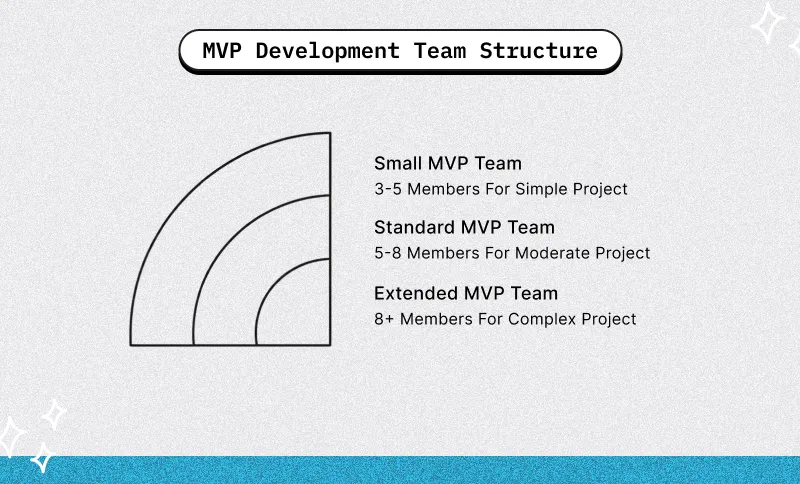
There is no one team structure that fits every startup. The right MVP team depends on your product, budget, timeline, and goals. Some startups can build an MVP with a small team, while others need more people because the product is more complex. This is common in SaaS MVP development, where the product often needs regular updates, user feedback, and room to grow over time.
Small MVP Team (3–5 Members)
A small MVP team is a good choice for startups that want to test a simple idea quickly and with a lower budget. This type of team usually focuses only on the most important work needed to launch the first version of the product.
A small team often includes a founder or product owner, a designer on a part-time basis, one full-stack developer or two developers, and basic QA support. In this setup, some team members may handle more than one role. This structure works well when the goal is to move fast and keep costs under control.
Standard MVP Team (5–8 Members)
A standard MVP team is better for startups that need a more balanced setup. It gives enough support for design, development, testing, and project coordination without making the team too large.
This team often includes a product owner, project manager, UI/UX designer, frontend developer, backend developer, and QA engineer. It is a strong option for startups that want to build a polished MVP for real users while still keeping the team lean.
Extended MVP Team (8+ Members)
An extended MVP team is usually needed when the product is more advanced. This can include SaaS products, mobile apps, AI tools, or platforms with more technical needs such as security, cloud infrastructure, or large amounts of data.
This type of team may include all core roles, along with extra specialists like a DevOps engineer, business analyst, or AI specialist. It gives the startup more expertise, but it also increases the cost. That is why startups should only choose a larger team when the product really needs it.
Core Roles in an MVP Development Team
Every MVP team needs a few important roles to turn an idea into a real product. These roles help the startup plan the product, design the user experience, build the main features, and test everything before launch.
Product Owner
The Product Owner decides what the MVP should do and what should be built first. This person keeps the team focused on the main goal, user needs, and business priorities. In many startups, the founder takes this role because they understand the product idea best.
Project Manager / Scrum Master
The Project Manager or Scrum Master helps the team stay organized and on schedule. This person manages the workflow, supports communication, and solves problems that may slow the team down. In a small MVP team, this role may be handled by the founder or development partner.
UI/UX Designer
The UI/UX Designer makes the MVP easy to use and simple to understand. This role focuses on user flows, layout, and overall product experience. Good UX design for an MVP is important because it helps users move through the product more easily and understand its value from the start.
Frontend Developer
The Frontend Developer builds the part of the product that users see and use. This includes pages, buttons, forms, and other screen elements. Their work helps make the product feel smooth, clear, and responsive.
Backend Developer
The Backend Developer builds the technical part behind the product. This includes the server, database, APIs, and core system logic. This role makes sure the product works properly and supports the features users need.
Quality Assurance Engineer
The Quality Assurance Engineer checks the product for bugs, broken flows, and other issues before users see it. This role helps improve product quality and reliability. Even a simple MVP should work well enough to give users a good first experience.
Optional Roles Based on Product Complexity
Not every MVP needs a large team. Some roles are only needed when the product is more complex or has special technical needs.
DevOps Engineer
A DevOps Engineer helps with deployment, cloud setup, system performance, and infrastructure. This role is useful when the MVP needs better security, smooth releases, or the ability to handle more users from the start. For simple MVPs, these tasks are often managed by a senior developer.
Business Analyst
A Business Analyst helps turn business goals into clear product requirements. This role can be helpful when the product has complex workflows, many stakeholders, or industry-specific processes. In smaller MVP projects, the founder or Product Owner often handles this work.
Data Engineer / AI Specialist
A Data Engineer or AI Specialist is needed when the MVP includes AI features, machine learning, automation, recommendation systems, or advanced data workflows. This role is not needed for most basic MVPs. It should only be added when data or AI is a core part of the product.
How Much Does an MVP Development Team Cost?
The cost of an MVP development team depends on the type of product, the number of people on the team, and the hiring model you choose. A small and simple MVP usually costs less, while a larger or more advanced product costs more. Checking an MVP cost breakdown can help you see where the money goes and what changes the total cost.
Average Hourly Rates of MVP Developers
Hourly rates are different for each team type. Freelancers usually cost less, agencies or dedicated teams cost more, and in-house teams often cost the most because they include salaries and other company costs. But the total cost also depends on how well the team works and how smoothly the project is managed.
Freelancers vs Agencies vs In-House Teams
Freelancers are often the cheaper option, so they can be good for startups with a small budget. Agencies or dedicated teams usually cost more, but they also offer better support, project management, and testing. In-house teams give you more control, but they usually take more time and money to build.
Example MVP Development Cost Breakdown
A simple MVP may need a product owner, designer, two developers, and QA support for around 2 to 3 months. The total cost can be low or high depending on who you hire and where they are based. The most important thing is not to choose only by price. A team that works well can save you more time and money overall.
Hiring Models for MVP Development Teams
There are three common ways to build an MVP team. Each option has its own benefits and challenges, so the right choice depends on your budget, timeline, and how much control you want. Many startups compare outsourced and in-house MVP development before making a decision, because each model offers a different balance of cost, speed, flexibility, and support.
In-House Development Team
An in-house team means you hire people as part of your own company. This gives you more control and helps the team stay closely connected to your business goals. It can be a good choice if you want direct involvement in daily work and plan to build your product over the long term. But it usually takes more time and money because hiring, salaries, and team management can be expensive.
Freelance Developers
Freelancers can be a good option for simple MVP projects, especially when you want to start quickly and keep costs lower. They also give you flexibility to hire only for the work you need. But if you hire different freelancers for different roles, managing the work can become harder and communication problems may happen.
Dedicated Development Team
A dedicated development team is usually hired through an agency or development partner. This is one of the most common forms of outsourced MVP development, because it gives startups access to a ready-made team that already knows how to work together. It is often a good middle option because it gives more support and structure than freelancers, without the time and cost of building a full in-house team.
How to Hire the Right MVP Development Team
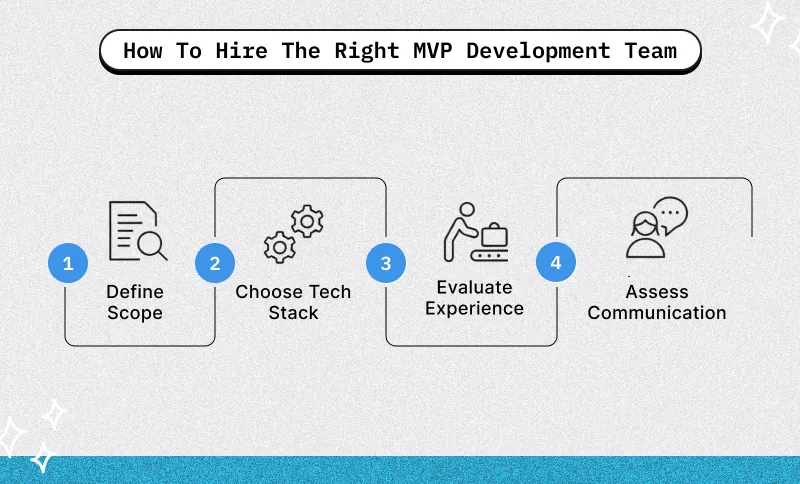
Hiring the right MVP team is important for any startup. You need a team that can build fast, keep the product simple, and focus on the main features first. A good team should also understand the MVP development process so they can build, test, and improve the product step by step.
Define Your MVP Scope and Core Features
Before you hire a team, be clear about what your MVP should do. Know the main problem you want to solve, who the product is for, and which features are truly necessary. This helps the team understand your goals and stops the project from becoming too big too early.
Choose the Right Tech Stack
The tech stack should fit your product goals. In many cases, a simple setup is better for an MVP because it helps the team build faster and make changes more easily. Do not choose technology only because it is popular. Choose it based on what your product really needs.
Evaluate MVP Development Experience
Try to hire people who have already worked on MVPs or early-stage startup products. They usually understand how to move fast, work with changing requirements, and focus on validation. If you want to choose the best MVP development company, look for a team that has real experience building simple, testable products for startups. A team with only large enterprise experience may not be the best fit for a startup MVP.
Assess Communication and Collaboration
Good communication is just as important as technical skill. The right team should ask clear questions, explain their ideas well, and keep you updated during the project. Poor communication can lead to confusion, delays, and extra work.
Start With a Small Pilot Project
It is often smart to begin with a small test project before giving the team the full MVP. This could be a short discovery phase, a simple prototype, or one small feature. It helps you see how the team works, communicates, and solves problems before you make a bigger commitment.
Common Mistakes When Building an MVP Team
Many startups make simple mistakes when building their first MVP team. These mistakes can waste time, increase costs, and make the product harder to launch successfully.
Hiring Too Many Developers Too Early
Many founders think a bigger team will build faster, but that is not always true. When too many people join too early, communication becomes harder and costs go up. It is usually better to start with a small team and grow only when needed.
Ignoring UX Design
Some startups focus only on development and forget about design. This can make the product confusing for users and reduce the value of early feedback. Even a simple MVP should be easy to use and understand.
Building Too Many Features
A common mistake is trying to add too many features in the first version. This makes the product take longer to build and harder to test. An MVP should focus only on the most important features needed to solve the main problem.
Poor Communication and Project Management
Even a skilled team can struggle without clear communication and planning. If roles, priorities, and timelines are not clear, the project can slow down and quality may suffer. That is why good teamwork and proper project management are so important.
These are only a few examples, and many other MVP development mistakes can slow down progress or increase costs during the first build.
Best Practices for Managing an MVP Development Team
After your MVP team is ready, good management helps the project move in the right direction. It keeps the team focused, improves teamwork, and helps the product grow step by step.
Follow Agile Development
Agile is a good way to manage MVP development because it allows the team to build step by step. Instead of planning everything in detail from the start, the team can create, test, and improve the product as they go. This makes it easier to adapt when new feedback comes in.
Use Short Sprint Cycles
Short sprint cycles help the team stay focused on small goals. These sprints are often one or two weeks long and make it easier to review progress regularly. They also help the team fix problems early and make changes without slowing down the whole project.
Collect Early User Feedback
The main purpose of an MVP is to learn from real users. That is why startups should collect user feedback during MVP development as early as possible. This helps the team understand what users like, what problems they face, and what should be improved next. It is also important to test your MVP with real users so you can see how they use the product in real situations.
Continuously Iterate the Product
An MVP is only the first version of the product. After launch, the team should keep improving it based on feedback, user behavior, and business goals. Small updates over time often work better than trying to build everything at once.
Conclusion
Building a successful MVP is not only about having a good idea. It is also about having the right team to turn that idea into a real product. A strong MVP development team helps you focus on the main features, launch faster, avoid mistakes, and learn from real users early.
For most startups, it is best to start with a small team and add more people only when needed. The right team can help you build a simple product, test your idea, and improve it step by step.
FAQs
1. What is the minimum team required to build an MVP?
A small MVP can often be built by 2 to 4 people. This may include a founder, one developer, a designer, and QA support. For a very simple product, even a founder and one full-stack developer can be enough.
2. What are the roles on an MVP development team?
An MVP team usually includes a Product Owner, designer, developers, and QA support. Some startups may also need a Project Manager. Bigger or more complex products may need extra roles like DevOps or a Business Analyst.
3. How much does an MVP development team cost?
The cost depends on the team size, product complexity, and hiring model. A small MVP with freelancers may cost less, while an agency or in-house team may cost more. The final cost also depends on how well the project is planned.
4. How to hire a dedicated MVP development team?
Start by defining your MVP goals, main features, and budget. Then look for a team with startup or MVP experience. It is also smart to check their communication, past work, and how they manage projects.
5. Can one developer build an MVP?
Yes, one developer can build an MVP if the product is simple. This works best when the feature list is small and the founder gives clear direction. But in many cases, a small team gives better design, testing, and faster progress.







 30 mins free Consulting
 10 min read
 Canada
 Hong Kong
 Global





 Love we get from the world