

 Lets Talk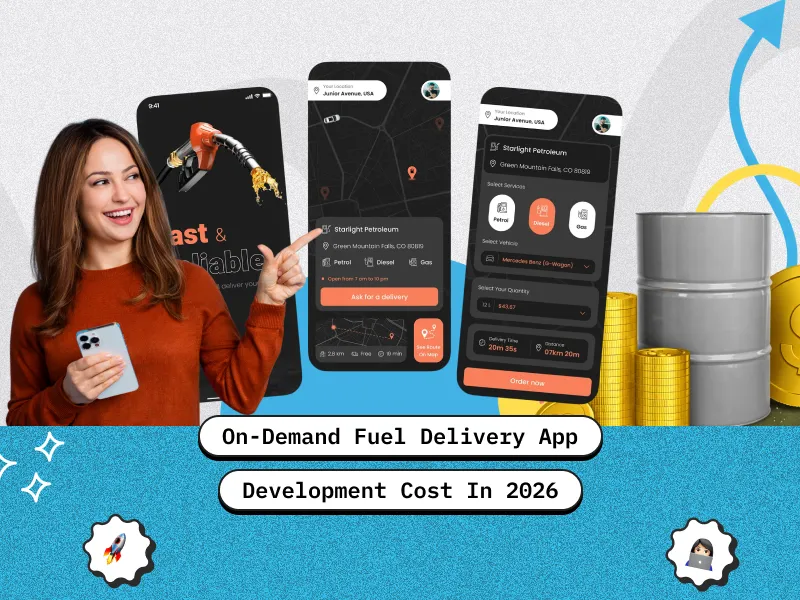
TL;DR
- Fuel delivery app development mainly depends on the features and overall complexity of the app.
- Simple apps can be launched quickly, while advanced apps need more planning and scalability.
- Regular maintenance, hosting, and third-party services are important for smooth operation.
- Platform choice, design, integrations, and development team location all affect the process.
- Starting with an MVP and using cross-platform development helps save time and resources.
Introduction
The demand for on-demand services continues to rise, and fuel delivery apps are emerging as a convenient and scalable solution for both consumers and businesses. From doorstep fuel delivery to fleet management, these apps are reshaping how fuel is accessed and distributed. Partnering with an experienced mobile app development company can help businesses build scalable, secure, and compliant solutions that meet growing market demands.
However, building a fuel delivery app involves multiple cost factors, including development complexity, features, technology stack, and compliance requirements. Whether you’re a startup validating an idea or an enterprise planning a scalable platform, understanding the development cost is crucial.
In this guide, we break down the fuel delivery app development cost in 2026, including detailed pricing, cost factors, hidden expenses, and strategies to optimize your budget.
Global Market for Fuel Delivery Systems
Market Growth and Trends
The fuel delivery market is growing rapidly due to:
- Rising demand for on-demand services
- Expansion of fleet and logistics industries
- Increased adoption of mobile-first solutions
- Growth in smart city infrastructure
According to recent industry insights, the on-demand fuel delivery market size and growth trends show that the market was valued at around $3.5 billion in 2023 and is projected to reach $12.7 billion by 2032, growing at a CAGR of 15.4%.
Additionally, reports on the mobile fuel delivery market forecast and analysis indicate steady expansion, with the market expected to nearly double over the next decade due to increasing adoption across both B2C and B2B segments.
Impact on App Development
As the market grows:
- Competition increases, leading to higher feature expectations
- Regulatory requirements become stricter, increasing compliance efforts
- Scalability becomes essential, requiring stronger infrastructure
This growth directly influences development decisions, as companies must focus on performance, security, and user experience to stay competitive.
Estimated Cost Breakdown for Fuel Delivery App Development
These cost ranges can vary significantly depending on project requirements, as mobile app development costs often depend on features, platform choice, and scalability needs.
Cost Based on App Complexity
| App Type | Features Included | Estimated Cost | Timeline |
| Basic App | Single platform, login/signup, fuel ordering, basic tracking, payment integration | $25,000 – $50,000 | 2 – 4 months |
| Mid-Level App | Cross-platform, real-time tracking, notifications, multiple payments, admin panel | $40,000 – $80,000 | 4 – 6 months |
| Advanced App | AI features, route optimization, analytics, scalable backend, IoT integration | $60,000 – $120,000+ | 6 – 9 months |
Explanation of Cost Breakdown
- Basic App
Ideal for startups launching an MVP. Focuses only on essential features to validate the idea quickly and cost-effectively. - Mid-Level App
Suitable for growing businesses that need better user experience, multi-platform support, and operational efficiency. - Advanced App
Built for enterprises aiming for scalability, automation, and data-driven decision-making with AI and analytics.
Ongoing Costs
| Cost Component | Description | Estimated Cost |
| Maintenance & Updates | Bug fixes, upgrades, and performance optimization | 15% – 20% annually |
| Server & Hosting | Cloud infrastructure (AWS, Azure, GCP) | $500 – $5,000/month |
| Third-Party Services | APIs (Maps, Payment, SMS, Notifications) | $100 – $2,000/month |
Explanation of Ongoing Costs
- Maintenance & Updates
Regular updates keep the app secure, bug-free, and compatible with new OS versions, while also improving performance and adding necessary enhancements. - Server & Hosting
Costs depend on user traffic, storage, and real-time tracking needs. As the app grows, scalable cloud infrastructure is required to maintain performance and reliability. - Third-Party Services
Includes recurring charges for APIs like Google Maps, payment gateways, and communication tools. These costs can increase over time, especially in apps that rely on real-time services similar to typical on-demand app development cost structures.
Factors Affecting Fuel Delivery App Development Cost
App Complexity and Features
The overall complexity of your app plays the biggest role in determining development cost, as key cost factors typically include feature depth, integrations, and scalability requirements. A basic app with limited features is much more affordable compared to a feature-rich platform.
Adding advanced functionalities such as:
- AI-based demand prediction
- Real-time route optimization
- Smart scheduling and automation
- Advanced analytics dashboards
can significantly increase both development time and cost. The more sophisticated the features, the higher the investment required.
Platform Selection
Choosing the right platform directly impacts both cost and performance.
- Single Platform (iOS or Android): Lower development cost and faster launch
- Cross-Platform (Flutter, React Native): Balanced cost with wider audience reach
- Native Apps (Separate iOS + Android): performance but higher development cost
For startups, cross-platform development is often the most cost-efficient choice.
UI/UX Design
User experience plays a critical role in the success of a fuel delivery app.
- Basic UI Design: Uses standard templates, lower cost
- Custom UI/UX Design: Includes animations, micro-interactions, and branding
A premium UI/UX can increase development cost by 20–30%, but it also improves user engagement and retention.
Technology Stack
The choice of technologies affects both scalability and long-term costs, as cloud app development costs often depend on infrastructure, integrations, and scalability requirements.
Popular tech stacks include:
- Frontend: React Native, Flutter
- Backend: Node.js, Python, Ruby on Rails
- Database: MongoDB, PostgreSQL
A modern and scalable tech stack may have a slightly higher upfront cost, but it reduces future maintenance and scaling expenses.
Development Team Location
The cost of development varies significantly by region.
| Region | Hourly Rate |
| USA/Canada | $80 – $150 |
| Europe | $50 – $100 |
| India | $20 – $50 |
Outsourcing to cost-effective regions like India can reduce overall development costs by 40–60% without compromising quality when working with experienced teams.
Third-Party Integrations
Fuel delivery apps rely heavily on external services to function efficiently.
Common integrations include:
- Payment gateways (Stripe, Razorpay, PayPal)
- Maps and navigation (Google Maps API)
- SMS and push notifications (Twilio, Firebase)
These services often come with subscription fees or usage-based pricing, which adds to both initial and ongoing costs.
Compliance and Security
Fuel delivery apps must follow strict regulations due to the nature of the industry.
This includes:
- Local fuel transportation and storage laws
- Safety and hazard compliance standards
- Secure payment processing (PCI-DSS)
- Data protection regulations
Ensuring compliance requires additional development effort, legal consultation, and security implementation, which increases the overall cost.
Must-Have Features and Their Cost Impact
Feature Breakdown Table
| Feature Category | Key Features | Cost Impact |
| User Panel | Registration & login, fuel type selection, real-time tracking, secure payments | Medium |
| Driver Panel | Route optimization, delivery status updates, and earnings dashboard | Medium to High |
| Admin Panel | User & driver management, order tracking, analytics dashboard | High (backend-heavy) |
| Advanced Features | AI-based demand prediction, IoT integration, subscription models, voice ordering | High (adds scalability & ROI) |
Explanation of Feature Costs
User Panel Features
The user panel is the core interface where customers interact with your app.
It typically includes:
- Easy registration and login
- Fuel selection based on type and quantity
- Real-time delivery tracking
- Secure and seamless payment options
Cost Impact: Medium
These are essential features and form the foundation of your app.
Driver Panel Features
The driver panel ensures smooth delivery operations and logistics management.
Key functionalities:
- Route optimization for faster deliveries
- Live order updates and status tracking
- Earnings and performance dashboard
Cost Impact: Medium to High
Costs increase due to real-time tracking and logistics optimization features.
Admin Panel Features
The admin panel is the backbone of the entire system, controlling all operations.
Includes:
- Managing users and drivers
- Monitoring orders and deliveries
- Access to analytics and performance insights
Cost Impact: High
This requires strong backend development, database management, and reporting systems.
Advanced Features (Optional Cost Additions)
These features are not mandatory initially, but can significantly enhance your app’s value.
Examples:
- AI-based fuel demand prediction
- IoT integration for real-time fuel monitoring
- Subscription and membership models
- Voice-enabled ordering systems
Cost Impact: High
While these increase development cost, they also improve automation, scalability, and long-term ROI.
Hidden Costs in Fuel Delivery App Development
Even with a well-planned budget, several hidden costs can impact your overall investment. These costs are often overlooked but play a crucial role in long-term success.
1. Cloud Hosting and Infrastructure
As your app grows, so does the need for scalable infrastructure, and many software development cost challenges arise when planning for long-term scalability and performance.
- Server scaling to handle traffic spikes
- Data storage and backups
- CDN for faster performance
Cost Impact: Medium to High
Costs increase gradually as your user base expands.
2. API and Integration Costs
Fuel delivery apps depend heavily on third-party services.
- Google Maps API for navigation
- Payment gateway transaction fees
- SMS and email notification services
Cost Impact: Medium
Most APIs follow a pay-as-you-use model, so expenses grow with usage.
3. App Store and Licensing Fees
These are fixed but necessary costs to launch your app.
- Apple App Store: $99/year
- Google Play Store: $25 (one-time)
Cost Impact: Low
Minimal compared to development, but mandatory for publishing.
4. Marketing and User Acquisition
Building the app is only half the job—acquiring users is equally important.
- Paid advertising campaigns
- SEO and content marketing
- App Store Optimization (ASO)
Cost Impact: High
This is often the most underestimated expense, yet critical for growth.
How to Reduce Fuel Delivery App Development Cost
Reducing development cost is not about cutting corners—it’s about making smarter decisions during planning and execution.
- Start with an MVP (Minimum Viable Product)
Focus on core features required to launch and test your idea in the market. This helps validate demand before investing in advanced functionalities. - Choose Cross-Platform Development
Use frameworks such as Flutter or React Native to build a single app for iOS and Android.
Benefit: Reduces development cost by 30–40% and speeds up time-to-market. - Outsource Strategically
Hire experienced teams from cost-effective regions such as India or Eastern Europe to lower development expenses without compromising quality. - Prioritize Essential Features
Avoid adding too many features in the initial phase. Start simple, gather user feedback, and scale gradually.
ROI and Profit Potential of Fuel Delivery App Development
Fuel delivery apps offer multiple monetization opportunities and strong long-term growth potential.
Revenue Opportunities
You can generate revenue through:
- Delivery or convenience charges
- Subscription or membership plans
- Commission from fuel providers
- B2B services for fleet and logistics companies
Growth and Scalability
As your platform grows, you can expand into:
- EV charging and energy delivery solutions
- Fleet management platforms
- Logistics and route optimization services
Estimate Your App Development Cost Instantly
Get a clear idea of your project budget based on features, platform, and scalability. Plan smarter and avoid unexpected costs with a quick, tailored estimate.

Conclusion
Fuel delivery app development in 2026 offers strong business potential, but the total cost depends heavily on your app’s complexity, features, and scalability goals. While basic apps can be launched with a moderate budget, advanced solutions require higher investment due to integrations, automation, and compliance needs.
By adopting a strategic approach, such as building an MVP, choosing the right technology, and optimizing features, you can effectively control costs while preparing for long-term growth. If you’re planning your project, using a software development cost calculator can help you estimate your budget more accurately based on your specific requirements. With the right execution, a fuel delivery app can become a scalable and profitable digital product.
FAQs
How much does it cost to develop a fuel delivery app?
Fuel delivery app development typically costs between $25,000 and $120,000+. The final cost depends on app complexity, features, and platform selection.
How much does it cost to fully develop an app?
A fully developed app can cost anywhere from $20,000 to $150,000+. Pricing varies based on features, design quality, and development team location.
How much would it cost to make an app like DoorDash?
An app like DoorDash may cost $80,000 to $200,000+. It requires multiple panels, real-time tracking, and advanced logistics features.
What’s the average cost of developing an app?
The average app development cost ranges between $40,000 and $100,000. This depends on complexity, platform, and scalability requirements.
How long does it take to develop a fuel delivery app?
It usually takes 3 to 9 months to develop a fuel delivery app, depending on features, complexity, and development approach.
What features are essential in a fuel delivery app?
Key features include fuel ordering, real-time tracking, secure payments, driver management, and an admin dashboard.
Can I reduce the fuel delivery app development cost?
Yes, you can reduce costs by building an MVP, using cross-platform development, and outsourcing to cost-effective regions.
Is fuel delivery app development a profitable business?
Yes, with multiple revenue models like delivery fees, subscriptions, and B2B services, fuel delivery apps offer strong long-term ROI.







 30 mins free Consulting
 12 min read

 Singapore
 USA
USA 
 Finland





 Love we get from the world