
 Lets Talk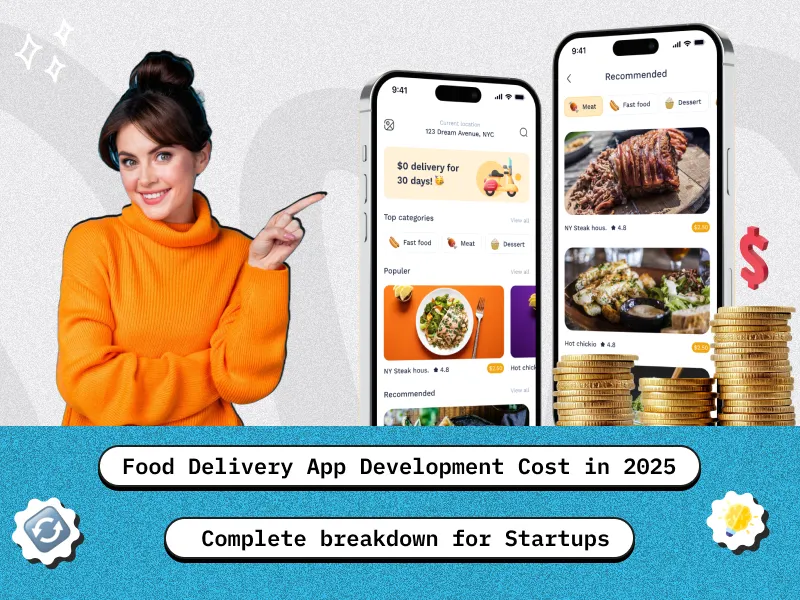
The food delivery app development cost typically ranges from $10,000 to $200,000+. A focused restaurant-ordering app may cost $10,000–$25,000, while a lean delivery MVP generally requires $20,000–$40,000. A scalable marketplace with restaurant onboarding, driver tracking, payouts and logistics automation may cost $90,000–$200,000+. Your final budget depends on the business model, feature scope, platforms, integrations and expected scale.
TL;DR
- A single-restaurant ordering app typically costs $10,000–$25,000.
- A lean food delivery MVP usually costs $20,000–$40,000.
- A multi-restaurant delivery marketplace generally costs $40,000–$90,000.
- An advanced delivery platform with logistics automation may cost $90,000–$200,000+.
- A meal-kit subscription app similar to HelloFresh generally costs $25,000–$70,000, with advanced versions exceeding $70,000.
- The most practical way to control the initial investment is to launch with essential workflows, a defined service area and a staged feature roadmap.
How Much Does Food Delivery App Development Cost in 2026?
The cost to build a food delivery app depends primarily on the type of product you want to launch.
A single-restaurant ordering app may only require a customer-facing mobile app, online payments and an admin dashboard. A multi-vendor marketplace needs restaurant onboarding, driver allocation, commission logic, real-time delivery tracking and multiple operational interfaces. A meal-kit subscription app similar to HelloFresh requires recurring payments, meal selection, dietary preferences and scheduled deliveries.
Use the following ranges as an initial planning benchmark:
| Food Delivery App Type | Typical Scope | Estimated Development Cost |
| Single-restaurant ordering app | Ordering, checkout, payments and basic admin controls | $10,000–$25,000 |
| Lean food delivery MVP | Customer journey, restaurant dashboard and basic order tracking | $20,000–$40,000 |
| Meal-kit subscription app | Weekly meals, subscriptions, recipes and delivery scheduling | $25,000–$70,000 |
| Multi-restaurant marketplace | Customer, restaurant, rider and admin workflows | $40,000–$90,000 |
| Advanced delivery platform | Multi-city operations, analytics and logistics automation | $90,000–$200,000+ |
These are indicative estimates. The actual investment depends on your product requirements, operating model and technical architecture.
Need a project-specific estimate?
Use our software development cost calculator to estimate your budget based on product type, complexity, platforms and development scope.
An Illustrative MVP Cost Example
Consider a startup launching a food delivery service in one city with a limited group of restaurant partners.
Instead of building a feature-heavy marketplace immediately, the first release could focus on:
- Customer registration and saved addresses
- Restaurant and menu listings
- Cart, checkout and online payments
- Restaurant order acceptance
- Basic rider assignment
- Order status notifications
- Admin visibility into users, orders and restaurant activity
Advanced features such as route optimization, loyalty points, subscriptions and AI-based recommendations can be added after validating customer demand and operational feasibility.
This approach helps the team learn from real orders before investing in complex automation.
Which Food Delivery App Business Model Are You Building?
Before estimating costs, define your business model. This decision influences the number of applications, operational workflows, third-party integrations and backend requirements.
| Business Model | Best Suited For | Key Capabilities | Cost Complexity |
| Single-restaurant ordering app | Restaurants and cloud kitchens | Menu browsing, checkout, payments and pickup or delivery status | Low |
| Multi-restaurant marketplace | Regional delivery platforms | Restaurant listings, rider workflows, commissions and payouts | Medium to high |
| Logistics-heavy delivery platform | High-volume or multi-location businesses | Order batching, rider allocation, service zones and route optimization | High |
| Meal-kit subscription app | Subscription-based food brands | Meal plans, recurring billing, recipe content and scheduled deliveries | Medium to high |
Single-Restaurant Ordering App
A restaurant ordering app gives a food business direct control over its menu, pricing, customer relationships and promotions.
It commonly includes:
- Customer registration and login
- Menu browsing
- Cart and checkout
- Payment gateway integration
- Delivery or pickup selection
- Order status updates
- Discount codes
- Basic admin dashboard
This model is typically the most cost-effective option.
Multi-Restaurant Food Delivery Marketplace
A marketplace connects customers with multiple restaurants and delivery partners through one platform.
It commonly requires:
- Customer app
- Restaurant dashboard or app
- Delivery-partner app
- Admin dashboard
- Restaurant onboarding
- Commission management
- Rider assignment
- GPS tracking
- Notifications
- Ratings and reviews
- Payout management
The cost increases because the system must coordinate multiple stakeholders and real-time order activity.
Logistics-Heavy Delivery Platform
A logistics-heavy product goes beyond ordering and payments. It may require route planning, driver allocation, order batching, service-area controls and advanced reporting.
This model is suitable for businesses managing substantial order volume, multiple cities or complex fulfilment workflows.
Meal-Kit Subscription App Similar to HelloFresh
A HelloFresh-style product follows a different fulfillment model. Instead of ordering prepared food on demand, users select meal plans, receive ingredients and prepare recipes at home.
It commonly includes:
- Weekly meal selection
- Subscription plans
- Recipe database
- Dietary filters
- Portion-size options
- Delivery scheduling
- Recurring payments
- Inventory planning
- Skip, pause and cancellation controls
How Much Does It Cost to Build an App Like HelloFresh?
The cost to build an app like HelloFresh typically ranges from $25,000 to $70,000 for a basic or mid-level meal-kit subscription product. A more advanced platform with deeper personalization, inventory automation and multi-region operations may cost $70,000 to $120,000+.
Unlike a standard restaurant-ordering app, a meal-kit platform must manage recurring payments, weekly menus, dietary preferences, recipes and scheduled fulfillment.
HelloFresh-Style App Cost Breakdown
| Meal-Kit App Version | Key Capabilities | Estimated Cost |
| Basic meal-kit MVP | Registration, weekly meals, recipes, checkout, subscriptions and delivery scheduling | $25,000–$40,000 |
| Growth-stage meal-kit platform | Dietary filters, flexible plans, delivery tracking, analytics and admin controls | $40,000–$70,000 |
| Advanced multi-region solution | AI recommendations, inventory forecasting, loyalty and nutrition tracking | $70,000–$120,000+ |
Which Features Does a Meal-Kit Subscription App Need?
A meal-kit product commonly includes:
- User profiles and saved addresses
- Weekly meal catalogue
- Dietary filters and preferences
- Portion-size selection
- Recurring billing
- Skip, pause and cancellation controls
- Recipe instructions
- Nutritional information
- Delivery-slot selection
- Push notifications
- Ratings and feedback
- Admin dashboard for meals, orders and users
A subscription payment provider can help manage recurring billing, invoice generation, payment collection, subscription changes and cancellations. Review the official Stripe subscription documentation when planning this workflow.
Covering HelloFresh-style functionality within this guide gives readers a complete view of food delivery app development costs without creating a separate competing page.
Which Features Should a Food Delivery MVP Include?
The first release should focus on the minimum workflows required to place, fulfil and monitor an order successfully.
| Module | MVP Features | Features to Add After Validation |
| Customer experience | Registration, restaurant discovery, menus, cart, checkout and order status | AI recommendations, subscriptions, loyalty and personalized offers |
| Restaurant operations | Order acceptance, menu updates and preparation status | Analytics, inventory management and multi-location controls |
| Delivery workflow | Rider assignment, navigation and delivery status | Order batching, route optimization and automated payouts |
| Admin dashboard | User, restaurant and order management | Advanced analytics, service-area rules and operational reporting |
| Payments | Secure checkout and transaction history | Refund automation, split payments, wallets and subscription billing |
| Engagement | Push notifications and ratings | Referral programs, gamification and targeted promotions |
For an early-stage product, the objective is not to build every feature. The objective is to validate demand, operational workflows and the commercial model with the smallest practical release.
Founders planning their first version can review our MVP development services to define the right initial scope.
What Factors Affect Food Delivery App Development Cost?
1. App Complexity
A single-restaurant ordering app is significantly simpler than a multi-vendor marketplace. Complexity increases when you add delivery-partner workflows, restaurant dashboards, payout logic, subscriptions and real-time logistics.
2. Number of User Interfaces
A complete marketplace may require:
- Customer mobile app
- Restaurant app or web dashboard
- Delivery-partner app
- Admin dashboard
Each interface requires design, development, testing and maintenance.
3. Platform Strategy
You can launch on Android, iOS or both. Native apps offer platform-specific flexibility, while cross-platform frameworks can reduce initial development effort when they are suitable for the product requirements.
4. Third-Party Integrations
Food delivery apps commonly depend on external services, including:
- Maps and navigation APIs
- Payment gateways
- SMS and OTP providers
- Push notification tools
- Analytics platforms
- Customer support systems
- CRM platforms
- Logistics providers
Each integration requires implementation, testing and monitoring.
For advanced rider routing, Google Maps Platform provides a Route Optimization API that can assign tasks and routes to a vehicle fleet based on defined objectives and constraints.
5. UI/UX Requirements
Users should be able to browse restaurants, find meals, complete checkout and track delivery status with minimal friction.
Custom branding, animations, complex filters, personalized suggestions and advanced search experiences increase the design effort.
6. Backend Scalability
A delivery platform must handle changes in order status, rider location, restaurant availability and payment activity. Infrastructure requirements increase as the number of users, concurrent orders, service areas and integrations grows.
7. Post-Launch Maintenance
Your budget should account for:
- Security monitoring
- API updates
- Performance optimization
- Operating-system updates
- Bug fixes
- Infrastructure monitoring
- Feature improvements
Launch is the first product milestone, not the final one.
How Long Does It Take to Build a Food Delivery App?
A focused MVP may take 2 to 4 months, while an advanced multi-region platform may require 6 to 12+ months.
| Product Scope | Estimated Timeline |
| Single-restaurant ordering app | 1–3 months |
| Lean food delivery MVP | 2–4 months |
| Meal-kit subscription app | 3–6 months |
| Multi-restaurant marketplace | 4–8 months |
| Advanced multi-region platform | 6–12+ months |
What Does the Development Process Look Like?
Step 1: Define the Product Scope
Identify the target users, business model, initial service area and operational workflows.
Step 2: Create the UX Flow
Map the customer journey, restaurant workflow, rider experience and admin controls before development begins.
Step 3: Design the Interface
Create wireframes, clickable prototypes and final user interfaces.
Step 4: Build the Product
Develop mobile apps, dashboards, backend services and third-party integrations.
Step 5: Test Critical Workflows
Test payments, notifications, cancellations, refunds, rider assignment and order-status updates.
Step 6: Launch and Improve
Release the first version, monitor product usage and prioritize improvements based on real customer and operational feedback.
Which Technology Stack Should You Use?
The right stack depends on your expected scale, internal expertise and long-term roadmap.
| Layer | Common Technology Options |
| Cross-platform mobile app | Flutter or React Native |
| Native iOS app | Swift |
| Native Android app | Kotlin |
| Web dashboard | React or Vue.js |
| Backend | Node.js, Python or Ruby on Rails |
| Database | PostgreSQL, MySQL, MongoDB or Firebase |
| Cloud infrastructure | AWS, Google Cloud or Firebase |
| Payments | Stripe, PayPal or region-specific providers |
| Maps and routing | Google Maps Platform or Mapbox |
| Notifications | Firebase Cloud Messaging or comparable services |
| Analytics | Product analytics and monitoring tools selected for your requirements |
Firebase Cloud Messaging is a cross-platform messaging solution for sending notifications and data messages. Review the official Firebase Cloud Messaging documentation when planning order updates and engagement notifications.
The technology stack should support your initial MVP without creating avoidable scaling constraints.
How Can You Reduce Food Delivery App Development Cost?
1. Start with a Focused MVP
Build the smallest functional version that allows customers to place orders and your team to manage fulfillment. Delay complex automation until the operating model has been validated.
2. Launch Within a Defined Service Area
A limited launch area makes restaurant onboarding, delivery operations and customer support easier to manage. Expand only after the initial workflows are stable.
3. Prioritize Features by Business Value
Classify every feature into one of three categories:
- Must-have for launch
- Useful after validation
- Future enhancement
This reduces scope creep and protects the initial budget.
4. Use Cross-Platform Development Where Appropriate
Flutter or React Native can support iOS and Android through a shared codebase when the product requirements allow it.
5. Use Proven Integrations
Payments, maps, notifications and analytics do not need to be built from scratch. Reliable third-party APIs can reduce delivery time and technical risk.
6. Map Operational Exceptions Before Development
Do not define only the ideal ordering flow. Document how the platform should respond when:
- A restaurant rejects an order
- A rider cannot be assigned
- A customer cancels after payment
- An item becomes unavailable
- A payment fails
- A refund is required
- A delivery is delayed
- A subscription renewal fails
These scenarios affect backend logic, notifications, customer support workflows and testing effort.
What Should You Budget for Your First Release?
Food delivery app development costs can range from $10,000 to $200,000+, depending on the product type, feature scope and operating model.
A single-restaurant ordering app is relatively straightforward. A HelloFresh-style meal-kit app requires recurring payments, recipe content and delivery scheduling. A multi-vendor marketplace needs more advanced restaurant, delivery-partner and operational workflows.
For most startups, the practical approach is to start with a focused MVP, validate demand in a manageable service area and add automation based on measurable business needs.
Planning a food delivery product?
Use our software development cost calculator for an initial estimate or book a free 30-minute consultation to discuss your product scope.

Frequently Asked Questions
1. How much does it cost to develop a food delivery app?
A food delivery app generally costs between $10,000 and $200,000+. A focused MVP may cost $20,000–$40,000, while a multi-vendor marketplace with advanced logistics may exceed $90,000.
2. How much does it cost to build an app like HelloFresh?
A basic meal-kit subscription app similar to HelloFresh typically costs $25,000–$40,000. A mid-level product may cost $40,000–$70,000, while an advanced multi-region platform may exceed $70,000.
3. How much does it cost to build an app like DoorDash?
A regional marketplace with customer, restaurant and delivery-partner workflows may cost $40,000–$90,000. A larger DoorDash-style platform with multi-city operations and logistics automation may cost $90,000–$200,000+.
4. How much does a restaurant ordering app cost?
A single-restaurant ordering app may cost $10,000–$25,000, depending on the required features, integrations and delivery workflows.
5. How long does it take to build a food delivery app?
A focused MVP typically takes 2–4 months. A mid-level marketplace may take 4–8 months, while an advanced multi-region platform may require 6–12+ months.
6. What features should a food delivery MVP include?
A food delivery MVP should include registration, restaurant listings, menus, cart and checkout, payments, order updates, notifications and a basic admin dashboard. Rider tracking should be included only when it is required for the operating model.
7. Can I launch a food delivery app on both iOS and Android?
Yes. Cross-platform frameworks such as Flutter and React Native can support iOS and Android through a shared codebase when they are suitable for the product requirements.
8. How can I reduce food delivery app development costs?
Start with a limited feature set, launch within one service area, use proven third-party integrations and add advanced logistics after validating demand.


 13 min read


