
 Lets Talk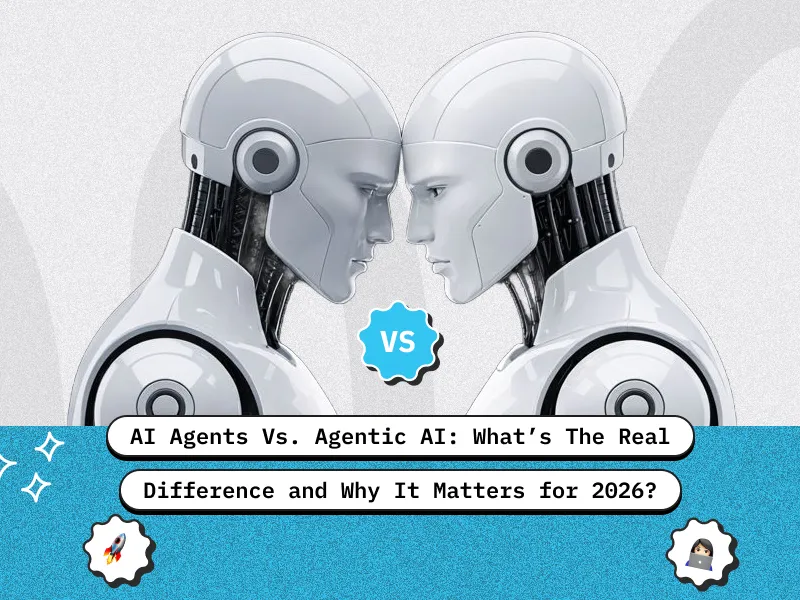
TL;DR
- AI Agents automate specific tasks using predefined rules, making them ideal for early-stage automation and rapid execution needs.
- Agentic AI adds planning, reasoning, and self-improvement, enabling automation of complex end-to-end workflows across teams.
- Startups benefit most from AI Agents to accelerate software development for startups with fast deployment and low complexity.
- SMBs gain more value from Agentic AI, especially when supported by it consulting for small businesses that focus on scalable operational efficiency.
- Creole Studios, a Digital Transformation Company offering AI agent development services, helps businesses choose the right approach for success in 2026 and beyond.
Introduction
Artificial intelligence is evolving quickly, and organizations across industries are no longer satisfied with basic workflow automation. As we approach 2026, business leaders from startup founders to SMB IT decision-makers are increasingly exploring systems that can think, plan, and act with autonomy, not just execute predefined tasks.
This shift brings an important question to the forefront: What’s the real difference between AI Agents and Agentic AI and which one delivers the right value for your business?
Understanding this distinction is becoming essential for companies focused on rapid product delivery and efficiency. Startups building AI-enabled products need automation that accelerates early momentum. SMBs modernizing operations require intelligence that scales across departments and decision-making.
Creole Studios, a Digital Transformation Company that also offers AI Agent Development Services, helps both startups and SMBs evaluate their automation readiness and decide whether AI Agents, Agentic AI, or a phased approach will deliver the strongest outcomes for their business.
Accelerate Your AI Automation
Discover whether AI Agents or Agentic AI is the right starting point for faster delivery and operational efficiency tailored to your business.

What Are AI Agents? (Simple Definition for Business Leaders)
AI Agents are software systems capable of performing specific tasks autonomously based on rules, instructions, or goals defined by humans. They react to inputs, follow defined business rules, and perform tasks accordingly but typically within a limited scope.
How AI Agents Work
They follow a loop:
- Observe → Think → Act → Repeat (within a predefined scope)
- They rely on clear instructions, business rules, input data, and expected outcomes.
Common Examples Businesses May Already Use
- Customer service chatbots handling common queries
- Marketing automation systems triggering emails or notifications
- Taskbots generating proposals or meeting notes
- Inventory-reorder assistants responding to threshold-based stock levels
Think of them as specialized workers, efficient, consistent, but limited to specific jobs.
AI Agents are well-positioned for early-stage automation, making them a good fit for businesses, especially companies doing software development for startups seeking quick wins.
What Is Agentic AI? (Forward-Looking Definition)
Agentic AI represents the next level systems that don’t just react but reason, plan, learn, and can take action toward broader goals without constant human input.
Instead of simple triggers, Agentic AI interprets intent, anticipates needs, and executes multi-step plans.
Capabilities of Agentic AI
- Evaluates multiple strategies
- Adapts based on outcomes
- Anticipates needs before explicit requests
- Handles multi-step planning
- Self-improves with feedback
Agentic AI behaves more like an autonomous business analyst or project manager capable of not only doing tasks, but making decisions, optimizing workflows, and executing complex processes.
Emerging Use Cases (2026 Outlook)
- Service desk systems diagnosing root causes and resolving tickets end-to-end
- Sales-intelligence agents adjusting strategy based on deal probability and history
- Operations tools orchestrating supply chain decisions in real time
- HR automation proactively preventing employee churn with data-driven interventions
Agentic AI moves beyond automation to orchestration and optimization ideal for businesses that require advanced decision support and cross-function coordination.
AI Agents vs. Agentic AI Key Differences Explained
| Feature | AI Agents | Agentic AI |
| Core Behavior | Operates based on predefined rules or triggers; performs tasks when instructed | Understands goals, evaluates context, and acts proactively to achieve desired outcomes |
| Decision-Making | Follows fixed logic with limited situational analysis | Uses reasoning, planning, and multi-step decision processes to determine the best path forward |
| Learning Capability | Typically static unless manually updated | Learns from outcomes, adapts to new information, and optimizes performance over time |
| Memory + Awareness | Short-term and task-specific context | Maintains broader state and environmental awareness to operate autonomously |
| Skill Scope | Designed for one or few tasks | Capable of orchestration across multiple tasks, tools, and functions |
| Autonomy Level | Executes tasks independently but within boundaries | Operates independently at process or strategy level with minimal oversight |
| Collaboration Capability | May work in isolation | Coordinates across departments, systems, and other AI components |
| Infrastructure Needs | Lightweight implementation; simpler tech stack | Requires stronger data pipelines, orchestration frameworks, and governance |
| Risk & Control | Low complexity and easier to oversee | Needs guardrails to prevent errors in high-impact decision areas |
| Typical Use Cases | Customer support bots, lead routing, task automation | Intelligent service desks, workflow orchestration, supply chain optimization |
| Time to Value | Quick deployment; delivers faster automation wins | Longer setup but higher scalability and long-term ROI |
| Entry Investment | Lower upfront cost | Higher investment but with strategic payback |
| Best Fit | Early-stage automation, startups, simple processes | Scaling SMBs and enterprises with complex workflows and cross-team operations |
They are not competitors but rather different points on an autonomy spectrum. Many businesses begin with AI Agents and evolve into Agentic AI as their operations and data maturity grow.
How Startups and SMBs Gain Value from AI Agents Today and Move Toward Agentic AI Over Time
The impact of AI varies based on where a business is in its growth stage. Startups usually focus on speed, quick delivery, and minimizing manual work so they can build and improve products faster. AI Agents fit well here because they automate rule-based and repetitive tasks, helping teams working on software development for startups reduce workload and accelerate product development without high upfront cost.
As organizations grow into SMBs, their operational needs expand across multiple teams, tools and workflows. They require automation that supports coordination, intelligent decision-making, and adaptability. With the right guidance similar to IT consulting for small businesses, Agentic AI becomes useful because it can reason, plan multi-step outcomes, and adjust actions based on changing conditions.
A practical approach for both business types follows a clear path:
- Begin with AI Agents to achieve immediate automation gains for predictable tasks
- Scale into Agentic AI to enable more autonomous and intelligent operations as complexity rises
This progression ensures that businesses capture early value while also building toward a future where automation delivers broader strategic impact.
Plan Your AI Roadmap
Work with experts to identify quick wins and build a scalable automation pathway from AI Agents to advanced Agentic AI.
Conclusion
AI Agents and Agentic AI represent different levels of autonomy in modern automation. AI Agents are ideal for organizations that need to streamline repetitive tasks and deliver outcomes quickly, which is why they are often the right starting point for software development for startups focused on launching products faster and operating lean. As workflows expand and decision-making grows more complex, Agentic AI becomes more valuable by enabling proactive reasoning, adaptive execution, and automation across functions, a priority for companies investing in it consulting for small businesses to improve efficiency at scale.
Many businesses will adopt a phased approach: begin with AI Agents to capture immediate benefits, then advance into Agentic AI as readiness and impact increase. Creole Studios, a Digital Transformation Company offering AI Agent Development Services, partners with organizations to determine the right path based on their goals, resources, and growth stage, helping ensure each step in the AI journey contributes to long-term competitive advantage in 2026 and beyond.
Frequently Asked Questions
1. What is the key difference between AI Agents and Agentic AI?
AI Agents follow predefined rules to execute tasks, while Agentic AI can plan, reason, and independently take multi-step actions toward business goals.
2. Which approach is better for startups?
Startups typically benefit from AI Agents because they support fast implementation and lower-complexity software development for startups, enabling rapid product delivery and testing.
3. Why are SMBs shifting toward Agentic AI?
As SMB operations expand, they need automation that improves decision-making in addition to completing tasks. Guided by it consulting for small businesses, Agentic AI supports efficiency and scalability across multiple teams.
4. Can a business start with AI Agents and upgrade to Agentic AI later?
Yes. Most organizations adopt AI Agents first for quick wins, then evolve into Agentic AI as workflows, data maturity, and automation goals grow.
5. How does Creole Studios support this transition?
Creole Studios, a Digital Transformation Company offering AI agent development services, helps businesses assess their automation readiness and implement phased AI adoption strategies aligned with both short-term value and long-term autonomy.










 30 mins free Consulting
 12 min read
 United States






 Love we get from the world