
 Lets Talk
TL;DR
- Agile helps startups build the right product through short iterations, customer feedback, and continuous adaptation.
- DevOps helps startups deliver and operate that product reliably through automation, monitoring, and shared ownership.
- Most early-stage teams should keep both lightweight: use Agile practices for prioritization and introduce basic DevOps foundations such as automated testing and repeatable builds early.
- Expand DevOps maturity as release frequency, infrastructure complexity, and reliability requirements increase.
- The right starting point depends on your current bottleneck: product clarity, delivery reliability, or both.
Introduction: Agile vs DevOps is not a choice, it is a sequencing problem
Startups often ask whether they should implement Agile or DevOps first, assuming both solve the same problem. They do not.
Agile helps you decide what to build and how to iterate quickly based on feedback. DevOps helps you deliver what you build reliably, without breaking production or slowing down releases.
The confusion happens because both promise speed. But they operate at different layers of the product lifecycle. Agile improves product discovery and prioritization. DevOps improves delivery, deployment, and operations.
If you start with the wrong one, you optimize the wrong bottleneck.
- If your team is unclear about priorities, users, or features, DevOps will not help. You will just ship the wrong product faster.
- If your team knows what to build but struggles to release it safely, Agile alone will not help. You will still face slow, risky deployments.
The real decision is not Agile vs DevOps. It is understanding where your startup is stuck right now and applying the right system at the right time.
If you need a structured way to evaluate your current bottleneck and implement DevOps without overengineering, exploring DevOps consulting services can help define a practical roadmap aligned with your stage and growth goals.
What is Agile? The engine of product discovery
Agile is an iterative approach to building software that focuses on collaboration, customer feedback, and rapid, incremental delivery. The principles behind the Agile Manifesto emphasize early delivery of valuable software, frequent feedback, and adapting to changing requirements. Instead of betting everything on one long plan, Agile breaks work into small chunks, ships frequently, and learns continuously.
Core Agile values in practice
Agile teams tend to optimize for:
- Clear priorities (what matters most right now)
- Short feedback loops (learn fast, adjust fast)
- Small batches (smaller changes, lower risk)
- Team collaboration (tight alignment between product and engineering)
Scrum, Kanban, and sprints in one view
- Scrum: Fixed-length sprints of one month or less, with defined accountabilities and structured events such as planning, daily scrums, reviews, and retrospectives.
- Kanban: continuous flow, visual board, limit work-in-progress, optimize throughput.
- Many startups use a hybrid: Scrum-like planning with Kanban-like flow for execution.
When Agile is the bigger win for startups
Agile is most valuable when:
- Requirements change weekly
- You need product-market validation
- You are trying to avoid building features nobody wants
- Your biggest risk is product direction, not infrastructure
What is DevOps? The engine of product delivery
DevOps is a culture and set of practices that brings development and operations together to deliver software faster and more reliably. Agile focuses primarily on iterative product development and continuous feedback. DevOps extends the delivery conversation by emphasizing how software is built, tested, deployed, operated, monitored, and improved in production.
The DevOps foundation: collaboration plus automation
DevOps usually includes:
- Continuous Integration (CI): merge code frequently and test automatically
- Continuous Delivery/Deployment (CD): release changes reliably through automated pipelines
- Automation: reduce manual steps that slow releases or introduce errors.
- Monitoring and feedback: production telemetry, alerts, incident response
- Shared ownership: teams build and run what they ship
The Three Ways in simple terms
A useful way to understand DevOps principles:
- Systems thinking: Optimize the complete delivery system, not only one team’s output.
- Amplifying feedback loops: Detect issues quickly and use feedback to improve future work.
- Continuous learning and experimentation: Create a culture where teams test improvements, learn from failures, and refine delivery practices.
When DevOps becomes urgent for startups
DevOps becomes the bigger win when:
- Deployments are slow, stressful, or risky
- Bugs escape into production often
- Environments are inconsistent across team members
- Reliability issues block growth
- You need release frequency to increase without adding chaos
Agile vs DevOps: key differences that matter for startups
Comparison table
| Category | Agile | DevOps |
| Primary focus | Building the product | Delivering and operating the product |
| Main goal | Rapid iteration and customer feedback | Fast, reliable releases and stability |
| Team scope | Cross-functional product and delivery teams | Development, operations, QA, security, and other delivery stakeholders |
| Release style | Iterative, often sprint-based | Continuous delivery and automation-driven |
| Feedback source | Customers and stakeholders | Monitoring, telemetry, incidents, pipeline signals |
| Success metrics | Sprint outcomes, velocity, value delivered | Deployment frequency, change lead time, failed-deployment recovery time, and change-failure rate |
A simple way to remember it:
- Agile reduces product risk.
- DevOps reduces operational risk.
If you are evaluating how DevOps fits into your broader engineering strategy, explore our DevOps comparison guide. It explains how DevOps compares with Agile, SRE, GitOps, DevSecOps, MLOps, Platform Engineering, and other operating models so you can identify the right approach for your current stage of growth.
4 common misconceptions startups have
Misconception 1: Agile and DevOps are synonyms
They overlap on collaboration and feedback, but they solve different problems. Agile is mainly about how you plan and build. DevOps is about how you deliver and run what you built.
Misconception 2: Agile and DevOps are technologies you can buy
Tools help, but they do not implement the mindset for you.
- Jira does not make you Agile if priorities are unclear.
- CI/CD does not make you DevOps if ops is still a separate handoff.
Misconception 3: DevOps requires Agile
DevOps benefits from Agile, but it does not require Scrum or sprints. Some teams do DevOps with Kanban or other planning approaches.
Misconception 4: DevOps replaces Agile
DevOps does not replace Agile. They are complementary. Agile improves how you choose and build work. DevOps improves how you ship and operate it.
Startup decision matrix: what should you implement first?
| Your top priority | Start with | Why |
| Market validation | Agile | You need tight feedback loops and fast iteration on features |
| Reliability and uptime | DevOps (plus basic planning hygiene) | You need stable releases, monitoring, incident readiness |
| Scaling delivery speed | DevOps layered onto Agile | You need automation to keep velocity without breaking prod |
| Cost control at scale | DevOps plus FinOps practices | You need cost visibility, guardrails, and automated governance |
Rule of thumb:
If your biggest pain is what to build, start with Agile.
If your biggest pain is shipping and stability, prioritize DevOps.
Startup phase roadmap: when to introduce each
These startup phases are directional, not fixed rules. Your DevOps maturity should also reflect release frequency, infrastructure complexity, customer expectations, compliance exposure, and the cost of production failures.
Phase 1: MVP stage (pre-seed to seed)
Goal: validate the problem and solution quickly.
Start with: Agile discipline.
What to implement:
- Basic backlog and prioritization
- Short iterations with reviews and retros
- Lightweight definition of done
- Simple release checklist
DevOps at this stage:
- Minimal CI is still worth it (run tests on PRs)
- Avoid heavy platform investment unless your product demands it
Phase 2: Early growth (seed to Series A)
Goal: increase shipping speed without breaking trust.
Add: DevOps fundamentals.
What to implement:
- CI pipelines that run tests automatically
- Repeatable builds
- Staging environment parity
- Basic monitoring and alerting
- Release automation for predictable deploys
Phase 3: Scale stage (Series A and beyond)
Goal: reliability and delivery at high frequency.
Lead with: DevOps maturity while keeping Agile planning.
What to implement:
- Robust CD pipelines
- Infrastructure as Code
- Observability (logs, metrics, traces)
- Clear incident response
- Reliability practices (error budgets, SLO thinking)
At this stage, many teams move toward platform engineering patterns to reduce developer toil and standardize delivery.
As infrastructure becomes more complex, adopting Infrastructure as Code as a form of business insurance can help reduce environment drift, improve repeatability, and make recovery workflows easier to manage.
Real-world startup scenarios
Scenario 1: Agile without DevOps hits a wall
A team runs 2-week sprints and “finishes” features, but deployments take days and often cause downtime. The real bottleneck is not planning. It is release reliability.
Fix:
- Introduce CI, automated tests, and CD
- Standardize environments
- Add monitoring so production issues become feedback, not surprises
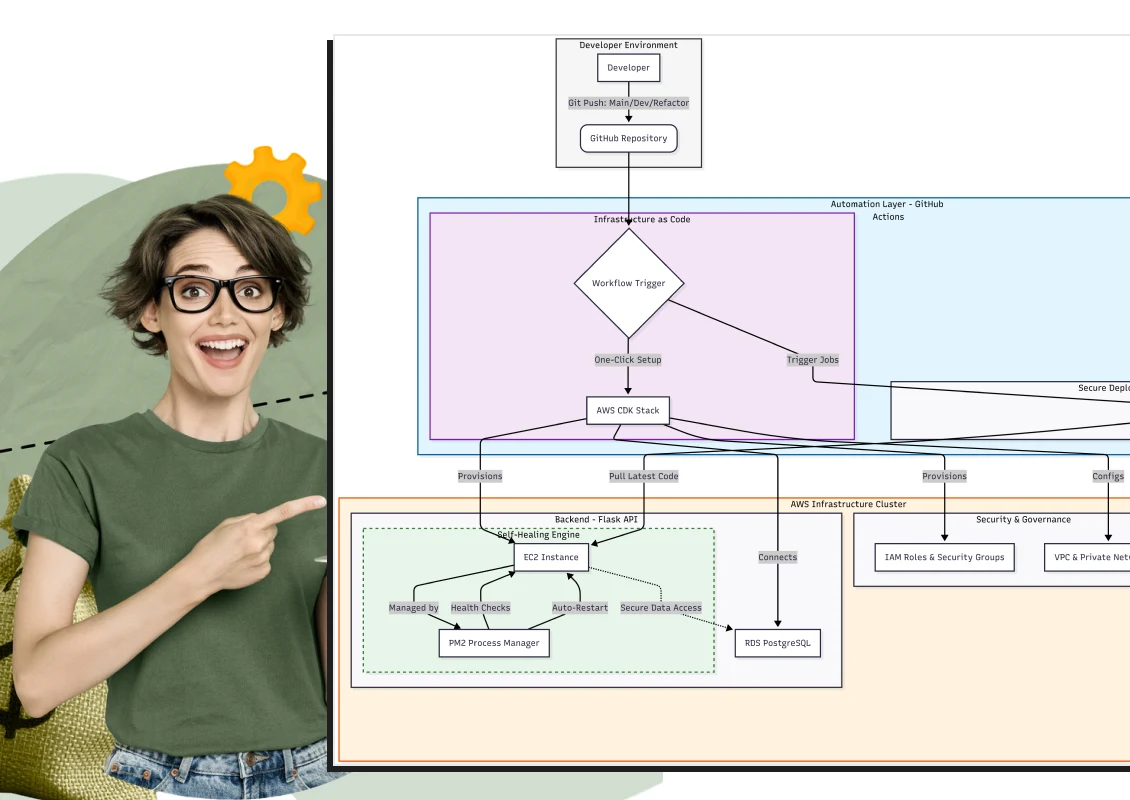
Creole Studios has seen this exact shift in real DevOps implementation work. In one self-healing CI/CD pipeline implementation, our team helped move delivery away from manual release dependency by adding infrastructure automation, deployment validation, monitoring, health checks, and recovery logic. This is a practical example of why Agile alone is not enough once a startup knows what to build but struggles to release it safely and consistently.
Scenario 2: DevOps too early becomes over-engineering
A pre-seed team invests weeks in complex infrastructure, Kubernetes, and elaborate pipelines before validating the product. They delay learning and burn the runway.
Fix:
- Keep the delivery stack lean until product usage and operational complexity justify additional investment.
- Establish basic CI, automated testing, repeatable builds, and simple monitoring early.
Add more advanced infrastructure only when it solves a demonstrated delivery, reliability, or scaling problem.
Scenario 3: Balanced approach wins
A startup uses Agile to prioritize and iterate, while progressively adding DevOps automation as release frequency grows. This keeps learning fast and delivery stable.
Can Agile and DevOps work together?
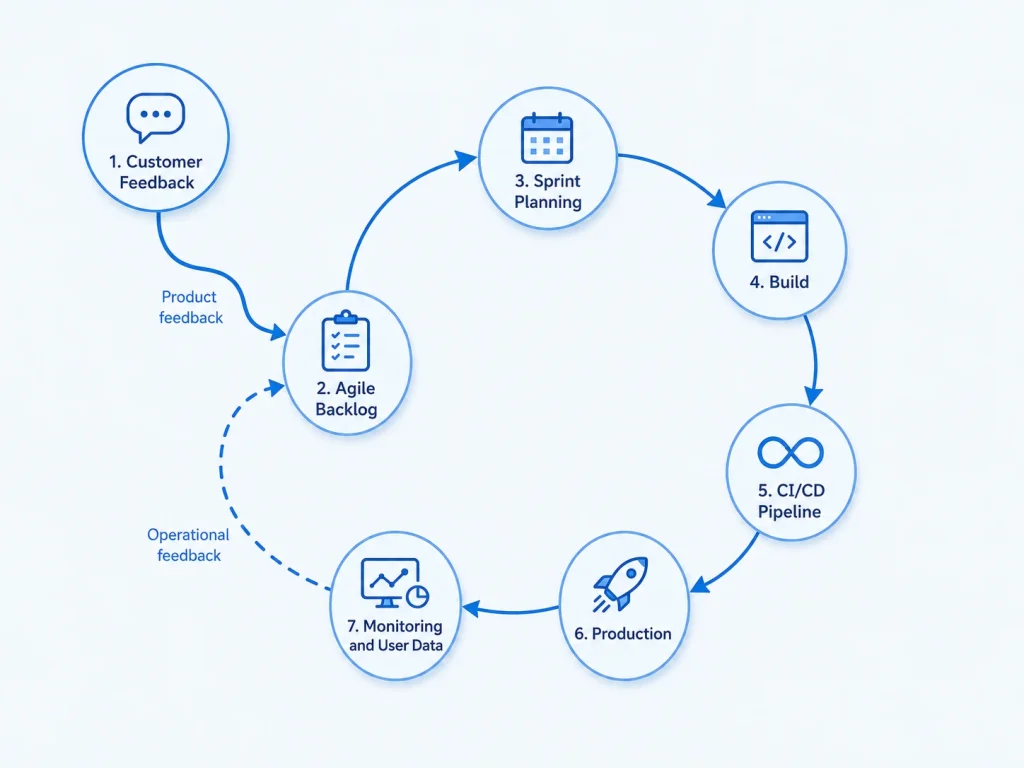
Yes, and that is the standard pattern in modern teams.
- Agile creates a predictable rhythm for prioritization, iteration, and feedback.
- DevOps ensures that what you build can be delivered and operated continuously with confidence.
- Production feedback then feeds back into Agile planning, creating a continuous improvement loop.
If you want one simple mental model:
- Agile helps you build value.
- DevOps helps you deliver and sustain value.
Practical implementation plan for startups
- Find your bottleneck
- Are you stuck in prioritization and product clarity, or stuck in release reliability?
- Start with simple process discipline
- Backlog hygiene, clear ownership, short review cycles, retros that actually change something
- Add CI early
- Even a small team benefits from automated tests and repeatable builds
- Automate releases as pain appears
- If deploys are stressful, automate them before you hire more engineers
- Instrument production
- Monitoring and alerts turn production into a feedback loop, not a black box
- Measure both sides
- Agile metrics for planning health
- Track DORA software-delivery performance metrics to evaluate delivery reliability and speed using signals such as deployment frequency, change lead time, failed-deployment recovery time, and change-failure rate.
Conclusion: Choose the Right Starting Point, Then Scale Intelligently
For most startups, the smartest path is not Agile or DevOps in isolation. It is sequencing.
Start with Agile to reduce product risk, validate assumptions, and build what users actually need. Once release cycles become stressful, slow, or fragile, introduce DevOps to remove operational risk and scale delivery with confidence.
As your startup grows, both must evolve together. Agile keeps your roadmap focused and adaptable. DevOps keeps your releases fast, stable, and production-ready.
If you are unsure where to begin or how to transition without disrupting your team, explore our DevOps Consulting Services. We help startups implement practical, stage-appropriate DevOps foundations without overengineering. And if you need hands-on execution support to build CI/CD pipelines, automate deployments, and improve release reliability, you can also hire DevOps engineers to accelerate your delivery process and reduce operational bottlenecks.
FAQs
What is the main difference between Agile and DevOps?
Agile focuses on how you build and prioritize software. DevOps focuses on how you ship, run, and improve it in production.
Should a startup implement DevOps from day one?
Implement lightweight CI early. Full DevOps maturity can wait until release pain and reliability needs demand it.
Can DevOps work without Scrum?
Yes. DevOps is not tied to Scrum. It pairs well with Scrum, Kanban, or hybrid planning.
Does DevOps replace Agile?
No. They are complementary. Agile helps you build the right thing, DevOps helps you ship it reliably.
Which one improves time-to-market faster?
Early stage: Agile usually improves speed fastest by clarifying what to build.
Growth stage: DevOps improves speed fastest by removing release bottlenecks.
Startup Delivery Fit Check
We’ll assess whether your bottleneck is planning (Agile) or shipping (DevOps), then share a phased rollout plan.











 30 mins free Consulting
 9 min read

 global






 Love we get from the world