
 Lets Talk
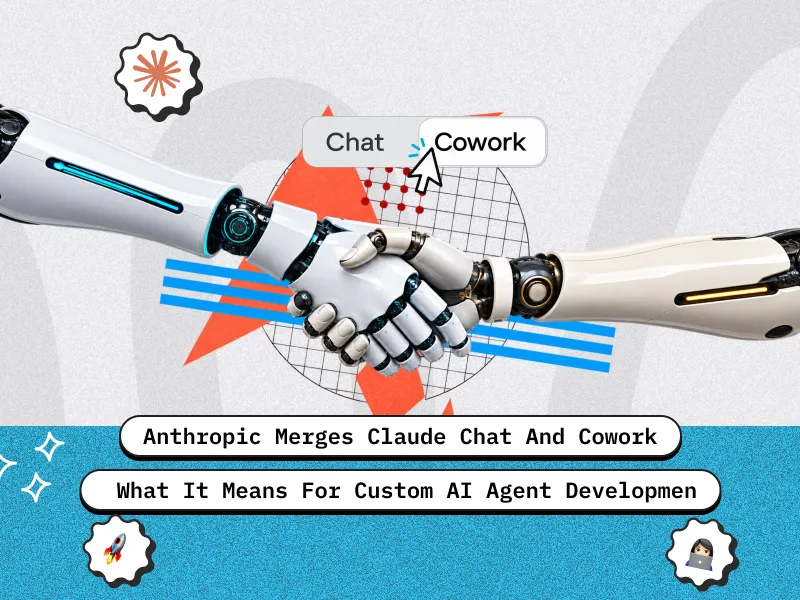
Anthropic is merging Claude Chat and Cowork into one unified Claude experience. Announced on September 16, 2026, the update reduces the need for users to decide whether a task belongs in regular chat or a more agentic workspace. Claude can instead determine what a request needs and bring relevant context, skills, connectors, and creation capabilities into the same experience.
For custom AI agent development, the bigger implication is not simply the interface change. It is the shift toward AI applications where users describe what they want accomplished, while the system determines how the work should be completed.
TL;DR
- Claude Chat and Cowork are becoming one Claude experience.
- Users no longer need to manually decide whether work belongs in a conversational or more agentic mode.
- Claude can determine which capabilities, context, connectors, and tools a task requires.
- This reinforces an important AI product design principle: start with the user’s goal, not the underlying AI features.
- For custom AI agents, orchestration, context, integrations, permissions, and human approval become increasingly important.
- Businesses do not need to recreate Claude. They can apply the same outcome-driven approach to workflows involving their own data, APIs, software, and business rules.
What Changed With the Claude Chat and Cowork Merge?
Claude Chat and Cowork previously represented different ways of working with Claude.
Chat was commonly used for questions, analysis, brainstorming, and conversational work. Cowork was designed for larger tasks where Claude could work more independently across files, tools, research, and longer-running workflows.
Anthropic says one source of friction was deciding where a particular task belonged. Work and context could also become separated when users moved between different experiences.
The unified approach reduces that decision.
Instead of starting by choosing a mode, users can start with the outcome they need.
Before
User Request
↓
Choose Chat, Cowork, or Another Experience
↓
Provide Context
↓
Complete the Task
Now
User Request
↓
Claude Determines What the Task Requires
↓
Uses Relevant Capabilities and Context
↓
Produces the Outcome
Anthropic is also bringing Claude Docs, Slides, and Design closer to the same workflow. A user can research something, create a document, develop slides, and continue working from the same context rather than treating each output as a completely separate task.
The important change is therefore not simply where features appear.
It is the idea that the user states the goal while the AI determines what capabilities are required.
Why Did Anthropic Merge Claude Chat and Cowork, and Why Does It Matter?
The unified Claude experience reduces how much product knowledge users need before they can get work done.
Imagine someone asking:
“Review this month’s sales pipeline, identify major risks, prepare a short report, and create slides for Monday’s meeting.”
That person should not necessarily have to decide:
- whether to use Chat or Cowork;
- whether research is required;
- which connector should be used;
- whether files need to be analyzed;
- whether a document or presentation tool needs to be opened;
- which steps Claude should complete first.
They should be able to describe the outcome.
The interaction changes from:
Choose Feature → Give Instructions
to:
State Outcome → System Determines Capabilities
That is why the Claude Chat and Cowork merge matters beyond Anthropic’s product interface.
It reflects a broader shift from:
Prompt → AI Response
toward:
Goal → Planning → Tools + Data → Actions → Approval → Outcome
For AI product teams, this means the conversation can become the entry point into a workflow, rather than the entire AI experience.
How Does the Unified Claude Experience Change the Way AI Agents Are Designed?
The Claude update highlights several principles that are directly relevant to custom AI agent development.
1. Start With Intent, Not Features
Users should not have to understand the architecture behind the request.
Instead of saying:
“Query Salesforce, retrieve customer activity, run the information through Claude, analyze the results, and then generate follow-up emails.”
a sales manager could simply say:
“Find high-value opportunities that have gone quiet and prepare the next follow-up.”
The agent then determines what needs to happen.
For custom AI development, this means the UX increasingly starts with the business outcome, while the technical workflow remains behind the interface.
2. Orchestration Becomes More Important
Some requests only require a model response.
Others may require:
- retrieval;
- database access;
- API calls;
- calculations;
- several tools;
- multiple workflow steps;
- human approval.
The application needs to route the task correctly.
This makes orchestration increasingly important because the LLM is only one part of an agentic system.
3. Context Needs to Follow the Task
A user should not repeatedly explain the same customer, account, document, or project as the workflow progresses.
For example:
CRM Record → Emails → Meeting Notes → Product Usage → Recommended Action
All of those steps may relate to one customer.
A useful agent therefore needs mechanisms for carrying relevant context throughout the task without indiscriminately remembering everything.
The objective is to provide the right context at the right time.
4. Tools Move AI From Answers to Actions
A model can tell a user what might need to happen.
A connected agent can help complete the work.
AI without integrations:
“This customer may be at risk of leaving.”
Connected agent:
“This customer’s usage has dropped, they have three recent support tickets, and their renewal is approaching. I prepared a follow-up for the account manager. Would you like me to create the task?”
That requires connections to business systems such as CRMs, databases, email, support applications, and internal APIs.
5. Human Approval Needs to Be Part of the Workflow
As AI moves from generating information to performing actions, businesses need clear boundaries.
An agent might be allowed to:
Read → Analyze → Recommend → Prepare → Execute
But not every workflow should allow the agent to reach the final step automatically.
A support agent might prepare a refund but require approval before issuing it.
A finance agent might prepare a payment request but never authorize payment.
Anthropic’s unified Claude experience similarly retains user control around actions rather than treating maximum autonomy as the goal.
The lesson for custom AI development is straightforward:
Good agent design is not about maximum autonomy. It is about appropriate autonomy.
Claude Cowork vs Custom AI Agents: Where Does Custom Development Fit?
Claude’s unified experience and a custom AI agent solve different types of problems.
| Area | Claude Unified Experience | Custom AI Agent |
| Purpose | Broad knowledge work and productivity | Defined business workflow |
| Interface | Claude | Custom or embedded interface |
| Integrations | Supported connectors | Custom APIs and internal systems |
| Data | Connected sources | Proprietary business data |
| Business logic | Platform capabilities | Organization-specific rules |
| Permissions | Platform controls | Custom roles and approval logic |
| Model strategy | Claude ecosystem | Claude, GPT, Gemini, open-source, or multi-model |
| Deployment | Claude environment | Existing SaaS, web app, or enterprise system |
The point is not that businesses should recreate Claude.
A team might use Claude for research, writing, document creation, and individual productivity while using a purpose-built AI agent for a workflow unique to its product or operations.
For example, a SaaS company might need an agent that:
- authenticates the customer;
- retrieves account-specific information;
- interprets the request;
- calls proprietary APIs;
- follows subscription-specific rules;
- prepares an action;
- asks for approval where necessary;
- records the result.
That type of workflow belongs inside the company’s product architecture.
For simpler workflows, businesses may also evaluate no-code platforms before committing to custom engineering. Creole Studios’ comparison of custom AI agents vs. no-code AI tools explains where platform limitations, proprietary integrations, security, governance, and long-term control begin to make custom development more relevant.
What Does the Claude Cowork Merge Mean for Custom AI Agent Development?
One of the clearest technical lessons is that the LLM should be treated as one layer of an agentic system, not the complete system.
Connecting Claude, GPT, Gemini, or another model to an application does not automatically create a production AI agent.
A custom agent may need five broader components.
Model
The model handles language understanding, reasoning, extraction, classification, or content generation.
Depending on the workflow, the architecture might use Claude, OpenAI models, Gemini, open-source models, or multiple models.
This is also why broader Generative AI development can involve model selection, RAG, enterprise data, integrations, evaluation, and production deployment rather than simply connecting an LLM API.
Orchestration
The orchestration layer determines what happens next.
It may handle:
- task planning;
- routing;
- tool selection;
- workflow state;
- retries;
- error handling;
- approval checkpoints.
Business Data and Context
Agents may need access to:
- CRM records;
- databases;
- documents;
- product information;
- knowledge bases;
- RAG systems;
- structured internal data.
Tools and Integrations
Tools allow the agent to do more than return text.
They might include:
- CRM APIs;
- email;
- support platforms;
- analytics systems;
- payment systems;
- internal APIs;
- enterprise software.
Permissions and Monitoring
Businesses need control over what the agent can access and what actions it can perform.
They may also need visibility into:
- tool calls;
- workflow failures;
- human interventions;
- costs;
- completion rates;
- output quality.
A simplified architecture looks like:
User Goal
↓
Intent + Context
↓
Agent / Orchestrator
↓
Model + Business Data + Tools
↓
Business Rules
↓
Human Approval Where Required
↓
Action
↓
Monitoring
That is what turns an AI response into a controlled business workflow.
How Can Businesses Apply Claude-Like Agentic Workflows to Their Own Software?
Businesses do not need to reproduce Claude’s product to apply the same underlying principle.
Consider a sales manager.
A standard assistant might receive:
“Which opportunities have been inactive for more than two weeks?”
and return a list.
An agentic workflow could instead receive:
“Review opportunities that haven’t moved in 14 days, identify likely blockers, prepare follow-ups for high-value accounts, and ask me before updating Salesforce.”
The system could then:
- authenticate the user;
- retrieve CRM information;
- review account history;
- identify stalled opportunities;
- prioritize them using business rules;
- determine likely blockers;
- prepare follow-ups;
- request approval;
- update approved records;
- log the activity.
From the user’s perspective, this is one request.
Behind the interface, it is a coordinated process involving AI, business data, permissions, tools, and actions.
Creole Studios explores a similar operational pattern in its guide to AI agents in RevOps, where agents can assist with pipeline analysis, CRM processes, and controlled updates.
The same principle can apply to customer support:
“Investigate this issue, review the customer’s previous tickets, check their subscription, suggest the most likely resolution, and prepare the response for approval.”
Or operations:
“Review delayed orders, identify those caused by inventory shortages, find alternative warehouses, and prepare recommended transfers for approval.”
These workflows can also be embedded directly into an AI-powered custom web application so the agent works within existing users, authentication, APIs, business rules, and product experiences.
When Does a Business Actually Need a Custom AI Agent?
Not every business process requires custom agent development.
A general-purpose AI assistant may be sufficient when the requirement is primarily:
Ask → Analyze → Answer
Custom development becomes more relevant when completing the outcome requires:
Understand → Retrieve → Decide → Use Tools → Act → Validate
Consider a custom agent when AI needs to:
- work with proprietary data;
- interact with several internal systems;
- follow company-specific business rules;
- execute multi-step workflows;
- support different user roles;
- apply custom permissions;
- operate inside an existing product;
- trigger actions rather than only generate responses;
- maintain audit trails;
- include approval checkpoints;
- provide workflow-level monitoring.
The right starting question is therefore not:
“Do we need an AI agent?”
It is:
“Which business outcome requires AI to do more than answer a question?”
If the workflow is simple and standardized, an existing AI product or no-code tool may be enough.
If the workflow depends on proprietary systems, complex integrations, custom controls, or business-critical actions, purpose-built AI agent development services become more relevant.
What Does the Claude Chat and Cowork Merge Mean for the Future of Agentic Applications?
Anthropic’s decision to combine Chat and Cowork reduces the visible distinction between talking to AI and giving AI work to complete.
That distinction is likely to become less important across AI-powered products.
A future interaction may increasingly look like:
User States Goal
↓
Application Determines Workflow
↓
Agent Selects Relevant Data + Tools
↓
System Executes Within Defined Permissions
↓
Human Reviews High-Impact Actions
↓
Application Delivers Outcome
The interface becomes simpler even as the architecture behind it becomes more capable.
For businesses, the opportunity therefore goes beyond adding another chatbot.
The more useful question is:
“Which parts of our software or operations could become outcome-driven AI workflows?”
A sales platform could identify stalled opportunities and prepare next actions.
A support system could investigate cases before preparing resolutions.
A logistics platform could examine exceptions across multiple systems.
A SaaS application could let customers complete complex tasks using natural-language instructions rather than navigating several screens.
That is the broader significance of the Claude Chat and Cowork merge for custom AI agent development.
Final Thoughts
The Claude Chat and Cowork merge removes a decision users previously had to make themselves: whether a task belonged in conversation or a more agentic environment.
Claude increasingly handles that complexity behind one experience.
For custom AI applications, the same product principle matters.
Users should not need to understand models, connectors, retrieval systems, APIs, orchestration frameworks, or workflow engines to complete a business task.
They should be able to explain the outcome they want.
The engineering challenge is building the system that can interpret that goal, retrieve the right context, select appropriate tools, work within defined permissions, involve humans where necessary, and reliably complete the workflow.
The future of AI applications may therefore be designed less around:
“Which AI feature should the user open?”
and more around:
“What does the user want accomplished?”
Ready to Build an AI Agent Around Your Business Workflow?
Turn repetitive tasks, disconnected tools, and manual processes into secure AI-powered workflows designed around your data, systems, and approval rules.

Frequently Asked Questions
What is the Claude Chat and Cowork merge?
Anthropic is combining Claude Chat and Cowork into a unified Claude experience. Users can begin from a conversation while Claude determines what capabilities and context are appropriate for the task.
Why did Anthropic merge Claude Chat and Cowork?
Anthropic says separating the experiences created friction because users had to decide where a task belonged and context did not always move naturally between them. The unified approach lets users focus more on the outcome they want.
What does the Claude Cowork merge mean for AI agents?
It reinforces an outcome-driven approach to agent design. Instead of requiring users to select tools or AI modes manually, the application can interpret the goal and determine which models, data, tools, and workflow steps are required.
Does the Claude merge change how custom AI agents are built?
It does not replace the existing technical foundations of agent development. However, it highlights the growing importance of orchestration, context management, tool integration, permission controls, and human approval behind a simpler user experience.
Can businesses build workflows similar to Claude Cowork?
Yes. Businesses can apply similar design principles to their own processes by combining an LLM with proprietary data, business systems, APIs, workflow orchestration, permissions, human approval, and monitoring. They do not need to recreate Claude itself.
What is the difference between Claude and a custom AI agent?
Claude is a general-purpose AI product provided by Anthropic. A custom AI agent is built around a specific organization’s workflows, systems, data, permissions, users, and business rules. Depending on the architecture, a custom agent may itself use Claude as the underlying model.


 12 min read


