

ML Deployment Automation
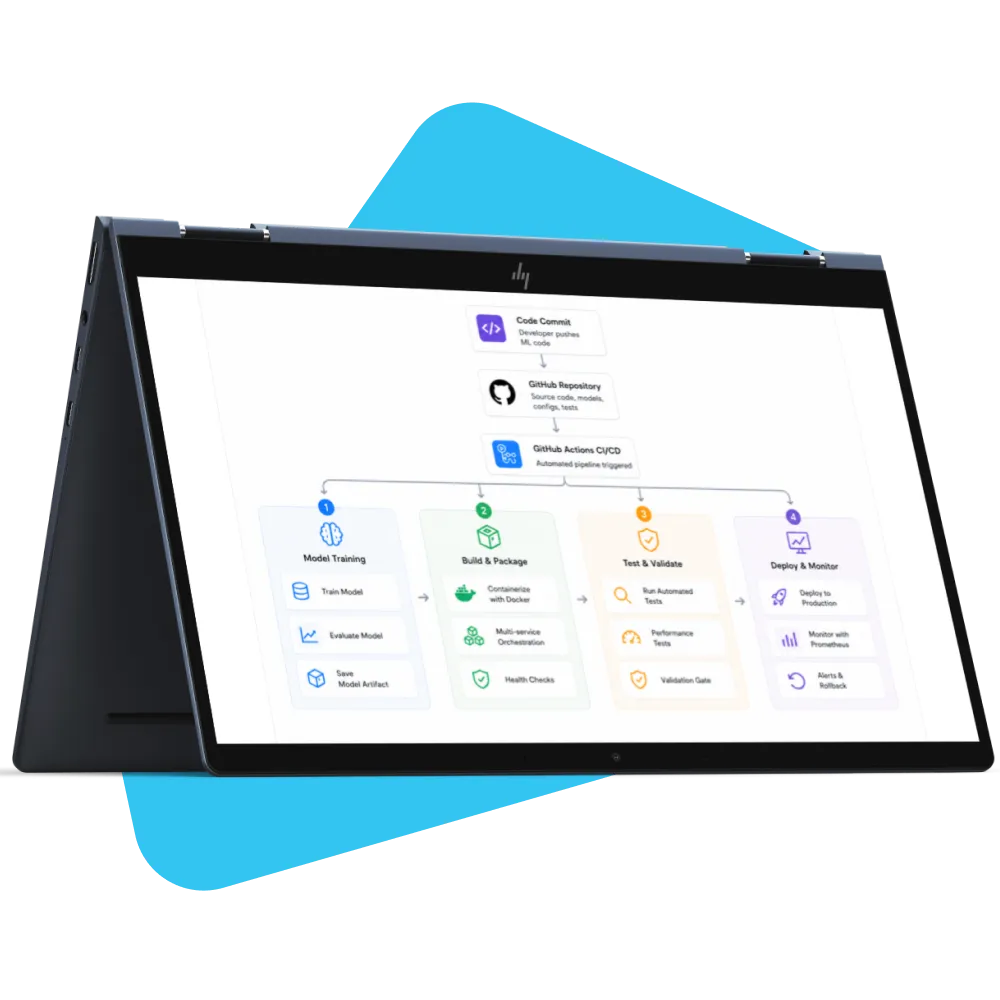
Building an Intelligent, Self-Healing ML Deployment Ecosystem for Enterprise Microservices AutoML-Deploy to transform how organizations handle machine learning model deployment at scale. By implementing an "Intelligent Orchestration Engine," we eliminated manual deployment bottlenecks and reduced deployment time from hours to minutes. For teams struggling with release delays, infrastructure complexity, or manual deployment workflows, structured DevOps consulting services can help create faster, safer, and more automated delivery systems. In this project, we first established automated model training pipelines, then implemented zero-downtime deployment strategies with automated rollback capabilities. The result is a self-healing deployment pipeline that not only trains and deploys models but also autonomously validates performance and triggers remediation when issues arise.
 Remote
5K – 10K USD
2 - 3 Months
Web
About the Project
Eliminating Deployment Bottlenecks through Intelligent Orchestration.
The project aimed to solve the “Manual Deployment Paradox” in ML Engineering, where critical model updates are delayed because deployment teams are overwhelmed by manual processes, testing requirements, and deployment validation.
By focusing on Automated Pipeline Orchestration and Intelligent Validation, we addressed the gap left by traditional manual deployment workflows. This is where the overlap between MLOps and DevOps becomes important, as ML systems need both model lifecycle automation and reliable software delivery practices.
The result is a self-healing pipeline that not only trains and deploys models but autonomously validates performance, monitors metrics, and triggers remediation when accuracy drops or errors occur.

Project Challenges
Building this autonomous deployment environment required solving several unique challenges in the ML lifecycle:


Manual Deployment Bottlenecks : The client’s legacy ML deployment process depended on manual testing, validation, and DevOps approvals, causing each model update to take 4 to 6 hours and slowing down rapid iteration.
Model Performance Degradation : Without automated monitoring or rollback, production performance issues often went unnoticed until accuracy dropped by 5 to 10%, creating service risks and forcing manual recovery.
Inconsistent Testing & Validation : Different team members used different testing methods, which led to unreliable validation results, inconsistent production behavior, and no clear way to compare model versions.
Infrastructure Complexity : Managing Docker containers, services, CI/CD workflows, and multiple deployment environments required DevOps expertise that the client did not have available in-house.


How Did We Help?
We approached the development with a phased strategy to ensure each deployment challenge was addressed systematically. For businesses planning a similar transition from manual releases to automated delivery, a clear DevOps implementation roadmap helps define the right foundation before scaling automation.
Model Training Pipeline
REST API Development
Containerized Deployment
Automated Testing Suite
CI/CD Pipeline Automation
Monitoring & Observability
Remediation & Reporting

The outcome
The project emerged as a model for modern ML DevOps, replacing a “Manual Deployment” culture with an “Autonomous Orchestration” ecosystem.
- Deployment Speed: Reduced Mean Time to Deployment (MTTR) from 4-6 hours to under 5 minutes.
- Performance Reliability: Automated validation ensures model accuracy never drops below 95% in production.
- Operational Efficiency: Eliminated 100% of manual deployment steps, freeing DevOps team for strategic work.
- Compliance Ready: Automated audit trails and compliance reports make the project ready for SOC2/ISO27001 audits.
- Zero Downtime Patching: Security updates and model patches happen in parallel with development, never blocking the release cycle.
- Scalability: The pipeline can now handle multiple models, environments, and deployment targets without manual intervention.

Ryan Mitchell
"The AutoML-Deploy engine transformed our deployment process overnight. We went from spending 4-6 hours manually deploying models to having a fully automated pipeline that deploys in minutes. The intelligent validation ensures our models never degrade in production, and the automated rollback gives us confidence to deploy frequently. It is the most intuitive approach to ML deployment we've ever seen. Our team can now focus on building better models instead of managing deployments."