
 Lets Talk
TL;DR
- An AI MVP is a simple first product with one useful AI feature.
- It helps startups test an idea before spending too much time or money.
- The first version should solve one clear problem for a specific group of users.
- Start with a small product, launch early, and learn from real feedback.
- Do not add too many AI features in the beginning.
Introduction
Many startups want to build AI products, but the first version should be simple. A common mistake is trying to build too much too early. Founders often add too many features, spend more money, and make the product harder to test. This can slow down the launch and increase risk.
That is why an AI MVP is useful. It helps startups test an idea with a simple product that includes one useful AI feature. Instead of building a full product right away, you launch a smaller version, collect feedback, and learn what users really need. This guide explains how to plan, build, and improve an AI MVP step by step.
What Is an AI MVP?
An AI MVP is a simple first version of a product that includes one useful AI feature. It is built to test whether the idea solves a real problem for users. The goal is not to build a complete product at the start. The goal is to learn if people find the feature useful and if it gives them enough value to keep using it. A good AI MVP stays focused on one main problem so the team can launch faster and improve based on real feedback.
An AI MVP differs from a regular MVP because AI is central to its value. While a traditional MVP may validate a basic idea, an AI MVP also tests whether the AI feature enhances user experience or outcomes. This makes it more complex, requiring careful testing, output validation, and attention to data, privacy, and cost throughout the MVP Development process.
Does Your Startup Really Need an AI MVP?
Not every startup needs AI in the first version. Sometimes a simple MVP is the better choice. If AI does not clearly improve the product, it can make the MVP harder to build, more expensive, and slower to launch.
AI makes sense when it solves a real problem in a better way. It can help automate repeated tasks, give more personal results, make smart recommendations, or provide useful predictions. Understanding the difference between an AI MVP and a traditional MVP can help founders decide which approach makes more sense for their product.
But if the idea can be tested with simple features, rules, or manual work, a normal MVP may be enough at the start. Before adding AI, ask: does it solve a clear problem, will users notice the benefit, and can it be tested with limited data? If not, start with a simpler MVP first.
Research from McKinsey & Company also highlights that many AI projects struggle because companies adopt AI before validating a strong use case or data readiness.
Is Your Startup Ready to Build an AI MVP?
Evaluate your problem, data, AI use case, technical requirements, risks, and validation goals.
Best AI Features for an MVP
Some AI features are easier to launch in an MVP because they solve a clear problem and are simple to test. The best ones give quick value to users without making the first version too complex.
AI Chat
AI chat can help users get answers quickly. It can reply to common questions, guide users during onboarding, or help them complete simple tasks. This makes the product more useful from the beginning and can also reduce support work.
Smart Search
Smart search helps users find the right content, product, or option faster. This is useful when users have many choices and do not know where to start. It makes the product feel easier to use and more helpful.
Content Summary
Content summary features save time by turning long information into short and useful output. They help users understand content faster and can also support writing or note-taking. This works well in learning, research, and productivity tools.
Task Automation
Task automation helps users by reducing repeated manual work. It can handle simple steps automatically and save time on routine tasks. This makes it a useful feature in business tools and workflow-based products.
Personal Results
Personal results make the product feel more relevant for each user. AI can show better suggestions, useful next steps, or more suitable content based on user behavior. In an MVP, this feature should stay simple and focused.
Build vs Buy in AI MVP Development
When building an AI MVP, startups need to decide whether to use existing AI tools or create their own solution. The best choice depends on budget, timeline, product needs, and technical skills. It can also depend on your MVP team structure, especially if you are thinking about open-source models or custom AI development.
Ready-Made Tools
Ready-made AI tools are often the best choice for startups that want to launch quickly. They are faster to set up, easier to use, and usually cost less in the beginning. This makes them useful for testing an idea before spending too much time or money.
Open-Source Models
Open-source models can be a good option when the team wants more control. They give more flexibility and can be adjusted to fit the product better. But they also need more technical work, setup, and ongoing maintenance.
Custom AI
A custom AI solution makes more sense when the product has special needs that existing tools cannot handle well. This can happen when the startup works with unique data or needs very specific features. Still, custom AI usually takes more time, money, and effort, so it is often not the best choice for the first version.
Choosing the Right Option
The best option depends on what matters most for your startup right now. If speed and lower cost are important, ready-made tools are usually the better choice. If you need more control or have special product needs, open-source or custom AI may be worth considering later.
How to Build an AI MVP Step by Step
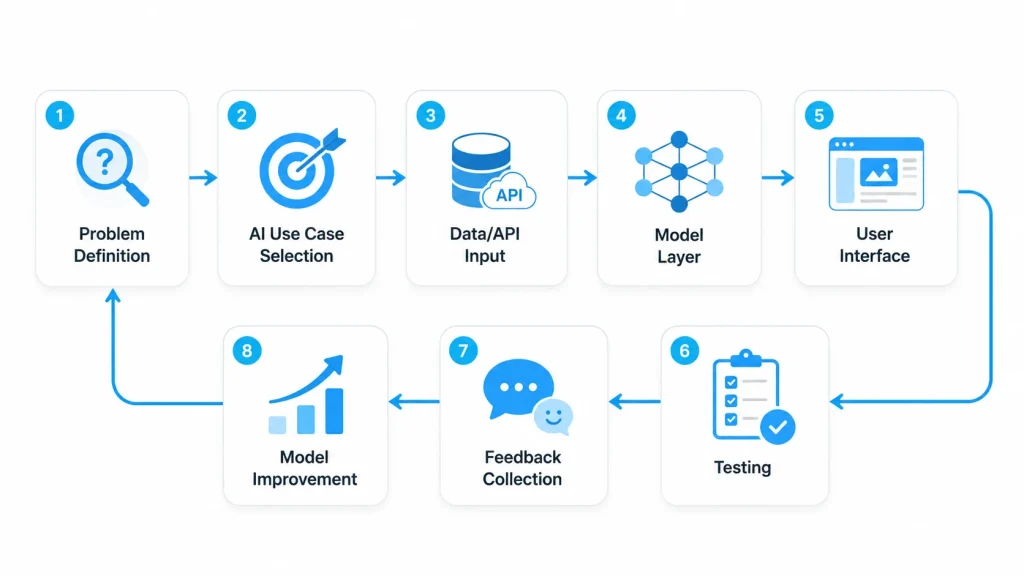
Building an AI MVP is easier when the process stays simple. The goal is to test the idea quickly, learn from users, and improve step by step without making the product too big.
Start With the Problem
Start with the user problem, not with AI itself. First, understand what is difficult, slow, or frustrating for users. When the problem is clear, it becomes much easier to decide what kind of product to build.
Pick One AI Feature
After defining the problem, choose one AI feature that clearly helps solve it. This feature should give users an obvious benefit, such as saving time or making a task easier. Keeping it to one feature makes the MVP easier to build and test.
Use Ready-Made Tools
For most startups, it is better to begin with existing AI tools, APIs, or models. This helps save time, reduce cost, and avoid too much technical work in the beginning. It also lets the team focus more on the product and user experience. In some cases, working with an experienced MVP development company can also help startups move faster and avoid common early mistakes.
Start With Basic Data
Do not wait for perfect data before launching. Use the minimum data that is useful for testing the feature, even if it is small or collected manually. At the MVP stage, learning what works is more important than building a perfect AI system.
Launch and Learn
Once the product is working, launch it to a small group of real users. Watch how they use it, where they get confused, and what they find useful. Their feedback will help you improve the AI MVP in the right direction.
Common Challenges in AI MVP Development
AI MVPs can be very useful, but they also come with some extra challenges. Startups should understand these early so they can plan better and avoid common problems.
Limited Data
Many startups do not have enough data in the beginning. Small or messy data can make AI results weaker and less useful. That is why early AI MVPs should use simple features and improve the data over time.
Higher Cost
AI MVPs can cost more than basic MVPs. Tools, APIs, testing, and extra setup can increase the budget quickly. This is why startups should keep the first version small and only build what is needed to test the idea.
Output Quality
AI does not always give perfect results. Some outputs may be helpful, while others may be unclear or incorrect. Startups need to review outputs carefully and use feedback to improve the feature step by step.
More Technical Work
AI adds more technical work to the product. It may need extra setup, integration, testing, and maintenance. For small teams, this can make development harder, so it is better to start with a simple use case.
Privacy and Rules
If the product uses sensitive user data, privacy becomes very important. Some industries also have strict rules about how data is collected and used. Startups should think about these issues early so they do not create bigger problems later.
How to Measure AI MVP Success
The success of an AI MVP is not about how advanced the technology looks. It is about whether the feature is useful, whether users like it, and whether it helps the product grow.
Product Usage
Start by checking if people are really using the AI feature. Look at how often they use it, whether they come back, and where they stop using it. If users try it once and do not return, the feature may not be useful enough yet.
Output Quality
The AI output should be helpful and easy to use. Check if it saves time, gives useful results, or makes a task easier for the user. Also review errors and weak results so you know what needs to be improved.
User Feedback
User feedback helps you understand what is working and what is not. Ask users what they find useful, what feels confusing, and whether they trust the feature. This gives you clear ideas for what to improve next.
Business Results
You should also watch simple business signals. These can include sign-ups, conversions, repeat use, or early retention. If users take real action after using the feature, it is a strong sign that the AI MVP is creating value. These results can also help founders decide whether the cost of MVP development is leading to the right outcome.
Creole Studios developed LemonAI, a first-of-its-kind AI Visibility Optimizer platform designed to track brand presence across AI-generated search answers like ChatGPT. When traditional SEO tools failed to monitor this new landscape, our developers engineered a scalable AI MVP by seamlessly integrating OpenAI and Perplexity APIs. By managing complex NLP data, API rate limits, and real-time sentiment analysis, Creole Studios helped the startup pioneer a completely new market segment. This case study demonstrates our profound expertise in building robust, market-ready AI platforms from the ground up.
Mistakes to Avoid When Building an AI MVP
Many of these are MVP mistakes startups should avoid, especially when the first version becomes too big, too confusing, or too hard for users to trust. Avoiding these problems can help startups launch faster and learn more clearly.
Starting With AI
Do not start with the idea of “we need AI.” Start with the user problem first. When the problem is clear, it becomes much easier to decide if AI is actually needed and how it should be used.
Choosing a Big Feature
A large AI feature can take too much time and money to build. It is also harder to test and improve in the early stage. A smaller feature is easier to launch, easier to understand, and better for learning.
Waiting for Perfect Data
Many startups wait too long because they think they need perfect data first. But early products usually do not have perfect data. It is better to start with enough useful data to test the idea and improve it over time.
Making It Hard to Use
Even a smart AI feature can fail if the product feels confusing. Users should quickly understand what the feature does and how it helps them. A simple and clear experience makes the MVP easier to trust and use.
Expecting Perfect Results
AI does not need to be perfect in the first version. It only needs to be useful enough to help users solve a problem. Startups should improve the quality step by step instead of expecting perfect output from the beginning.
Scaling Too Early
Do not try to build for a large scale before proving the idea works. First make sure users find the feature useful and want to keep using it. Once the value is clear, the product can be improved and scaled with more confidence.
Conclusion
An AI MVP helps startups test an AI product idea early without spending too much time or money on a full product. The best first version is small, focused, and built around one useful AI feature that solves a real problem. It should be simple enough for users to understand, easy enough to test, and useful enough to show whether the idea has real value.
Startups do not need to launch a complete AI platform in the beginning. They only need a practical first version that helps them learn from real users. When feedback, usage, and results guide the next steps, it becomes easier to improve the product in the right way. This is what makes AI MVP development so valuable for startups. It helps founders reduce risk, manage costs better, and build a smarter product step by step.
If you’re planning to build your AI MVP and want clarity on the right approach, features, or tech stack, you can start with a free 30-minute consulting session. It’s a simple way to validate your idea, avoid common mistakes, and get expert direction before you begin building.
FAQs
1. What is an AI MVP?
An AI MVP is a simple first version of a product that includes one useful AI feature. It is built to test whether the idea solves a real problem for users.
2. How is an AI MVP different from a regular MVP?
A regular MVP may test a product idea without AI. An AI MVP includes an AI-based feature and also tests whether that feature improves the user outcome in a meaningful way.
3. Does every startup need an AI MVP?
No. Some startup ideas can be tested better with a simpler MVP first. AI should be added only when it creates clear product value.
4. What AI feature should a startup build first?
Start with one feature that solves a clear user problem. Good options often include summarization, recommendations, simple automation, smart search, or AI support features.
5. How much data do you need for an AI MVP?
You only need enough relevant data to test the first version. It does not need to be perfect or very large. Quality and usefulness matter more than volume early on.
6. How do you measure AI MVP success?
Measure whether users use the feature, find the output useful, give positive feedback, and show real interest through repeat usage, retention, or conversions.










 30 mins free Consulting
 10 min read

 Canada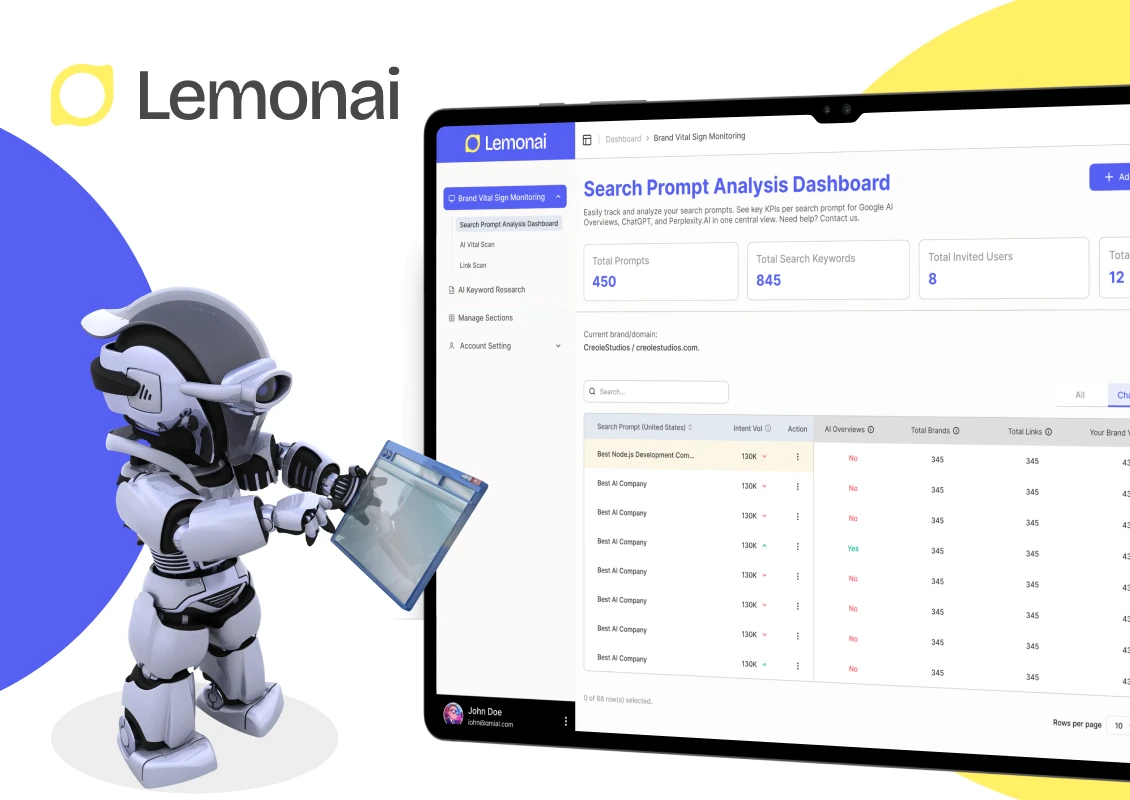
 Hong Kong
 Global





 Love we get from the world