
 Lets Talk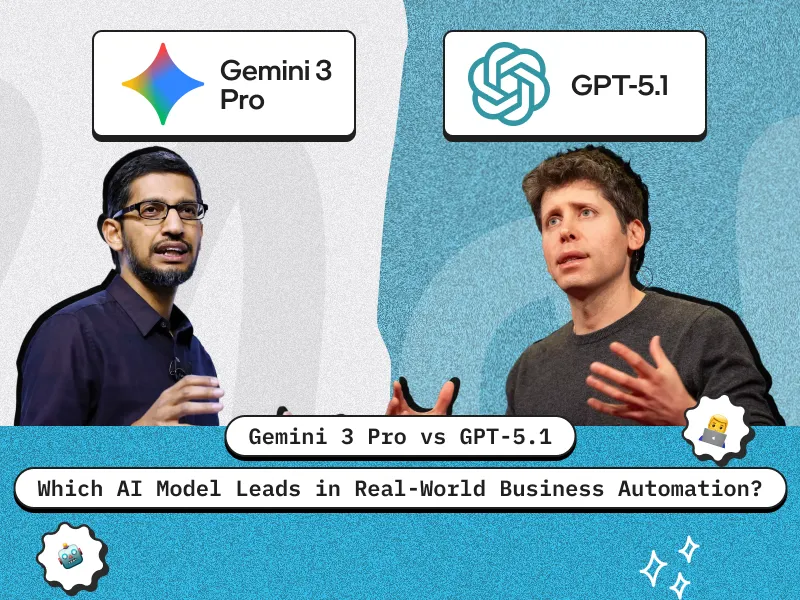
TL;DR
- GPT-5.1 excels in logic-heavy, code-driven, and agent-based automation with more predictable reasoning and lower cost for long-running workflows.
- Gemini 3 Pro dominates multimodal tasks, visual extraction, and long-context automation with its 1M-token window and superior screen/PDF/video understanding.
- For enterprise automation, GPT-5.1 is more reliable for engineering, decision-making, and structured outputs, while Gemini 3 Pro is better for document-heavy and visual-first pipelines.
- Both models differ sharply in cost and speed: GPT-5.1 offers better output economics, while Gemini 3 Pro shines with high-speed multimodal throughput.
- The best automation stack uses both models together—Gemini for extraction, GPT-5.1 for reasoning—forming the new industry-standard hybrid workflow.
Introduction: Why This Comparison Matters for Automation Teams
AI automation is evolving faster than most businesses can keep up with. We’re long past the stage where the benchmark for a “good model” was its ability to write a decent essay or score well on a standardized test. Today, organizations want AI systems that can run as dependable components inside their operational workflows, not creative toys, but automation engines that help teams move faster, reduce manual effort, and eliminate bottlenecks.
This shift has also changed how businesses evaluate technology partners. Instead of asking “Can this model write?”, leaders now ask “Can this model automate?” It’s the reason CTOs, product heads, and digital leaders increasingly work with a Generative AI development company to build automation systems that are stable, predictable, and production-ready.
And that brings us to the two biggest AI launches of late 2025: OpenAI’s GPT-5.1 and Google’s Gemini 3 Pro. Released just days apart, these frontier models represent two very different philosophies of automation. Both are incredibly powerful but they behave very differently when placed inside real business pipelines, automation platforms like Make or n8n, or custom enterprise workflows.
Understanding those differences is no longer optional.
It’s the difference between building an automation system that quietly runs your operations – and one that collapses every time a prompt changes or a document format shifts.
This guide breaks down exactly how GPT-5.1 and Gemini 3 Pro perform in real-world automation, helping you decide which AI model is the right foundation for your workflows – and where using both is the smartest long-term strategy.
Model Overview: What Each AI Is Designed to Do
GPT-5.1 – Built for Agents, Reasoning, and Code-Driven Automation
GPT-5.1 is OpenAI’s most production-oriented model yet – refined specifically for automation, agent workflows, and code-centric tasks. Instead of just boosting raw intelligence, OpenAI focused on making the model more predictable, structured, and reliable, which is exactly what modern automation teams need.
GPT-5.1 stands out because it handles:
- Multi-step reasoning with cleaner, more consistent logic
- Stable decision-making, even in nested or conditional workflows
- High-accuracy coding and debugging, ideal for engineering automation
- Robust tool and agent use, including shell commands and API-driven actions
- Clear, natural communication, useful for chatbots and support agents
- Faster responses on simple queries, thanks to adaptive thinking
Key upgrades include:
- Instant vs. Thinking modes for speed or depth
- Adaptive reasoning, letting the model “think harder” only when needed
- Improved code-editing tools like apply_patch and shell
- Stronger format adherence, reducing JSON or schema errors
- Prompt caching, cutting costs for long-running automation loops
Overall, GPT-5.1 behaves like an engine intentionally tuned for production systems – especially when workflows rely on logic, coding, structured outputs, and agent orchestration.
Gemini 3 Pro – Designed as a Multimodal, Long-Context Automation Engine
Gemini 3 Pro takes a different approach. It’s designed as a multimodal reasoning model with a massive 1M-token context window, giving it an entirely different skill profile compared to GPT-5.1.
Where Gemini 3 Pro excels:
- Understanding and analyzing visuals (images, PDFs, screenshots, diagrams)
- Extracting structured data from complex documents
- Combining visual + text reasoning in a single pass
- Processing extremely large inputs, like policy decks or full code repos
- Google-native automation, especially across Workspace, Drive, and Android
Primary strengths:
- 1,000,000-token input window
- Native multimodality – text, images, audio, video, PDFs, code
- High scores on visual reasoning benchmarks (MMMU-Pro, ScreenSpot, Video-MMMU)
- Highly creative zero-shot generation, especially for UI, SVG, and design tasks
If GPT-5.1 is the logic engine of automation, Gemini 3 Pro is the sensory system – built to see, interpret, and work with the mixed-media content modern businesses use every day.
Major AI Model Cost Comparison:
Deepseek vs ChatGPT Cost Comparison
Top AI Reasoning Model Cost Comparison 2025
How They Behave in Real Automation Workflows
Benchmarks matter.
But automation breaks when models misinterpret data, fail to follow instructions, or drift from previous context.
Here’s how both models behave under actual pressure.
Reasoning Stability and Multi-Step Workflow Reliability
GPT-5.1: More Reliable for Logic-Heavy Automation
Automation platforms (Make, Zapier, n8n, internal pipelines) require:
- Clean step-by-step reasoning
- Conditional routing
- Consistent decisions
- Error recovery
- Predictable structure
GPT-5.1 performs better here.
Why it wins:
- More coherent multi-step logic
- Cleaner action breakdowns
- Less variance across runs
- Stronger recovery when inputs are incomplete
- Fewer hallucinated conditions
- Better alignment with long chain-of-thought flows
Best for:
- Decision engines
- Routing logic
- Financial calculations
- Policy-based flows
- Compliance check automation
- Agent planning
Gemini 3 Pro: Good for Linear Flows, Less Consistent in Branching
Gemini 3 Pro performs very well when workflows are:
- Extraction-driven
- Linear
- Moderately complex
But under branching logic (if–else chains, nested rules), its output consistency can drop.
Best for:
- Summaries
- Extract → transform → load (ETL) tasks
- Information-rich flows
Instruction Following and Format Compliance
From real-world stress tests:
- Gemini won 7 out of 11 tasks
- GPT-5.1 won 4 out of 11
Where Gemini 3 Pro excels:
- Long prompts with multiple conditions
- Strict formatting + multi-part output
- Detailed, narrative or creative tasks
- Zero-shot instruction bundles
- Structured content across multiple media types
Example:
A fully coherent party plan with 20+ constraints delivered in a single prompt—GPT-5.1 failed this test.
Where GPT-5.1 excels:
- Business emails
- Ethical reasoning
- Math + logic
- Clean, professional communication
- Tasks requiring practical context
Example:
GPT-5.1 produced more accurate business emails with proper structure and tone.
Verdict:
Both are excellent – Gemini wins for complexity + creativity; GPT-5.1 wins for clarity + professionalism.
Coding, Engineering Assistants, and Tool Use
GPT-5.1: The Clear Winner for Code-Driven Automation
When your automation workflows depend on coding accuracy, structured transformations, or agent-based tool execution, GPT-5.1 consistently outperforms every other frontier model in this category.
If your automation includes:
- Schema transformations and API payload mapping
- Code generation for backend, frontend, or automation scripts
- JSON restructuring and strict format outputs
- Debugging and refactoring existing code
- CI/CD and Git-driven workflows
- Multi-agent tool orchestration
- Shell commands and command-line reasoning
Why GPT-5.1 leads here:
- Higher performance on SWE-bench and other real-world coding tests
- More stable and predictable code generation
- Better diff quality through apply_patch
- Stronger CLI and shell reasoning
- More consistent tool call outputs
- Better step-by-step debugging logic
In practice, GPT-5.1 feels like collaborating with a senior engineering assistant—fast, precise, and reliable across long coding chains.
Gemini 3 Pro: Excellent, But More Conservative
Gemini 3 Pro is a very capable coder, especially when tasks involve visual context such as screenshots, diagrams, UI components, or mixed-media documentation. Its massive 1M-token context window also makes it ideal for navigating and reasoning across extremely large codebases.
Where Gemini 3 Pro stands out:
- Works well with repositories that include images, UI flows, or architecture diagrams
- Handles long, multi-file contexts without chunking
- Provides safer, more cautious code when uncertain
- Performs solidly on algorithmic and multimodal developer tasks
However, Gemini 3 tends to generate shorter, more conservative code blocks and may hesitate in edge-case debugging or complex transformation logic.
For pure code reliability and tool-driven automation, GPT-5.1 remains the stronger, more predictable choice.
Multimodal Intelligence and Extraction Accuracy
Multimodality is one of the biggest differentiators between these two models—and this is where Gemini 3 Pro takes a decisive lead. While GPT-5.1 is strong in reasoning and tools, Gemini 3 Pro is built to see, interpret, and extract information from complex visual content with far greater accuracy.
Gemini 3 Pro: The Best Multimodal Model Available Today
Gemini 3 Pro isn’t just a text model—it’s a full-spectrum multimodal engine capable of understanding images, PDFs, videos, diagrams, UI screens, and mixed-layout documents in a single pass.
Where Gemini 3 Pro excels:
- Complex screenshot analysis (UI states, error screens, flows)
- PDF extraction with correct tables, layout, and embedded visuals
- Video frame reasoning for QA, training, or surveillance workflows
- Understanding diagrams, architecture sketches, workflows, charts
- Automated UI/UX audits using screenshots
- Deep mixed-content comprehension (images + text + layout combined)
Benchmark leadership:
- MMMU-Pro (multimodal understanding)
- Video-MMMU (visual + temporal reasoning)
- ScreenSpot-Pro (screen understanding)
- ARC-AGI-2 (advanced abstraction + pattern reasoning)
Because of its unmatched visual intelligence, Gemini 3 Pro becomes indispensable for automation use cases such as:
- Support ticket automation using screenshots
- Visual QA testing across apps and devices
- Product analytics from user-submitted media
- HR workflows involving scanned documents
- Compliance checks across PDFs or scanned contracts
- Marketing visual workflows (banner audits, layout generation, creatives)
Gemini 3 Pro effectively acts as the visual cognition layer of an enterprise – able to interpret visual data just like a human analyst.
GPT-5.1: Good Vision, But Not Cutting Edge
GPT-5.1 does support vision features, but its capabilities are still text-first and tool-heavy, not native multimodal like Gemini.
GPT-5.1 can reliably:
- Read and interpret basic images
- Extract text or labels
- Describe objects, layouts, or simple diagrams
- Provide suggestions based on visual inputs
But it cannot match Gemini 3 Pro’s multimodal depth, especially for:
- Complex layouts
- UI reasoning
- Video analysis
- Mixed-media PDFs
- Screen-intensive workflows
For automation teams, this difference becomes immediately visible when the input includes screenshots, user media, scanned documents, or design elements.
Long-Context Behavior and Document Automation
Gemini 3 Pro: The 1M-Token Beast
Gemini can load:
- Entire code repositories
- Multi-hour transcripts
- 400-page strategy decks
- Legal agreements
- Multi-file document collections
In one prompt, without chunking.
Huge advantage for:
- Due diligence
- Legal analysis
- Research workflows
- Multi-document compliance scanning
- Full-project ingestion for agents
GPT-5.1: More Stable Over Multi-Turn Context Reuse
GPT-5.1 is better when:
- The workflow spans many steps
- The agent needs to remember prior actions
- The same context is reused repeatedly
- Long-running automations loop through data
Verdict:
- Single-shot large ingestion → Gemini 3 Pro
- Multi-turn, long-running workflows → GPT-5.1
Speed, Cost, and Throughput in Automation Pipelines
In real-world automation, raw model intelligence matters—but execution speed, cost per workflow, and run-to-run reliability directly determine whether an automation pipeline scales or collapses under load. GPT-5.1 and Gemini 3 Pro handle these constraints very differently, and understanding their operational economics helps teams pick the right engine for the right workflow.
Speed Insights
Both models process tokens at different speeds, and this creates meaningful differences in throughput:
- Gemini 3 Pro → ~130 tokens/sec
Fast, especially on multimodal or long-context inputs.
- GPT-5.1 → ~87 tokens/sec
Moderately fast, prioritizing reasoning stability over raw speed.
Why this matters:
If your automation includes summarizing PDFs, generating UI code, or producing 2,000+ token outputs, Gemini finishes noticeably faster.
Example:
Extracting insights from a 150-page PDF:
- Gemini 3 Pro: ~8 seconds
- GPT-5.1: ~12–14 seconds
For small tasks, the speed difference is negligible.
For large tasks, it compounds significantly.
Cost Breakdown (Now with Clear 1M-Token Examples)
Automation teams often struggle to estimate token cost because context size, input/output ratios, and pricing tiers vary wildly. Below is the clearest, real-world-friendly breakdown possible.
GPT-5.1 Pricing
- Input: $1.25 per 1M tokens
- Output: $10 per 1M tokens
- Cached Input: $0.125 per 1M tokens (90% cheaper)
Gemini 3 Pro Pricing (Preview)
- Up to 200k context: $2 input / $12 output
- Above 200k context: $4 input / $18 output
Since 1M tokens exceed 200k, Gemini uses the higher tier.
How Much Does 1 Million Tokens Actually Cost?
Here is the simplest way to understand it:
Cost for 1,000,000 Input Tokens
| Model | Cost for 1M Input Tokens |
| GPT-5.1 | $1.25 |
| Gemini 3 Pro | $4.00 |
➡ Gemini is 3.2× more expensive for large inputs.
Cost for 1,000,000 Output Tokens
| Model | Cost for 1M Output Tokens |
| GPT-5.1 | $10 |
| Gemini 3 Pro | $18 |
➡ Gemini is 1.8× more expensive for large generated outputs.
Cost for 1M Cached Input Tokens (GPT Only)
GPT-5.1 offers a massive discount for repeated prompts:
- $0.125 per 1M tokens
→ ideal for agents or workflows reusing the same system prompt thousands of times.
Gemini does not offer caching at this scale.
Practical Workflow Example: 1M-token Policy Automation
Workflow
Upload 1,000,000-token corporate policy → summarize → convert to structured JSON.
Output tokens: ~150k
GPT-5.1 Cost
- Input: $1.25
- Output: 150k × $10/1M = $1.50
Total: $2.75
Gemini 3 Pro Cost
- Input: $4.00
- Output: 150k × $18/1M = $2.70
Total: $6.70
➡ GPT-5.1 = 2.4× cheaper
➡ Gemini = handles PDFs with diagrams, screenshots, mixed formatting in one go
Price vs capability becomes a strategic choice.
Where Gemini 3 Pro Is More Cost-Efficient
Gemini becomes cheaper at scale when the workload includes very large, very complex inputs such as:
- 300k–1M token documents
- PDF extraction with tables + diagrams
- Video analysis (frame-by-frame)
- Screenshot-based support automation
- Mixed-media compliance workflows
Why?
Because GPT-5.1 would require chunking, increasing token usage and latency.
Where GPT-5.1 Is More Cost-Efficient
GPT-5.1 wins on cost when automation is logic-oriented, code-heavy, or repetitive:
- CI/CD and Git ops
- JSON transformation
- Rule-based systems
- Chatbots and multi-turn conversations
- Multi-agent pipelines repeating the same prompt
Its prompt caching alone reduces cost by up to 90%, making it ideal for high-volume automation.
Throughput Reality: How They Behave at Scale
Throughput = how many automated tasks can run reliably per hour.
Here’s the practical difference:
Gemini 3 Pro
- Higher throughput
- Faster generation
- Best for large, visual, or multimodal workloads
- Ideal for teams handling 100+ large documents/day
GPT-5.1
- More predictable across thousands of runs
- Lower reasoning variance
- Better for rule engines, financial workflows, compliance automation
- Ideal for “never-break” back-office pipelines
Example:
A finance pipeline validates 20,000 transactions every hour.
- Gemini = faster but reasoning variance may cause small deviations
- GPT-5.1 = slower but produces near-identical results every run → critical for compliance
Not sure which AI model fits your automation costs?
Use our AI Automation Cost Calculator to compare GPT-5.1 vs Gemini 3 instantly

Enterprise Integration and Ecosystem Fit
Choose GPT-5.1 if you rely on:
- OpenAI ecosystem
- Azure enterprise stack
- GitHub + VS Code
- Agentic workflows
- Tool-driven automations
- Engineering-heavy systems
Choose Gemini 3 Pro if you rely on:
- Google Workspace
- Vertex AI
- Google Sheets automation
- Drive document workflows
- Android app ecosystems
- Visual + document-heavy processes
Which Model Fits Which Workflow?
The right model depends on how your automation behaves. GPT-5.1 and Gemini 3 Pro excel in very different environments, and most businesses ultimately benefit from using both strategically.
When GPT-5.1 Is the Better Choice
Use GPT-5.1 when your automation pipelines rely heavily on logic, structure, and predictable execution, such as:
- Logic-first workflows: Conditional routing, validation rules, decision engines.
- Code-heavy automation: CI/CD, schema transformations, debugging, refactoring, shell-based tasks.
- Multi-step reasoning and iterative loops: Agents that read, think, and act repeatedly.
- Tool-centric systems: Workflows requiring API calls, function chaining, browser actions, or multi-agent orchestration.
- Long-running routines: Pipelines that reuse the same prompt across thousands of runs (where caching saves 90%+ cost).
GPT-5.1 is the model you choose when accuracy, consistency, and reliability matter more than multimodal depth.
When Gemini 3 Pro Is the Better Choice
Use Gemini 3 Pro when your workloads depend on visual intelligence, massive context, or document-heavy inputs, including:
- Visual-first automation: Screenshot analysis, UI testing, diagram reading, slide audits.
- Document-heavy workflows: PDFs with tables, forms, charts, layouts, or embedded images.
- Multimodal input streams: Combining video frames, spreadsheets, emails, and images in one context.
- Extraction-based tasks: Compliance audits, invoice parsing, product analytics, knowledge extraction.
- Research and analysis: Technical papers, policy documents, educational content, multimodal RAG.
- Zero-shot creative tasks: Web design, SVG generation, UI layouts, animations, visual ideation.
Gemini 3 Pro excels where input complexity is high and where AI needs to “see,” not just “think.”
When You Should Use Both Models Together
Most businesses- and almost all automation platforms – fit into this category.
Use a hybrid strategy when you handle:
- Deep reasoning and heavy multimodal input
- Coding workflows plus document/screenshot processing
- Customer support automation and back-office extraction
- RAG pipelines with long contexts and structured logic tasks
- Multi-agent systems requiring both vision and strong planning
Many automation teams route:
- Gemini 3 Pro → for extraction, visual tasks, and large-input analysis
- GPT-5.1 → for reasoning, decisions, code, and structured actions
This combination provides the best accuracy, fastest processing, and lowest overall cost.
Need a hybrid GPT-5.1 + Gemini 3 automation strategy?
Get expert guidance on building clean, scalable, and cost-efficient automation workflows tailored to your business.
Final Verdict: Which One Leads in Real-World Business Automation?
Both models are extremely capable—but they lead in different areas.
Where GPT-5.1 Wins
- Engineering and coding workflows
- Stable multi-step reasoning
- Automated decision-making
- Agent-based tool use
- Conversational and support systems
- Cost-efficient scaling (especially with caching)
GPT-5.1 is the more predictable, logic-driven engine—ideal for pipelines that must run reliably at scale.
Where Gemini 3 Pro Wins
- Document automation and PDF extraction
- Screenshot, UI, and multimodal analysis
- Long-context tasks (300k–1M tokens)
- Cross-modal reasoning
- Visual and layout-heavy workflows
- Google Workspace and Drive automations
Gemini 3 Pro is the stronger choice when your automation relies on rich, visual, or mixed-media inputs.
The Real Answer: Use Both
Most teams get the best results from a hybrid setup:
- Gemini 3 Pro → all extraction, visual analysis, long documents
- GPT-5.1 → reasoning, coding, tool calls, structured decisions
This two-model strategy is quickly becoming the industry norm.
And for companies looking to build such hybrid automation systems, working with a specialised partner like a generative AI development company can help integrate both models cleanly into existing workflows.Book a free 30-minute consultation, and we’ll help you choose the right model (or combination) for your automation workflows.


 11 min read


