
 Lets Talk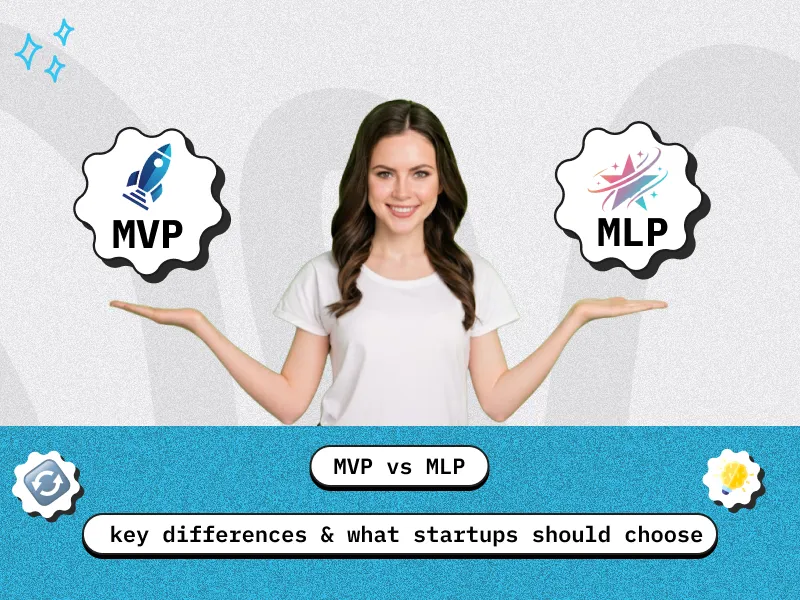
TL;DR
- MVP (Minimum Viable Product) = Build the simplest version to validate your idea and test assumptions quickly.
- MLP (Minimum Lovable Product) = Focuses on delighting users with a polished, lovable experience from the start.
- Key Difference: MVP prioritizes speed and validation, while MLP emphasizes user experience and retention.
- Best Approach in 2026: Start with an MVP → learn from users → evolve into an MLP for long-term growth.
- Takeaway: MVP answers “Does it work?” and MLP answers “Do users love it?” — choose based on your startup stage.
Introduction
When launching a startup, speed and innovation often matter more than perfection. That’s why frameworks like MVP (Minimum Viable Product) and MLP (Minimum Lovable Product) have become essential in the lean startup world.
Both concepts help founders test ideas and deliver value faster — but they’re not the same. Many entrepreneurs confuse them, which can lead to wasted resources or missed opportunities. This is where MVP development services play a crucial role, helping startups build the right product strategy, validate ideas quickly, and transition smoothly from an MVP to an MLP.
So, what’s the real difference between an MVP and an MLP? And which approach should your startup choose in 2026? Let’s break it down.
What is an MVP?
An MVP (Minimum Viable Product) is the most basic version of your product that lets you test your business idea with real users. Instead of spending months (or even years) building a full product, an MVP focuses only on the core features needed to validate your concept and see if it truly solves a problem.
- Purpose: Validate assumptions and reduce risks.
- Focus: Functionality first, design second.
- Goal: Gather real-world feedback and learn quickly.
Key Benefits of Building an MVP
- Faster time-to-market – Test your idea quickly.
- Lower development costs – Save money by avoiding unnecessary features.
- Real user insights – Collect valuable feedback before scaling.
In simple terms, an MVP helps you answer the question: “Do users really need this product?”
What is an MLP?
An MLP (Minimum Lovable Product) takes product development a step beyond the MVP. While an MVP focuses on functionality and validation, an MLP is designed to make users love the experience from the very beginning. The goal isn’t just to test an idea — it’s to delight early adopters and build lasting loyalty.
- Purpose: Create an emotional connection and excitement.
- Focus: Combine core functionality with a great user experience.
- Goal: Turn early adopters into passionate brand advocates.
Key Benefits of Building an MLP
- Stronger user retention – Keeps customers engaged long-term.
- Positive word-of-mouth – Delighted users naturally share their experiences.
- Builds brand loyalty – Creates emotional bonds from the start.
Put simply, an MLP answers the question: “Do users enjoy using this product enough to stick with it?”
Ready to Validate Your Idea Quickly?
Our expert team helps startups build MVPs and transition into MLPs efficiently, saving time and reducing risk.

MVP vs MLP: Key Differences
While both MVP and MLP are lean startup strategies, they serve very different purposes. An MVP is all about validating ideas quickly, while an MLP is about creating products users fall in love with.
| Feature | MVP (Minimum Viable Product) | MLP (Minimum Lovable Product) |
| Goal | Validate idea & test assumptions | Delight users & build loyalty |
| Focus | Core functionality only | Functionality + user experience |
| Speed | Launch as quickly as possible | Takes more time to refine |
| User Impact | Usable but basic | Usable, polished, and enjoyable |
| Best For | Early-stage startups | Competitive or user-driven markets |
For many startups, the ideal path is to start lean with an MVP (for validation) and then evolve into an MLP (to create user loyalty).
Read More: 7 Key Factors to Choose the Right MVP Development Company
When to Build an MVP
Building an MVP is the right choice when your startup needs to test the waters before diving in fully. It’s all about saving time, reducing risks, and validating whether your idea has real market demand.
You should consider an MVP if:
- You’re still testing whether your idea solves a real customer problem.
- You have limited time and budget and need to launch fast.
- Your target market is uncertain and requires validation.
- Your primary goal is learning and gathering feedback, not delighting users yet.
Best industries for MVPs
Some industries are perfect for MVP development because they involve high experimentation and fast iteration, such as:
- Emerging tech solutions (AI, blockchain, IoT).
- Marketplace platforms (buyer-seller apps, gig economy platforms).
- Products with unproven demand, where market acceptance is still unknown.
In short, if you’re unsure whether your idea will succeed, an MVP is your safest and smartest starting point.
When to Build an MLP
An MLP (Minimum Lovable Product) is the right choice when your idea is already validated, and you want to differentiate your product in a competitive market. Instead of focusing only on functionality, an MLP adds that extra layer of polish and delight that makes users stick around.
You should consider an MLP if:
- Your idea is already proven, but you need to stand out among competitors.
- User experience is critical, such as in SaaS or consumer-focused apps.
- You want to build customer loyalty from day one.
- Your audience cares about design and usability as much as functionality.
Best industries for MLPs
MLPs are especially effective in industries where user engagement and retention drive success:
- SaaS platforms that rely on strong daily usage.
- FinTech and HealthTech apps, where trust and usability are non-negotiable.
- Consumer-focused products, where delight directly impacts retention.
In simple terms: build an MLP when you’re not just looking to validate your idea, but to win hearts and loyalty from the very beginning.
Want to Know Your MVP/MLP Development Cost?
Use our free cost calculator to estimate your project budget and plan effectively before building your product.
Can You Transition from MVP to MLP?
Absolutely! In fact, many of the world’s most successful startups follow this exact path. They start lean with an MVP to validate demand, then use real customer feedback to refine the product into an MLP that users truly love.
Example of Transition
- Instagram – Originally launched as Burbn, a basic photo-sharing MVP. After validating user interest, the team pivoted, simplified the product, and added delightful features like filters and a sleek design. This evolution transformed it into a lovable product used by millions.
How to Transition from MVP to MLP
- Launch an MVP – Validate demand with minimal features.
- Collect user feedback – Identify what customers value most.
- Enhance the experience – Add delight factors such as improved UI, smoother UX, and emotional touchpoints.
- Iterate quickly – Keep refining until your product feels both functional and lovable.
The smartest strategy is simple: Validate with MVP, scale with MLP.
Read More: MVP Development Cost: Startup Budget & Pricing Guide
Common Mistakes Founders Make
Even though MVPs and MLPs are powerful strategies, many founders stumble in execution. Here are some common pitfalls to avoid:
- Treating the MVP as the final product: An MVP is a starting point, not the end goal. Founders who stop iterating after launching an MVP miss opportunities to improve, delight users, and stay competitive.
- Spending too much time perfecting the MVP before testing: The whole point of an MVP is speed and validation. Delaying launch to polish features defeats the purpose and risks losing market momentum.
- Ignoring user experience until later stages: While an MVP doesn’t need to be flawless, it must be usable. A clunky interface or confusing flow can turn early adopters away, making it harder to collect valuable feedback.
- Jumping straight to MLP without validation: Skipping the MVP phase and going all-in on “delightful” features increases the risk of building something nobody truly wants, wasting time and money.
MVP vs MLP: What Startups Should Prioritize
The startup landscape in 2026 is faster and more competitive than ever. Users no longer tolerate clunky first versions; they want both speed and a great experience. This creates a challenge for founders: launching only a bare-bones MVP may fail to attract users, but jumping straight to a polished MLP without validation can be equally risky.
The smart strategy:
- Start learning with an MVP – Validate your idea quickly and gather real user insights before investing heavily.
- Transition into an MLP fast – Once you confirm demand, add delight factors like intuitive design, smooth interactions, and emotional value.
- Balance validation and experience – Winning startups are the ones that ship quickly, but also deliver an enjoyable product that users want to stick with.
In short, treat the MVP as your launchpad and the MLP as your growth engine. Together, they create a sustainable path to product-market fit.
Conclusion
Both MVP (Minimum Viable Product) and MLP (Minimum Lovable Product) are essential strategies for startups, but they serve different purposes. An MVP helps you quickly test and validate your idea with real users, while an MLP focuses on creating a product that users love and stick with.
Choosing the right approach depends on your startup’s stage, budget, and goals. For early-stage validation, leveraging MVP development services can help you build a functional product efficiently and gather actionable feedback. Once your idea is proven, you can evolve into an MLP to enhance user experience and build loyalty.
The winning formula is clear: launch fast with an MVP, then smartly transition into an MLP for sustainable growth. This approach ensures both validation and long-term success in a competitive market.
FAQs
Q1. What is the difference between MVP and MLP?
An MVP (Minimum Viable Product) validates your idea with core features, while an MLP (Minimum Lovable Product) goes further by delighting users with a polished, lovable experience.
Q2. When should startups build an MVP?
Startups should build an MVP when they want to test assumptions quickly, validate demand, and launch with limited time and budget.
Q3. When is it better to build an MLP?
An MLP is ideal when your idea is validated, competition is strong, and you need to create emotional connections and retain users from the start.
Q4. Can an MVP evolve into an MLP?
Yes. Many startups launch with an MVP, gather user feedback, and then refine design, usability, and features to evolve into an MLP.
Q5. Which is better for startups in 2026: MVP or MLP?
Neither is universally better. The choice depends on your stage. Early-stage ideas need MVPs for validation, while validated concepts benefit from MLPs to boost retention and growth.


 10 min read


