

 Lets Talk
If you are comparing Austin web design companies, start with Creole Studios, GLIDE, Digitech Web Design, HMG Creative, Fahrenheit Marketing, UPQODE, Lucid Crew, Workhorse Marketing, Mighty Citizen, and Lounge Lizard. The right choice depends on whether you need a conversion-focused marketing site, ecommerce store, SaaS website, brand redesign, or a website backed by custom development.
This guide compares providers by practical project fit rather than relying only on portfolio appearance.
TL;DR
- Creole Studios is a strong option for businesses that need UI/UX design combined with web development and scalable technology.
- GLIDE suits content-heavy and mission-driven websites.
- Digitech Web Design focuses heavily on conversion-oriented website experiences.
- HMG Creative combines website design with branding and marketing.
- Evaluate agencies by relevant experience, UX process, development capability, accessibility, performance, SEO readiness, ownership terms, and post-launch support.
- Shortlist three companies and request proposals against the same scope before comparing pricing.
How Did We Select These Austin Web Design Companies?
This list is based on criteria that matter during an actual website project rather than simply ranking companies by brand recognition.
We considered:
- Web design and UX capabilities
- Development and CMS expertise
- Responsive design practices
- Portfolio and relevant project experience
- Accessibility and performance awareness
- SEO-ready website architecture
- Ability to support different business requirements
- Post-launch support and maintainability
Industry directories such as Clutch and Built In also maintain lists of web design providers operating in the Austin market, which can provide another source for independent research.
Austin Web Design Companies Comparison
| Company | Best For | Key Strength |
| Creole Studios | Startups, SMBs, SaaS and growing companies | UI/UX plus custom development |
| GLIDE | Content-heavy and purpose-driven organizations | UX, accessibility and CMS |
| Digitech Web Design | Lead-generation websites | Conversion-focused design |
| HMG Creative | Growing brands | Branding plus web design |
| Fahrenheit Marketing | B2B and growth-focused companies | Web design plus digital strategy |
| UPQODE | SEO-conscious businesses | WordPress and responsive design |
| Lucid Crew | Local businesses and SMBs | Maintainable business websites |
| Workhorse Marketing | Marketing-led organizations | Integrated creative services |
| Mighty Citizen | Nonprofits and mission-driven brands | Strategy and content |
| Lounge Lizard | Brand-focused businesses | Creative and visual identity |
Which Austin Web Design Companies Should You Consider?
1. Creole Studios
Best for: Startups, SMBs, SaaS businesses and companies needing design plus engineering.
Creole Studios provides website strategy, UI/UX design, responsive web design, CMS implementation, ecommerce development and custom web engineering.
Its design-and-development model can be useful when a project extends beyond a simple marketing site and requires reusable components, custom functionality, integrations or future product development.
For businesses evaluating a complete local engagement, the company’s Austin web design services explain its design, development and delivery process in more detail.
Consider Creole Studios when: your website requires both strong UX and technical scalability.
Validate before hiring: comparable project examples, proposed technology, content responsibilities, QA process and post-launch support.
2. GLIDE
Best for: Nonprofits, healthcare organizations and content-heavy websites.
GLIDE focuses on structured digital experiences with attention to usability, accessibility and content management.
It can be particularly relevant when multiple teams need to publish and manage website content after launch.
Validate: accessibility testing, CMS governance and editorial workflows.
3. Digitech Web Design
Best for: Businesses focused on lead generation.
Digitech Web Design approaches websites from a conversion and digital marketing perspective, making it relevant for organizations where the site’s primary objective is generating qualified inquiries.
Validate: how conversion decisions are researched, tested and measured after launch.
4. HMG Creative
Best for: Businesses combining a website redesign with broader brand work.
HMG Creative provides branding, web design and digital marketing services and is among Austin agencies identified by Built In.
Validate: whether your engagement includes strategy and messaging or only visual execution.
5. Fahrenheit Marketing
Best for: B2B companies requiring web design alongside digital marketing.
The company combines design and development with broader marketing capabilities, which may suit businesses coordinating their website with acquisition campaigns.
Validate: ownership of analytics, SEO, content and ongoing optimization.
6. UPQODE
Best for: Businesses looking for WordPress-oriented website delivery.
UPQODE combines responsive website design with development and SEO considerations.
Validate: CMS architecture, performance testing and whether ongoing SEO is included or separately scoped.
7. Lucid Crew Web Design
Best for: Local businesses and SMB websites.
Lucid Crew is suited to organizations prioritizing straightforward website management, clear layouts and ongoing maintenance.
Validate: maintenance agreements, response times and ownership of plugins, licenses and hosting accounts.
8. Workhorse Marketing
Best for: Businesses that want website design integrated with broader marketing activity.
Workhorse Marketing appears among Austin web design agencies identified by Built In and combines web work with creative and marketing services.
Validate: which services are performed internally and which are separately scoped.
9. Mighty Citizen
Best for: Nonprofits, associations and mission-driven organizations.
Mighty Citizen combines strategy, creative work and digital experiences, making it worth considering when messaging and content architecture are central to the redesign.
Validate: research methodology, stakeholder involvement and CMS requirements.
10. Lounge Lizard
Best for: Businesses prioritizing brand expression and creative direction.
Lounge Lizard combines web design, branding and digital marketing, making it relevant for companies seeking a more visually distinctive marketing website.
Validate: how creative concepts translate into usability, performance and measurable business goals.
What Should You Look for in an Austin Web Design Company?
A polished portfolio is useful, but it should not be your only selection criterion.
Ask each company how it handles:
- User experience: Does the team create sitemaps, user flows, wireframes and prototypes before visual design?
- Responsive design: How are layouts tested across desktop, tablet and mobile devices?
- Accessibility: Does the project consider WCAG requirements? The W3C’s current WCAG 2.2 standard provides testable accessibility criteria for web content.
- Performance: Ask how the team addresses loading speed, responsiveness and layout stability. Google’s Core Web Vitals currently measure these through LCP, INP and CLS.
- SEO foundations: Confirm responsibility for crawlability, redirects, page titles, canonical tags, structured data, content migration, and technical SEO requirements.
- Pricing and scope clarity: Before comparing proposals, understand what typically affects website pricing, including page count, custom UX, CMS complexity, ecommerce functionality, integrations, content migration, and ongoing support. Our guide to website design cost in Austin breaks down the major pricing factors so you can build a more realistic budget before contacting agencies.
- Ownership: Establish who owns the Figma files, source code, domains, analytics properties, CMS licenses, and third-party accounts.
You can also use this website evaluation checklist to assess your existing website before requesting redesign proposals.
Practical Experience: What Commonly Causes Website Redesign Problems?
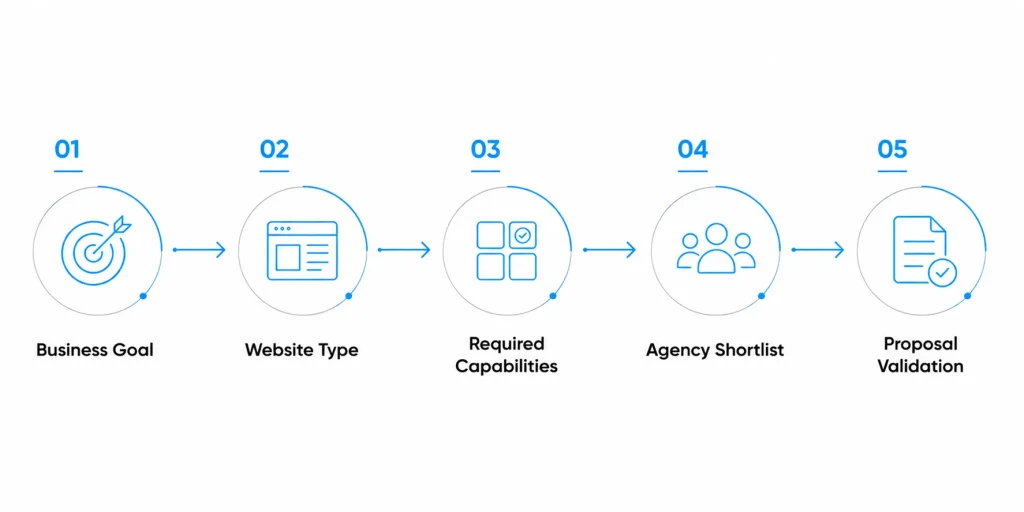
In web projects, design quality is rarely the only factor that determines whether a redesign launches smoothly.
Problems often appear when content ownership is unclear, every page is designed independently instead of using reusable templates, mobile states are reviewed too late, or integrations are discovered after development has started.
A better approach is to agree on the sitemap, reusable page templates, content responsibilities, responsive behavior, integrations and acceptance criteria before development begins.
For projects requiring more than a marketing website, involving a web development company early can also help identify architectural and integration constraints before they create expensive redesign work.
How Should You Shortlist an Austin Web Design Company?
Start with three agencies whose past work resembles your project.
Send each company the same brief covering your business goals, audience, required pages, functionality, integrations, preferred CMS, content responsibilities, accessibility expectations, SEO requirements, launch date and budget range.
Then compare proposals across five areas:
- Understanding of the business problem
- Proposed UX and design process
- Technical approach
- Deliverables and responsibilities
- Cost, timeline and post-launch support
Avoid choosing solely on the lowest quote. A cheaper proposal may exclude copywriting, migration, testing, SEO setup, accessibility work or ongoing maintenance.
Final Thoughts
There is no single Austin web design company that is right for every project.
Start by defining what your website must accomplish, then compare agencies against the same requirements. Look beyond visual portfolios and evaluate UX process, responsive behavior, accessibility, performance, development capability, SEO foundations, ownership and post-launch support.
For businesses that need both website design and technical implementation, Creole Studios’ Austin web design company page provides additional information about its design and delivery capabilities.
FAQs About Austin Web Design Companies
What are the best web design firms in Austin, TX?
The right firm depends on the project. Creole Studios can suit companies needing design plus custom development, GLIDE can fit content-heavy organizations, Digitech focuses on conversion-led websites, while HMG Creative may suit businesses combining branding and web design.
How much do Austin web design companies charge?
Website costs vary significantly according to page count, custom UX work, copywriting, ecommerce functionality, CMS requirements, integrations, animation, accessibility, SEO, migration and custom development.
Ask shortlisted companies to quote against the same written scope so the proposals are genuinely comparable.
How long does an Austin website redesign take?
A focused marketing website may take several weeks, while ecommerce, multilingual, integration-heavy or custom projects can require several months.
Content readiness, stakeholder feedback and technical integrations often have as much impact on delivery time as design itself.
Should I hire a local Austin web design company?
Local presence can help when in-person collaboration and Austin market familiarity matter, but location should not outweigh relevant experience, UX quality, communication, technical capability and delivery reliability.
What should a web design proposal include?
A useful proposal should define scope, sitemap or page count, design deliverables, revision rounds, development approach, content responsibilities, integrations, testing, SEO requirements, ownership, timeline, pricing and post-launch support.










 30 mins free Consulting
 10 min read
 Canada
 Hong Kong
 United Kingdom





 Love we get from the world