

 Lets Talk
TL;DR
- An AI call center voice agent can answer calls, understand intent, retrieve approved information, complete routine tasks, and transfer complex cases to a human.
- Agentic systems go beyond scripted IVR by selecting tools and actions within defined permissions.
- Strong use cases include appointment scheduling, order status, account support, lead qualification, and tier-one troubleshooting.
- Success depends on accurate knowledge, low latency, secure integrations, escalation rules, and continuous evaluation.
Introduction
An AI call center voice agent is a conversational system that handles phone interactions using speech recognition, language models, business data, and approved tools. It can answer questions, verify information, update records, book appointments, or route a caller. The goal is not simply to imitate a person. It is to resolve defined customer needs safely, quickly, and with a clear path to human assistance.
What Is an AI Call Center Voice Agent?
An AI call center agent communicates with customers by voice or digital channels and performs approved support tasks. It listens, identifies the request, retrieves relevant information, and responds in real time.
Unlike traditional interactive voice response, which usually asks callers to choose from fixed menus, a modern call center AI agent can understand requests such as, “Can you move my appointment to Friday afternoon?” It may check availability, verify the customer, present valid options, and update the booking after confirmation.
An agentic AI call center system can choose permitted tools, maintain context, and escalate when confidence is low or the request falls outside policy.
How Does a Call Center AI Agent Work?
A typical workflow is
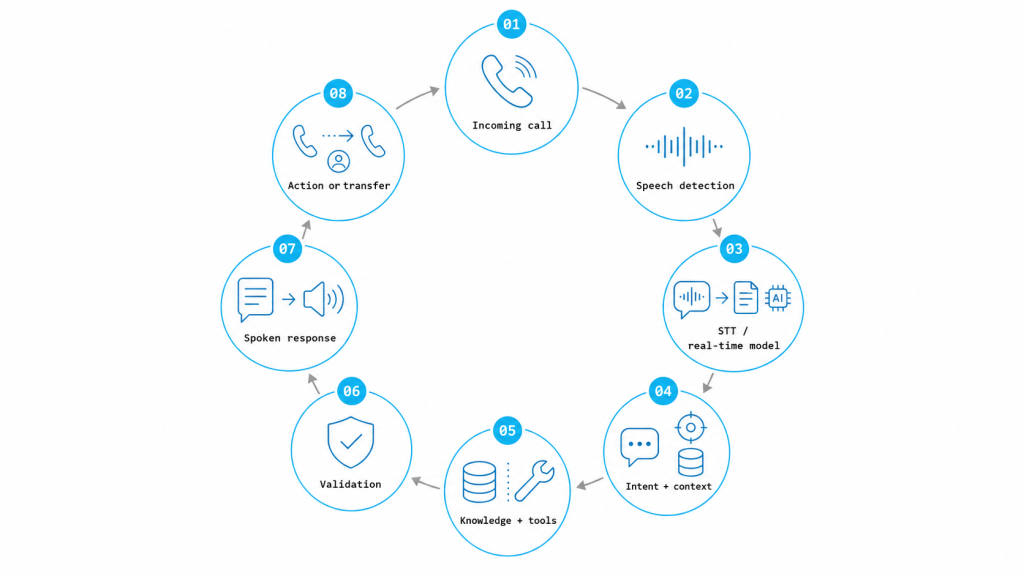
The system must manage interruptions, understand intent, access approved knowledge, and connect securely with business systems. Amazon’s contact-center documentation describes AI agents that answer questions, take actions, assist human staff, and escalate with conversation context when needed.
Before changing a booking or issuing a refund, it should validate identity, permissions, tool inputs, and business rules. Unsafe or unsupported cases should be transferred with context.
What Can Agentic AI Do in a Contact Center?
Agentic AI adds controlled action to conversational support. Instead of only answering a question, an AI contact center agent can complete a multi-step objective.
For example, a scheduling agent can verify the customer, retrieve a booking, check slots, confirm the selection, and update the system. These agents are typically deployed through modern call center software that unifies voice, chat, and email in one platform.
The agent still needs a defined toolset, transaction limits, approvals, and a fallback route. Google and AWS both support patterns in which virtual agents handle self-service while human assistance remains available for cases requiring judgment or escalation.
Which Call Center Use Cases Are Suitable for AI?
Start with frequent requests that have reliable data, predictable policies, and reversible outcomes.
| Use case | Suitable AI task | Recommended control |
| Appointment support | Book, reschedule, cancel, and remind | Confirm before updating |
| Order status | Retrieve current shipment information | Read-only access |
| Account assistance | Explain approved balances or plans | Identity verification |
| Lead qualification | Collect needs and availability | Human sales handoff |
| Tier-one support | Guide approved diagnostic steps | Escalate unresolved cases |
| After-call work | Summarize and update the disposition | Review sensitive cases |
| Quality monitoring | Evaluate transcript behaviors | Manager calibration |
Generative AI can also support human agents by surfacing knowledge, suggesting responses, and preparing summaries. Google documents in-the-moment knowledge assistance, while AWS supports AI-generated summaries and performance evaluations.
Will AI Replace Call Center Agents?
AI will automate a growing share of repetitive service work, but it is unlikely to remove the need for people across every interaction.
The U.S. Bureau of Labor Statistics projects customer-service employment to decline 5 percent from 2024 to 2034 as self-service systems automate more simple tasks. However, it still projects about 341,700 openings each year, mainly to replace workers leaving the occupation. BLS also notes that organizations continue to use human service teams for complex requests such as account refunds or insurance questions.
AI fits repetitive requests, structured updates, summaries, and first-line triage. Human agents remain important for emotional, ambiguous, regulated, and high-value cases. The practical model combines AI self-service, employee assistance, and human ownership of consequential outcomes.
How Should You Implement an AI Call Center Agent?
1. Select One Measurable Workflow
Choose a specific outcome and record current volume, handling time, transfer rate, failures, and customer impact.
Suitable first workflows include the following:
- Appointment rescheduling
- Order-status inquiries
- Basic account support
- Lead qualification
- Service reminders
- Tier-one troubleshooting
2. Define Conversation Boundaries
Document identity checks, approved data sources, tools, prohibited actions, confirmations, escalation conditions, and completion criteria.
The system should know:
- What information may it access
- Which actions may it perform
- When confirmation is required
- Which requests require human review
- When the call must be transferred
3. Prepare Trusted Knowledge
Use current policies, service rules, and structured system data with named content owners.
Do not allow the agent to answer from uncontrolled documents, outdated FAQs, or inconsistent business policies. Knowledge ownership and update processes are as important as model selection.
4. Limit Tool Permissions
Give each integration one purpose and the minimum required access. Do not provide unrestricted CRM, payment, or account-system permissions.
For example, an appointment agent may be allowed to:
- Retrieve available slots
- Read the existing booking
- Propose a new time
- Update the booking after confirmation
It should not automatically gain access to billing records, unrelated customer data, or administrative settings.
5. Test Real Conditions
Test accents, background noise, interruptions, silence, unclear requests, outages, angry callers, and attempted policy bypasses.
Evaluation should cover:
- Intent recognition
- Response latency
- Interruption handling
- Tool-call accuracy
- Authentication
- Correct escalation
- Policy compliance
- Resolution quality
6. Launch With Limited Autonomy
Start with read-only answers or draft actions. Enable confirmation-gated updates only after the system meets agreed quality thresholds.
Practical implementation lesson: Voice-agent quality often depends more on interruption handling, tool latency, fallback design, and knowledge freshness than on small differences between language models.
For implementation context, review Creole Studios’ AI agent development services, Pipecat voice AI framework guide, and AI appointment setter guide.
Which Risks and Metrics Matter?
Voice agents may handle recordings, personal data, and sensitive requests. Controls should include least-privilege access, encryption, consent notices, retention rules, redaction, audit logs, tool validation, escalation, and testing.
NIST’s AI Risk Management Framework provides a voluntary structure for governing, mapping, measuring, and managing AI risk across the system lifecycle.
Outbound calling needs additional legal review. The FCC has stated that AI-generated voices in robocalls fall under rules covering artificial or prerecorded voices, and the FTC has affirmed protections against deceptive AI-enabled telemarketing.
Track metrics tied to customer and operational outcomes:
- Containment rate
- First-contact resolution
- Transfer rate
- Time to resolution
- Abandonment rate
- Tool-call success
- Authentication failures
- Customer satisfaction
- Human override rate
- Cost per resolved interaction
- Policy exceptions
Do not optimize containment alone. An agent that avoids transfers by giving incomplete answers can reduce cost while damaging service.
Final Takeaway
An AI call center voice agent can reduce repetitive work and expand availability, but it still needs reliable knowledge, secure integrations, validated actions, escalation, and ongoing evaluation. Start with one workflow and expand only when customer outcomes improve.
Review real-world AI agent case studies and the AI agent development cost guide when planning scope and budget.
Frequently Asked Questions
What is an AI call center voice agent?
It is a conversational system that handles phone interactions using speech technology, language models, approved business data, and workflow tools. It can answer questions, complete routine tasks, and transfer complex requests to human agents.
How is an AI voice agent different from IVR?
Traditional IVR generally relies on fixed menus and keypad choices. An AI voice agent interprets natural speech, maintains context, retrieves information, and may complete approved actions.
What is an agentic AI call center?
It is a contact-center model where AI agents can choose approved tools and workflow steps to achieve defined service goals within permissions, validation rules, and escalation boundaries.
Will AI replace call center agents?
AI will automate more routine interactions, but people remain important for complex, emotional, unusual, and high-risk cases. Many organizations will combine AI self-service with human support.
Can a call center AI agent integrate with a CRM?
Yes. It can retrieve or update approved CRM fields through APIs. The integration should enforce identity checks, field-level permissions, validation, audit logs, and confirmation before consequential changes.
How do you measure AI call center ROI?
Compare implementation and operating costs with labor capacity released, lower after-call work, fewer abandoned calls, improved resolution, reduced transfers, and expanded availability.
Can AI voice agents make outbound calls?
They can support outbound workflows, but consent, disclosure, telemarketing, recording, and artificial-voice rules vary by jurisdiction and use case. Obtain legal review and provide appropriate opt-out controls.










 30 mins free Consulting
 12 min read
 United States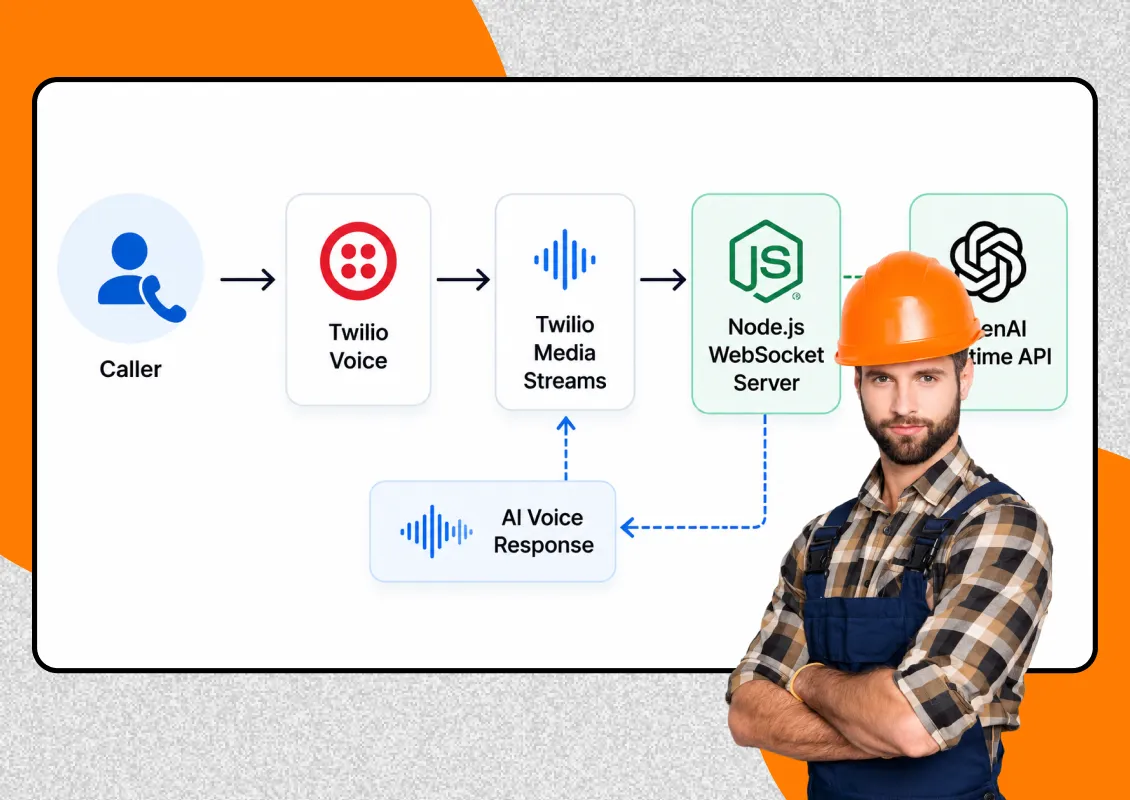






 Love we get from the world