

 Lets Talk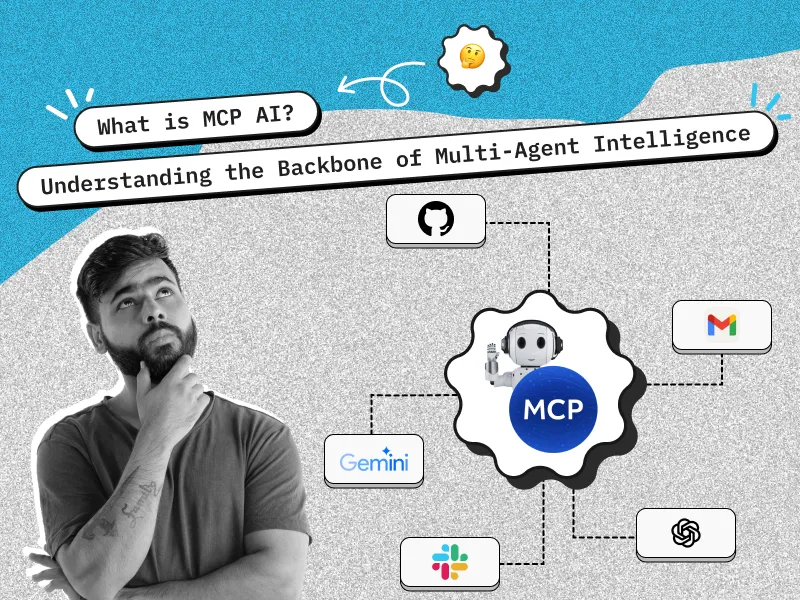
TL;DR
- MCP stands for Model Context Protocol, an open standard for connecting AI applications to external tools, data, and prompts.
- An MCP server exposes capabilities. It is not the AI model, agent, memory layer, or multi-agent orchestrator.
- MCP uses a host-client-server architecture. A host creates a separate client connection for each server.
- APIs are service-specific, while MCP standardizes how AI applications discover and use many capabilities.
- Multi-agent systems can use MCP, but they still need separate orchestration for roles, state, routing, and termination.
- Secure deployments require authorization, least-privilege access, confirmation for sensitive tools, logging, and prompt-injection defenses.
Introduction
MCP in AI means Model Context Protocol, an open standard that connects AI applications to external data, tools, and prompts through a consistent interface. An MCP server may expose files, database queries, calculators, or CRM actions. MCP does not create or coordinate AI agents. It standardizes the connection layer they can use. The official MCP documentation describes it as a common way to connect AI applications with external systems.
What Is MCP in AI?
Model Context Protocol is an open protocol for exchanging context and capabilities between AI applications and external systems. It uses JSON-RPC 2.0 and defines how hosts, clients, and servers communicate. MCP can support tools, resources, prompts, logging, cancellation, progress tracking, and error reporting.
The main benefit is reusable integration. A compatible server can expose selected capabilities to multiple compatible hosts. MCP does not specify the model, reasoning process, or memory design. It focuses on context exchange rather than controlling how applications use LLMs.
What Is an MCP Server for AI?
An MCP server is a local program or remote service that exposes capabilities to a client:
- Tools: Actions such as querying a database, creating a ticket, or running a calculation.
- Resources: Readable context such as files, records, schemas, or documentation.
- Prompts: Reusable templates or workflow instructions.
A server describes each tool with a name, description, and input schema. Official guidance recommends visibility and human confirmation for sensitive calls.
An MCP server is not a central brain. It does not inherently assign agents, manage shared memory, resolve conflicts, or combine outputs. Those jobs belong to the host or an orchestration framework.
How Does MCP Architecture Work?
MCP uses three main participant types.
MCP Host
The host is the user-facing AI application. It manages model interaction, permissions, and server connections.
Examples may include:
- AI assistants
- Development environments
- Enterprise copilots
- Custom AI agent applications
MCP Client
The host creates one MCP client for each server connection. Each client maintains a direct protocol relationship with one server.
This means a host connected to three MCP servers normally maintains three separate client connections.
MCP Server
The server provides tools, resources, or prompts, such as filing data, calculations, account lookup, or lead updates.
A simplified flow is:

Is MCP an AI agent?
No. MCP is not an AI agent.
An AI agent interprets goals, selects steps, maintains task state, uses tools, and works toward an outcome. MCP only standardizes how the agent or application connects to external capabilities.
| Component | Primary responsibility |
| AI model | Understands and generates outputs |
| AI agent | Chooses steps and tools to pursue a goal |
| Orchestrator | Manages routing, state, retries, and termination |
| MCP | Standardizes access to tools, data, and prompts |
| MCP server | Exposes selected capabilities |
An application can use MCP without autonomy, and an agent can work without MCP by calling direct APIs.
For additional context, review what an AI agent is and Creole Studios’ AI agent development services.
How Does MCP Support Multi-Agent Systems?
MCP can give several agents consistent access to approved tools and data, avoiding separate custom connectors for every agent.
For example, a multi-agent research workflow may include:
- A research agent accessing search and document tools
- An analyst agent accessing calculation and database tools
- A reviewer agent accessing evidence and validation tools
However, a multi-agent MCP architecture still needs another layer for:
- Task decomposition
- Agent selection
- Shared workflow state
- Handoffs
- Verification
- Retry and stopping rules
- Human approval
MCP standardizes capability access, not collaboration logic. A safer pattern is:
Orchestrator → specialist agents → MCP clients and servers → validation → shared state
Treating the server as the coordinator can create unclear ownership and excessive permissions. Review why multi-agent LLM systems fail before adding several agents.
CLI vs API vs MCP: What Is the Difference?
CLI, API, and MCP solve different integration problems.
| Interface | Best for | Main strength | Main limitation |
| CLI | Operators, scripts, local tools | Direct command execution | Less standardized for AI discovery |
| API | Fixed software integrations | Precise service-specific control | Requires custom integration logic |
| MCP | AI applications use many capabilities | Standardized discovery and invocation | Requires compatible hosts and servers |
MCP does not replace APIs. Many servers wrap existing APIs and expose selected operations. It also does not replace CLIs.
Use APIs for fixed integrations, MCP for reusable AI access, and CLIs for operator workflows or controlled automation.
Practical Example
A CRM may already provide an API for retrieving accounts and updating leads.
An MCP server can wrap selected CRM API endpoints and expose them as clearly described tools:
- get_customer_account
- list_open_opportunities
- update_lead_status
The underlying API still performs the actual operation. MCP standardizes how the AI application discovers and invokes it.
How Should Teams Secure MCP?
MCP can expose sensitive data and executable tools, so security belongs in the architecture.
Apply Least Privilege
Expose only required tools and resources. Separate high-risk actions into distinct permission scopes.
A customer-support agent may need access to order status but not unrestricted access to billing, user administration, or database modification.
Use Authorization
Official guidance follows OAuth 2.1 conventions and recommends authorization for user-specific data, auditable actions, enterprise controls, and usage tracking.
Confirm Sensitive Actions
Show which tool will run and what it will change. Require approval for:
- Payments
- Deletions
- External messages
- Production changes
- Permission updates
- Irreversible actions
Validate and Log
Enforce schemas, allowlists, rate limits, and business rules. Log the tool path, approval, result, and outcome.
A correctly formatted tool request may still be unsafe or unauthorized, so schema validation should not be the only control.
Protect Credentials and Sessions
Official security guidance covers token passthrough, session hijacking, server-side request forgery, confused-deputy risks, local server compromise, and scope minimization.
Practical implementation lesson: MCP prototypes often expose too many tools. Start with one server, a small read-only tool set, explicit confirmation, and end-to-end evaluation before adding write access.
MCP was introduced by Anthropic in 2024 and donated to the Agentic AI Foundation under the Linux Foundation in December 2025, supporting vendor-neutral stewardship.
Final Takeaway
MCP in AI is a standardized integration layer, not an agent, memory system, or multi-agent coordinator. An MCP server exposes tools, resources, and prompts. The host and its orchestration logic decide how those capabilities are used.
Use MCP when AI applications need reusable access to external systems. Keep routing, state, verification, and termination in orchestration components. Start with narrow permissions, authorization, confirmation, and observability.
Frequently Asked Questions
What does MCP stand for in AI?
MCP stands for Model Context Protocol. It is an open standard that helps AI applications connect to external tools, data sources, and reusable prompts.
What is an MCP server in AI?
An MCP server is a local program or remote service that exposes selected tools, resources, or prompts to an MCP client. It does not need to contain an AI model.
Is MCP an AI agent?
No. MCP is an integration protocol. An AI agent may use MCP, but its goals, reasoning, state, and workflow are managed elsewhere.
Do multi-agent systems need MCP?
No. They can use direct APIs or other connectors. MCP is useful when several agents need standardized access to shared capabilities.
Does an MCP server coordinate multiple agents?
Not by default. Task routing, agent roles, shared state, verification, and stopping rules belong to an orchestration layer.
What is the difference between an API and MCP?
An API defines how software interacts with one service. MCP standardizes how AI applications discover and invoke capabilities across many services.
Is MCP secure?
MCP can be deployed securely, but teams still need authorization, least privilege, validation, confirmation for sensitive actions, credential protection, logging, and testing.


 12 min read


