
 Lets Talk
TL;DR
- A generative AI model learns patterns from data and produces new text, images, audio, video, code, or synthetic data.
- Foundation models are broadly trained models that can be adapted through prompting, retrieval, or fine-tuning.
- Major model families include autoregressive transformers, diffusion models, generative adversarial networks, and variational autoencoders.
- The right model depends on modality, output quality, latency, data controls, deployment, and evaluation.
- A major challenge is producing confident but unsupported output, so important results require grounding, testing, and human review.
A generative AI model is a machine learning model trained to learn patterns in data and create new output that resembles those patterns. Depending on its architecture, it may generate text, images, code, speech, music, video, or synthetic records. The model is only one part of an AI application, which also needs instructions, data access, integrations, evaluation, and oversight.
How Does a Generative AI Model Work?
A generative model learns a probability distribution from examples. During inference, it uses that learned representation to produce an output from a prompt, file, image, audio sample, or another input.
For a text model, the workflow may look like this:
Prompt → tokenization → model processing → next-token prediction → response
Text is split into tokens. A transformer uses attention mechanisms to evaluate relationships between tokens and predict a likely continuation. The process repeats until the response is complete.
Image diffusion models work differently. They learn how to reverse a noise process. During generation, the model begins with noise and gradually converts it into an image that follows the prompt or reference.
Training creates the model’s general capabilities. Inference is when a user or application asks the trained model to produce something.
What Is a Foundation Model in Generative AI?
A foundation model is a broadly trained AI model that can be adapted to many tasks rather than being built for one narrow purpose. Google Cloud describes foundation models as models pre-trained on large datasets that can perform a wide range of tasks with limited additional training.
Large language models and multimodal models are common foundation models. The same base model may support summarization, question answering, classification, code assistance, and document analysis.
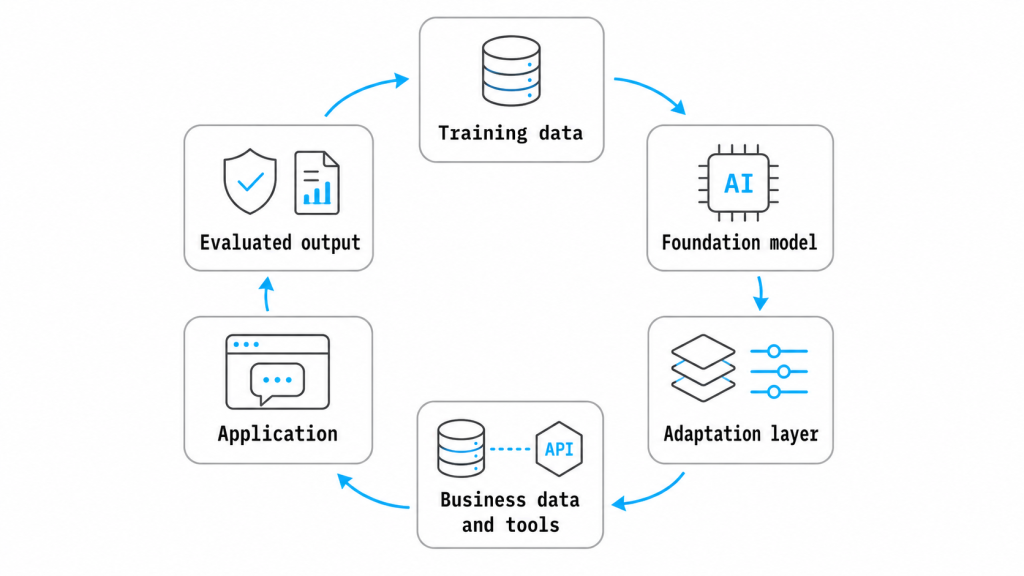
A production system may add:
- System instructions and prompt templates
- Retrieval from approved company data
- Fine-tuning or adapters
- Tools and API integrations
- Permission controls
- Evaluation and human approval
“Foundation model” and “generative AI model” overlap, but they are not exact synonyms. A foundation model refers to broad pre-training and adaptability. A generative model refers to the ability to create or transform output.
What Are the Main Types of Generative AI Models?
1. Autoregressive Transformer Models
Autoregressive models generate a sequence one element at a time based on previous elements. Large language models commonly use transformers and predict the next token from the available context.
They support conversational assistants, content drafting, summarization, translation, code generation, and document analysis. GPT, Claude, Gemini, Llama, and Mistral are prominent language or multimodal model families.
2. Diffusion Models
Diffusion models generate content through iterative denoising. They are widely used for text-to-image generation, image editing, visual variation, and increasingly video generation.
Diffusion is an architecture, while image or video is the modality. Some systems combine diffusion with transformers.
3. Generative Adversarial Networks
A generative adversarial network, or GAN, contains a generator and a discriminator. The generator creates samples, while the discriminator evaluates whether they resemble real training data.
GANs have been used for image synthesis, super-resolution, data augmentation, and synthetic media.
4. Variational Autoencoders
A variational autoencoder, or VAE, compresses data into a probabilistic latent representation and reconstructs it. New samples can be created by exploring that latent space.
VAEs support controlled generation, anomaly detection, compression, and representation learning.
5. Multimodal Generative Models
Multimodal models process or generate more than one type of information, such as text, images, audio, video, or documents. A user may upload a chart for explanation or an image for editing.
“Multimodal” describes capability rather than one architecture. A multimodal system may combine transformers, encoders, diffusion components, and tools.
How Are Generative AI Models Adapted?
Businesses rarely train a large foundation model from scratch. They usually adapt an existing model and the surrounding system.
Prompt engineering structures instructions, context, examples, and output requirements.
Retrieval-augmented generation, or RAG, retrieves relevant information from an approved source before the model answers.
Fine-tuning adjusts behavior using task-specific examples. It can improve style, format, terminology, or narrow-task performance.
Tool use allows a model to call databases, calculators, CRMs, or other software. Exact calculations and controlled actions should be handled by appropriate tools.
Review practical generative AI applications and generative AI use cases before deciding how much customization is necessary.
What Is a Major Challenge Associated With Generative AI Models?
A major challenge is confabulation, where a model produces information that appears credible but is inaccurate or unsupported. The NIST Generative AI Profile also identifies privacy, bias, information integrity, security, and human over-reliance as concerns.
Other challenges include inconsistent output, outdated knowledge, high computational cost, limited explainability, prompt injection, and difficulty evaluating open-ended responses.
Practical implementation insight: A stronger model does not automatically solve an unclear workflow. Projects often improve more by defining the source of truth, expected output, escalation rules, and evaluation set than by repeatedly switching model providers.
A reliable application should show sources when possible, use deterministic systems for calculations, test realistic edge cases, and assign qualified reviewers to high-impact outputs.
How Should a Business Choose a Generative AI Model?
Start with the required outcome rather than a model leaderboard.
| Selection factor | Question to ask |
| Modality | Does the task require text, image, audio, video, code, or several formats? |
| Quality | What level of factuality, reasoning, or visual control is required? |
| Context | How much information must the model process? |
| Latency | Must the response be interactive, or can it run in a batch? |
| Deployment | Is a hosted API acceptable, or is private deployment required? |
| Customization | Will prompting and retrieval be enough, or is fine-tuning needed? |
| Cost | What is the cost per accepted output or completed task? |
| Evaluation | Can performance be tested with representative examples? |
Use this decision flow:
Business task → required output → data and permissions → candidate models → controlled evaluation → pilot → monitoring
Test candidate models with the same inputs. Measure factual accuracy, accepted-output rate, response time, review effort, and total workflow cost.
A generative AI development company can support model evaluation, RAG architecture, fine-tuning, integrations, and monitoring.
Conclusion
A generative AI model learns patterns from data and creates new output. Foundation models provide broadly trained capabilities that businesses can adapt through prompts, retrieval, fine-tuning, and tools.
The main model families include autoregressive transformers, diffusion models, GANs, and VAEs. Multimodal models combine several forms of input and output.
Choosing the right model requires more than selecting the newest release. Define the business task, data requirements, output standard, deployment constraints, and evaluation method. The most suitable model is the one that delivers reliable value inside the complete workflow.
Frequently Asked Questions
What is a generative AI model?
A generative AI model is a machine learning model that learns patterns from data and creates new text, images, audio, video, code, or synthetic information.
What is a foundation model in generative AI?
A foundation model is pre-trained on broad datasets and can be adapted to many downstream tasks through prompting, retrieval, fine-tuning, or tool integration.
What are the main types of generative AI models?
The main types include autoregressive transformer models, diffusion models, generative adversarial networks, and variational autoencoders. Multimodal models process or generate several data types.
What is a major challenge associated with generative AI models?
A major challenge is confabulation, where the model generates plausible but inaccurate or unsupported information. Bias, privacy, security, cost, and inconsistent output are also important challenges.
Is a large language model the same as a generative AI model?
A large language model is one type of generative AI model focused primarily on language. Generative AI also includes image, audio, video, and multimodal models.
How do businesses customize generative AI models?
Businesses use prompt engineering, retrieval-augmented generation, fine-tuning, structured outputs, and tool integrations. Training a large foundation model from scratch is less common.










 30 mins free Consulting
 11 min read






 Love we get from the world