
TL;DR
- Massive Mobile Adoption: With smartphone penetration exceeding 98% and a digitally native population, mobile applications have shifted from optional touchpoints to the primary operating channel for Saudi enterprises.
- Economic Catalysts: Propelled by Vision 2030, the digital economy accounts for roughly 16% of Saudi Arabia’s GDP, with electronic transactions making up 85% of total retail payments.
- Top 9 Impacted Sectors: Retail & E-Commerce, Healthcare, Tourism & Hospitality, Banking & FinTech, Logistics & Transportation, Education, Real Estate, Food & Beverage, and Manufacturing/Industrial operations.
- Crucial Success Factors: Successful deployment requires bilingual (Arabic-first RTL) design, adherence to the Personal Data Protection Law (PDPL), integration with local infrastructure (Nafath, Mada, ZATCA), and reliable cross-platform architecture.
Introduction
Saudi Arabia is undergoing one of the most ambitious and accelerated economic transformations in the world. Driven by Vision 2030, the Kingdom is systematically diversifying away from oil dependency, placing technology, innovation, and digital infrastructure at the absolute core of its national agenda.
At the center of this transformation is a consumer and business base that is overwhelmingly mobile-first. Saudi citizens and residents rely on smartphones for daily services—from verifying identities via Nafath and booking medical consultations to ordering groceries and executing multi-currency financial transactions.
For commercial enterprises, this behavioral shift has permanently raised the bar. Relying solely on traditional web portals or brick-and-mortar setups is no longer sufficient to sustain a competitive edge. Embracing comprehensive digital transformation in Saudi Arabia through bespoke mobile software allows organizations to capture high-intent demand, automate back-office operations, and deliver frictionless, localized customer journeys.
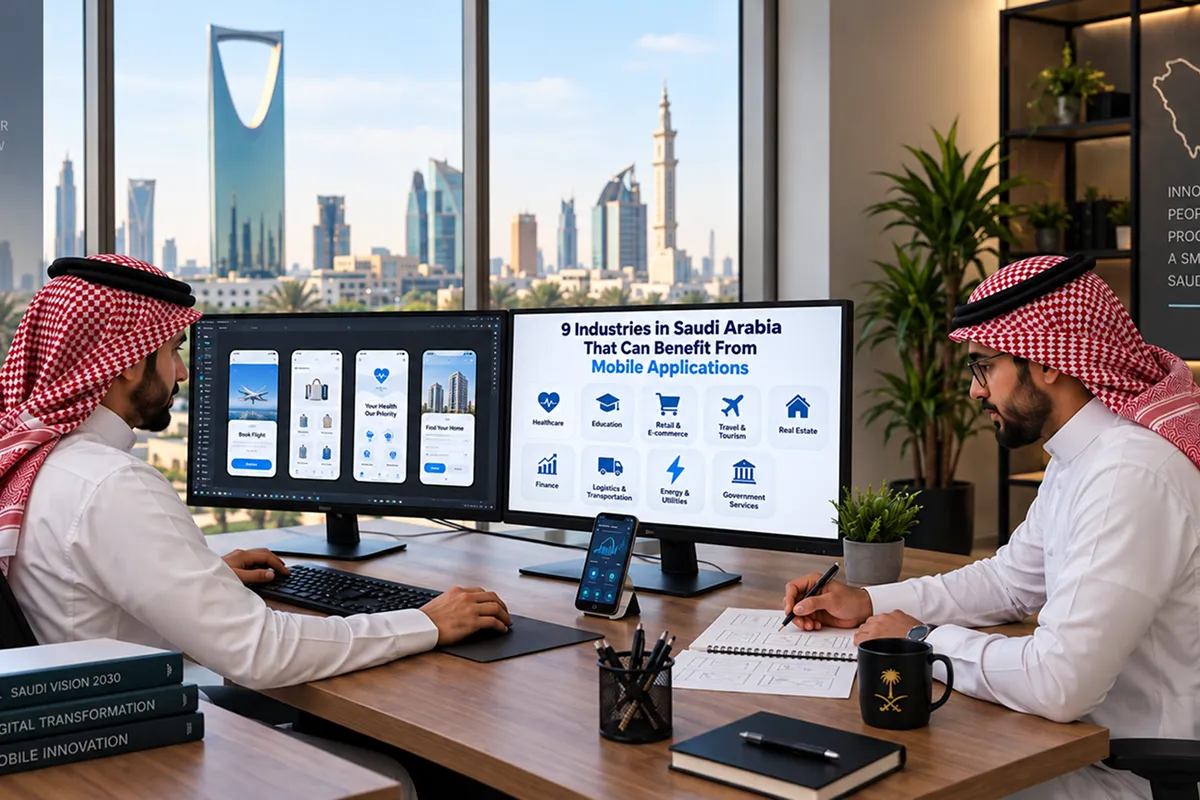
Below, we examine the 9 key industries in Saudi Arabia poised to gain the highest return on investment from mobile application development.
1. Retail and E-Commerce
The Saudi retail sector is experiencing unprecedented growth in digital commerce. Mobile commerce (m-commerce) dominates consumer spending, backed by ultra-fast 5G networks, widespread card adoption, and a strong preference for doorstep delivery.
Key Mobile App Use Cases
- Arabic/English Bilingual Commerce: Native right-to-left (RTL) navigation tailored to regional shopping behavior alongside seamless English toggles.
- Frictionless Checkout & Mobile Wallets: Direct integration with Mada, Apple Pay, and local Buy-Now-Pay-Later (BNPL) providers like Tamara and Tabby.
- Personalized Loyalty & Gamification: AI-driven personalized discount feeds, push-notification re-engagement, and tier-based reward programs.
- End-to-End Order & Delivery Tracking: Live GPS tracking from fulfillment centers to last-mile delivery couriers.
The Saudi Angle: Driven by initiatives from the Ministry of Commerce and the E-Commerce Council, online shopping adoption across Tier-1 and Tier-2 Saudi cities continues to climb. Businesses with dedicated, native mobile apps achieve significantly higher average order values (AOV) and customer retention rates compared to mobile browser storefronts.
2. Healthcare
Under the Health Sector Transformation Program, Saudi Arabia is modernizing public and private medical delivery. Mobile apps bridge the geographical distances across the Kingdom’s expansive provinces, democratizing access to quality clinical care.
Key Mobile App Use Cases
- Centralized Appointment Booking: Real-time scheduling across multi-specialty clinics, diagnostic laboratories, and imaging centers.
- Compliant Telemedicine Consultations: High-definition, encrypted audio and video calls connecting patients directly with certified specialists.
- Integrated Health Records (EHR): Direct mobile access to lab diagnostics, vaccination schedules, and radiological reports.
- Smart Medication Reminders & Refills: Integration with e-prescription systems (such as Wasfaty) for automated doorstep deliveries.
The Saudi Angle: Inspired by benchmark public platforms like Sehaty and the Seha Virtual Hospital, private clinics, diagnostic centers, and hospital networks are deploying custom mobile apps to slash waiting times, cut administrative overhead, and comply with Saudi Central Board for Accreditation of Healthcare Institutions (CBAHI) digital standards.
3. Tourism and Hospitality
Tourism is one of the foundational pillars of the Saudi Vision 2030 roadmap, targeting 150 million annual domestic and international visits by 2030. With giga-projects like NEOM, the Red Sea Project, Diriyah, and AlUla welcoming global travelers, mobile experiences serve as the central concierge.
Key Mobile App Use Cases
- Accommodation & Experience Booking: Instant reservation channels for luxury resorts, boutique desert stays, and local cultural tours.
- Digital Contactless Check-In: Keyless mobile room entry using NFC/Bluetooth and swift digital document verification.
- Curated Travel & Itinerary Planning: Hyper-localized recommendation engines that suggest seasonal events, Riyadh Season happenings, and historical attractions.
- In-App Concierge Services: Real-time multilingual chat for housekeeping requests, spa reservations, and dining bookings.
The Saudi Angle: The Ministry of Tourism’s Digital Tourism Strategy actively encourages hospitality operators to deploy digital solutions that streamline visitor journeys, eliminate friction at border touchpoints, and personalize cultural experiences.
4. Banking and FinTech
Saudi Arabia is one of the fastest-growing FinTech hubs in the EMEA region. Supported by the Saudi Central Bank’s (SAMA) Regulatory Sandbox and Open Banking Framework, consumer financial habits have tilted decisively toward mobile-first asset and cash management.
Key Mobile App Use Cases
- Branchless Digital Onboarding: Instant KYC authentication powered by the national Nafath identity verification system.
- Peer-to-Peer & Cross-Border Remittances: Low-latency fund transfers using local rails like Sarie and instant foreign exchange networks.
- Expense Management & Micro-Savings: Automated budgeting tools, spending categorization, and goal-oriented digital vaults.
- Alternative Financing & WealthTech: Fractional real estate investments, Sharia-compliant sukuk distribution, and robo-advisory apps.
The Saudi Angle: Electronic payments reached an unprecedented 85% of total retail transactions, surpassing the initial Financial Sector Development Program (FSDP) targets ahead of schedule. Choosing the top payment gateways in Saudi Arabia has become critical for all modern business applications.
5. Logistics and Transportation
Positioned at the crossroads of three continents (Asia, Europe, and Africa), Saudi Arabia is actively realizing its National Transport and Logistics Strategy (NTLS). The continuous surge in intra-Kingdom freight, cold-chain distribution, and same-day urban deliveries requires reliable mobile command platforms.
Key Mobile App Use Cases
- Driver Dispatch & Turn-by-Turn Route Optimization: AI-optimized routing that accounts for urban traffic patterns across Riyadh, Jeddah, and Dammam.
- Digital Proof of Delivery (e-POD): On-glass electronic signatures, barcode scanning, and photographic drop-off confirmation.
- Real-Time Fleet Telematics: Mobile dashboards displaying fuel consumption, vehicle maintenance alerts, and driver behavior indices.
- Customer Self-Service Apps: Precise drop-pin location selection (eliminating ambiguous street addresses) and automated delivery status alerts.
The Saudi Angle: From long-haul logistics corridors connecting King Abdulaziz Port to Riyadh Dry Port, to on-demand hyper-local couriers, building a dedicated solution based on best practices for on-demand delivery app development allows supply chain operators to slash transit delays and lower cost-per-delivery.
6. Education and E-Learning
The Kingdom’s Human Capability Development Program has sparked widespread digital evolution in education. K-12 institutions, higher education universities, and corporate upskilling academies are investing heavily in mobile edtech to augment classroom environments.
Key Mobile App Use Cases
- Micro-Learning & Video Courses: Byte-sized, on-demand video lectures with offline download capabilities for self-paced study.
- Live Virtual Classrooms: Interactive mobile lectures featuring real-time whiteboards, polls, and breakout discussion rooms.
- Automated Assessment & Grading: Instant quiz grading, assignment submission with anti-plagiarism checks, and progress dashboards.
- Direct Parent-Teacher Communication: Real-time visibility into student attendance records, grade reports, and tuition installment processing.
The Saudi Angle: Building on the nationwide digital infrastructure proven by platforms like Madrasati, Saudi private educational institutes use mobile applications to deliver hybrid learning models and continuous professional development tailored to local labor market demands.
7. Real Estate
Supported by the Real Estate General Authority (REGA) and national homeownership programs under Sakani, the Saudi property sector is adopting PropTech to modernize property transactions, lease administration, and facility management.
Key Mobile App Use Cases
- Interactive 3D Virtual Tours: Immersive, high-resolution remote property viewings for residential compounds and commercial towers.
- Verified Listing Portals: Search engines integrated with licensed real estate broker databases and authentic title deed validations.
- Tenant Lifecycle Portals: Centralized apps for rent payments, lease renewal notifications, and building amenity reservations.
- Maintenance & Facilities Ticketing: Photo-based repair dispatching that routes work orders directly to certified technicians.
The Saudi Angle: Mobile real estate apps that integrate cleanly with government platforms such as Ejar (for leasing contracts) and Mullak (for co-owned property management) deliver exceptional utility for landlords, property developers, and expatriate/local tenants alike.
8. Restaurants and Food Delivery
The Kingdom boasts one of the most vibrant Food & Beverage (F&B) and quick-service restaurant (QSR) markets in the Middle East. High disposable incomes and a culture centered around dining out have made restaurant apps essential for commercial survival.
Key Mobile App Use Cases
- Direct-to-Consumer Ordering: Eliminating high third-party aggregator commissions through branded online ordering.
- Smart Table Reservation Systems: Live floor-plan booking and pre-ordering for high-traffic dining seasons (e.g., Ramadan, Eid).
- Dynamic In-Venue QR Menus: Instant contactless ordering and split-bill payments straight from the patron’s device.
- Subscription Meal Plans: Automated recurring billing and daily customized meal selection for healthy eating programs.
The Saudi Angle: While third-party aggregators dominate discovery, forward-looking restaurant chains are driving higher margins by learning how to develop a dedicated food delivery app in Saudi Arabia that directly nurtures brand loyalty and repeat orders.
9. Manufacturing and Industrial Businesses
As part of the National Industrial Development and Logistics Program (NIDLP), Saudi factories and industrial hubs (such as MODON industrial cities and Royal Commission zones in Jubail and Yanbu) are rapidly embracing Industry 4.0 standards.
Key Mobile App Use Cases
- Mobile Enterprise Asset Management (EAM): Real-time equipment status alerts, preventive maintenance logging, and sensor monitoring.
- Shop-Floor Quality Assurance (QA): Standardized mobile audit checklists, defect photographic capture, and immediate supervisor escalations.
- Inventory & Barcode Scanning: Handheld raw-material tracking, warehouse bin reallocation, and real-time ERP sync.
- Industrial Safety & Compliance Tracking: Instant incident reporting, automated hazard notifications, and field workforce check-ins.
The Saudi Angle: Moving enterprise resource planning (ERP) functions to intuitive mobile apps on ruggedized tablets and smartphones gives industrial supervisors real-time operational visibility, reducing machine downtime across the Kingdom’s smart manufacturing zones.
What Can Mobile Applications Help Saudi Businesses Achieve?
Operating in a digital economy that contributes over 16% of Saudi Arabia’s GDP (as reported by GASTAT) demands speed, agility, and modern interfaces. Investing in enterprise-grade mobile software enables businesses to:
| Business Objective | Operational Impact in the Saudi Market |
| Elevate Customer Experience (CX) | Deliver 24/7 self-service options, localized Arabic interfaces, and rapid response times. |
| Digitize Core Processes | Eliminate manual paperwork, reduce data-entry human errors, and accelerate internal approvals. |
| Maximize Customer Retention | Leverage targeted push notifications, geo-fenced promotions, and automated loyalty mechanics. |
| Streamline Electronic Payments | Capture revenue frictionlessly via Mada, Apple Pay, and native installment options. |
| Harness Actionable Analytics | Gather structured behavioral and operational data to optimize inventory, staffing, and marketing spend. |
| Unlock New Digital Revenue | Roll out subscription services, on-demand upsells, and cross-border digital offerings. |
What Should Saudi Businesses Consider Before Developing a Mobile Application?
Building a high-impact mobile application for the Saudi market requires careful alignment with local user behaviors, technological standards, and regulatory frameworks.
1. Native Arabic & English Experience (RTL Design)
Localization in Saudi Arabia goes beyond literal translation. It demands a fully optimized Right-to-Left (RTL) layout, culturally contextual typography, and intuitive visual hierarchies. Adhering to the core principles of effective app design ensures user interfaces feel effortless to both native Arabic speakers and international expatriates.
2. Regulatory Compliance & Data Privacy (PDPL)
The Saudi Personal Data Protection Law (PDPL) sets strict requirements regarding how consumer personal data is gathered, processed, and stored. Businesses must ensure that mobile architecture respects user consent, enforces robust end-to-end encryption, and hosts sensitive data within local Saudi data centers.
3. Payment Gateway & E-Invoicing Integrations
Every commercial app must seamlessly connect to the local financial backbone. This includes integrating Mada and Apple Pay for high conversion rates, connecting to ZATCA (FATOORA) for mandatory e-invoicing compliance, and implementing Nafath Single Sign-On for secure national identity authentication.
4. Cross-Platform Frameworks & Performance
With Apple iOS commanding a substantial market share alongside Android devices across diverse price points, organizations must choose modern tech stacks. Utilizing reliable mobile app development frameworks like Flutter or React Native guarantees rapid time-to-market and uniform performance across both platforms.
5. Partnering with the Right Technical Experts
Executing a compliant, scalable mobile roadmap requires deep engineering expertise coupled with local market acumen. Collaborating with an experienced mobile app development company ensures that your digital architecture is built for scale, adheres strictly to CST and SAMA directives, and delivers sustainable business value.
Conclusion
From modernizing retail storefronts in Riyadh and powering telemedicine clinics across the Eastern Province to optimizing logistics corridors across the Red Sea, mobile applications have become the definitive engine of commercial growth in Saudi Arabia.
The most successful digital products are not generic templates—they are purpose-built solutions designed to solve specific operational friction points while catering directly to the expectations of Saudi consumers. As the Kingdom accelerates toward its Vision 2030 milestones, organizations that invest early in secure, scalable, and localized mobile software will solidify their market leadership in the region’s most dynamic economy.
Frequently Asked Questions (FAQs)
Which industries in Saudi Arabia benefit most from mobile applications?
The top sectors gaining the highest returns include Retail, Healthcare, Tourism, FinTech, Logistics, Education, Real Estate, Food Delivery, and Manufacturing. Each of these industries leverages mobile apps to automate customer journeys, improve operational efficiency, and comply with Vision 2030 digital mandates.
How can a mobile application help a Saudi business?
A dedicated app helps Saudi businesses capture the Kingdom’s mobile-first consumer base, streamline instant checkouts via Mada and Apple Pay, and automate back-office operations. It also ensures long-term customer retention through personalized loyalty rewards and direct push notifications.
How much does mobile app development cost in Saudi Arabia?
Developing a custom mobile app in Saudi Arabia typically ranges between SAR 40,000 to SAR 250,000+ ($10,000 to $65,000+), depending on feature complexity, compliance requirements, and third-party integrations. To evaluate project estimates in detail, review our comprehensive breakdown of mobile app development costs in Saudi Arabia.
Should Saudi businesses develop both Android and iOS apps?
Yes, developing for both iOS and Android is essential because device market share is divided across premium and value demographics throughout the Kingdom. Utilizing cross-platform frameworks like Flutter or React Native allows businesses to support both ecosystems efficiently from a unified codebase.
What features should a Saudi business mobile application include?
Essential features include a native Arabic-first (RTL) interface with English toggles, instant payment processing via Mada and Apple Pay, and Nafath digital ID authentication. Additionally, apps should integrate ZATCA-compliant e-invoicing and direct communication channels like WhatsApp or in-app live chat.
How long does it take to develop a mobile application in Saudi Arabia?
A standard mobile app development cycle takes between 3 to 9 months depending on overall project scope. A functional Minimum Viable Product (MVP) can be launched in 10 to 14 weeks, whereas complex enterprise platforms with deep regulatory and ERP integrations require 6 to 9 months.


