

 Lets Talk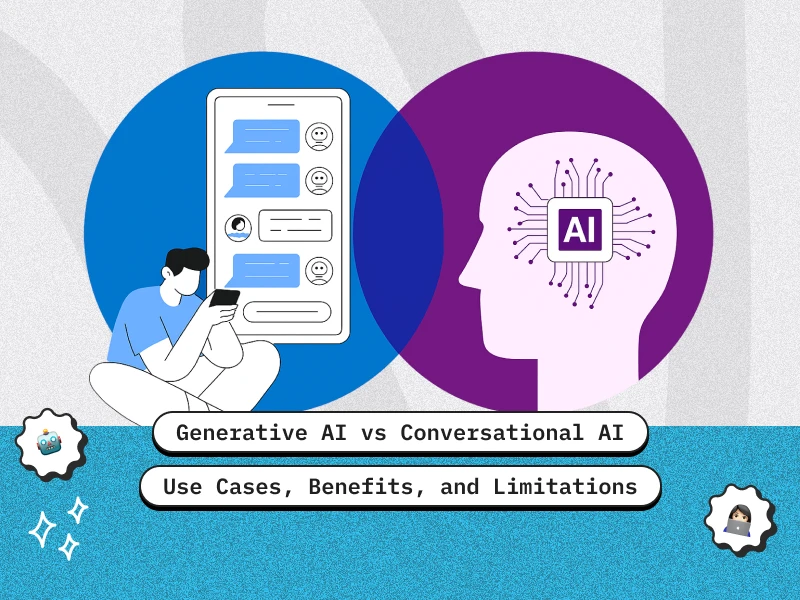
TL;DR
- Conversational AI manages human-to-machine dialogue through chat or voice.
- Generative AI creates new text, images, audio, video, code, or structured outputs.
- Conversational AI is an interaction system, while generative AI is a content-generation capability.
- A conversational assistant may use rules, retrieval, generative models, or a hybrid architecture.
- Use generative AI for creation and synthesis, conversational AI for multi-turn journeys, and both when users need natural responses plus reliable actions.
Introduction
Conversational AI vs. generative AI is not an either-or comparison. Conversational AI manages dialogue, context, intent, and task flow. Generative AI produces new content from prompts and data. Some conversational assistants use generative AI for flexible responses, while others rely on predefined flows. The right approach depends on whether the business needs content generation, structured interaction, or both.
What Is Conversational AI?
Conversational AI is a category of systems designed to simulate human conversation through text or voice. It interprets a user’s request, maintains context across turns, selects a response or action, and may transfer the interaction to a person.
Common examples include customer-service chatbots, banking assistants, appointment bots, employee help desks, and interactive voice systems. Microsoft describes conversational AI as technology that powers chatbots and virtual assistants through natural-language interaction, while Google supports conversational interfaces across text and audio channels.
What Is Generative AI?
Generative AI creates new content in response to an instruction or input. Outputs can include text, images, audio, video, software code, summaries, product concepts, and structured data.
These systems learn patterns from data and use them to produce new outputs rather than selecting only from a fixed response list.
Typical applications include drafting content, summarizing documents, producing code, creating visuals, and answering questions from connected knowledge sources. Readers who need a foundation can start with what generative AI is.
Conversational AI vs Generative AI: What Is the Difference?
| Factor | Conversational AI | Generative AI |
| Primary purpose | Manage dialogue and complete conversational goals | Create or transform content |
| Interface | Chat, voice, messaging, or virtual assistant | Prompt box, editor, API, Copilot, or embedded feature |
| Output | Response, question, action, route, or handoff | Text, image, audio, video, code, or structured content |
| Context | Tracks conversation state and intent | Uses prompts, retrieved data, or history |
| Control | Deterministic, generative, or hybrid | Usually generated probabilistically at runtime |
| Main metric | Resolution, containment, CSAT, handoff rate | Factuality, acceptance, quality, time saved |
| Main risk | Broken dialogue, bad routing, failed action | Hallucination, unsafe output, unsupported claims |
The key distinction is category type. Conversational AI describes how a user interacts with a system. Generative AI describes a capability the system may use. One product can therefore be both conversational and generative.
Is conversational AI generative AI?
Sometimes, but not always.
Earlier conversational systems commonly used intent detection, decision trees, templates, and predefined responses. They could guide users through controlled tasks without generating open-ended language.
Modern assistants often add large language models for natural responses, question answering, summarization, and unexpected wording. Google’s Dialogflow documentation distinguishes fully generative, partly generative, and deterministic conversational designs.
Three examples clarify the overlap:
- Conversational but mostly deterministic: A booking bot collects dates, checks availability, and confirms an appointment.
- Generative but not conversational: An image tool creates a product visual from one prompt.
- Generative conversational AI: A support assistant understands follow-up questions, retrieves approved information, generates an answer, and completes an authorized action.
Where Should Businesses Use Each Technology?
Use Generative AI for Creation and Knowledge Work
Choose generative AI when users need a new output or a transformed version of existing information. Examples include product descriptions, report summaries, software documentation, campaign variations, and policy explanations.
Define the source data, acceptable output, evaluation criteria, and review process. This guide to building a generative AI solution covers the implementation stages.
Use Conversational AI for Guided Interaction
Choose conversational AI when users must complete a multi-turn journey, such as checking an order, booking an appointment, resetting account access, qualifying a lead, or collecting claim details.
The system must manage state, confirm important information, and provide human escalation. Success depends on task completion, not merely sounding human.
Use Both for Complex Service Workflows
A hybrid assistant can retrieve knowledge, generate an explanation, call an API, request confirmation, and complete a task. Google’s current conversational tooling combines generative playbooks and data stores with deterministic flows, helping teams preserve control for sensitive steps.
Organizations planning tool-connected automation can review AI agent development services.
Case study callout: Bank of America reported that its virtual financial assistant Erica had exceeded 3.2 billion interactions since its 2018 launch as of March 2026. The scale demonstrates sustained conversational AI adoption, although every business should use its own resolution, satisfaction, and service-cost benchmarks.
How Should You Choose Between Conversational AI and Generative AI?
Ask these five questions:
- Does the user need content or a completed journey? Choose generative AI for drafts, answers, summaries, images, or code. Choose conversational AI for questions, decisions, confirmations, and actions.
- How much control is required? Brainstorming can allow flexible output. Payments, account changes, and regulated disclosures need validation and tighter flows.
- What data must the system access? Identify whether it needs documents, customer records, real-time inventory, or transactional systems. Apply permission-aware retrieval.
- How will success be measured? Test factuality and usefulness for generative AI. Test intent accuracy, completion, fallback, transfer quality, latency, and CSAT for conversational AI.
- What happens when the AI is uncertain? Define clarification, refusal, safe defaults, and human handoff before launch.
First-hand implementation insight: In our AI discovery work, teams often begin by asking whether a chatbot should use an LLM. The more important decision is which conversation steps can remain flexible and which must be deterministic. Separating those paths early improves testing, security, and cost control.

How Do Generative AI and Conversational AI Work Together?
A production- and generative-conversational AI system may:
- Receive a text or voice request.
- Identify intent, details, and conversation history.
- Retrieve approved information or call a business system.
- Generate a context-aware response.
- Validate it against safety, policy, and formatting rules.
- Request confirmation before sensitive actions.
- Complete the task or transfer to a human.
This design uses generative AI where flexibility adds value and deterministic controls where reliability matters.
Companies evaluating a custom assistant can explore generative AI development services for architecture, retrieval, evaluation, integrations, and deployment.
Conclusion
Conversational AI and generative AI solve related but different problems. Conversational AI manages dialogue and guides users toward an outcome. Generative AI creates new content and flexible responses. A conversational system does not have to be generative, and a generative system does not have to be conversational.
Choose based on the user journey, risk, required data, and evaluation method. For many customer and employee workflows, the strongest design combines generative language capabilities with controlled flows, verified data, tool permissions, and human escalation.
Frequently Asked Questions
What Is the Main Difference Between Conversational AI and Generative AI?
Conversational AI manages dialogue and user journeys. Generative AI creates new content such as text, images, audio, video, and code. A conversational assistant may use generative AI as one component.
Is Conversational AI a Type of Generative AI?
Not necessarily. It may use rules, templates, retrieval, traditional language processing, generative models, or a hybrid architecture.
Is ChatGPT Generative AI or Conversational AI?
ChatGPT is a conversational application powered by generative language models. It is both generative and conversational from a user-experience perspective.
Can Generative AI Be Used in Customer-Service Chatbots?
Yes. It can generate grounded answers, summarize conversations, translate responses, and handle unexpected questions. Sensitive actions still need validation, permissions, and controlled workflows.
Which Is Better for a Business?
Neither is universally better. Use generative AI for content and knowledge tasks, conversational AI for dialogue-driven journeys, and a hybrid system when users need natural responses plus reliable actions.


 11 min read


