
 Lets Talk
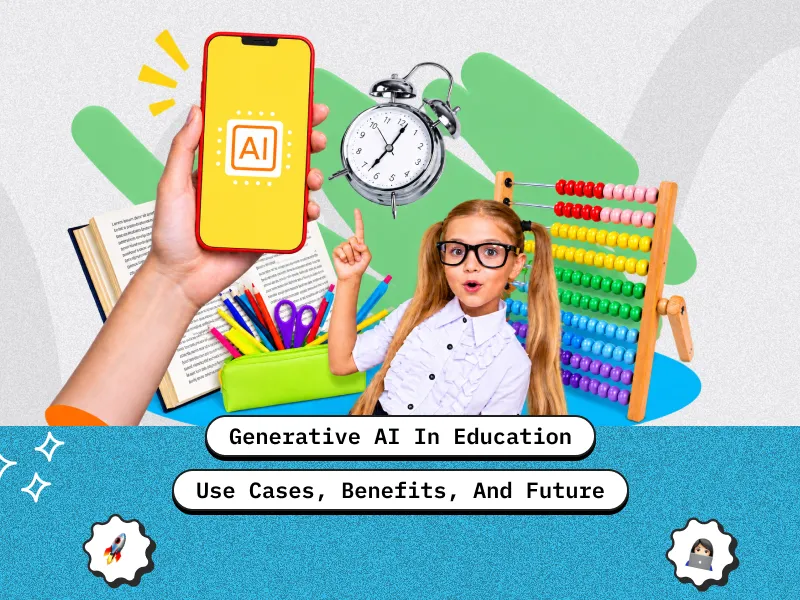
Generative AI is changing how students learn, how teachers create educational content, and how institutions provide learning support. From personalized explanations and AI tutors to lesson creation and study assistance, these tools are creating new possibilities for more flexible and accessible learning. At the same time, schools and universities need to consider accuracy, privacy, academic integrity, and responsible use.
TL;DR
- Generative AI can help students understand difficult topics and practice new skills.
- Teachers can use AI to create lessons, quizzes, assignments, and learning materials.
- AI can make learning more personalized and provide additional support outside the classroom.
- Schools need to address accuracy, privacy, academic integrity, and overdependence on AI.
- The future of education will likely involve teachers and AI working together.
Introduction
Generative AI is changing the way students learn, teachers prepare educational materials, and educational institutions provide learning support. It can explain difficult topics, create practice questions, summarize information, and help teachers prepare classroom content. However, its use also brings important questions around accuracy, privacy, academic integrity, and responsible use.
The adoption of these tools is growing quickly among students. A 2025 Higher Education Policy Institute (HEPI) survey of 1,041 undergraduate students found that 92% had used AI in some form, compared with 66% in 2024. It also found that 88% had used generative AI for assessments, compared with 53% the previous year. Common uses included explaining concepts, summarizing articles, and suggesting research ideas.
What Is Generative AI in Education?
Generative AI is a type of artificial intelligence that can create new content based on instructions from a user. It can generate text, summaries, questions, images, audio, and other types of content. In education, students can use these capabilities to understand difficult subjects, practice skills, explore ideas, and get additional help when they are studying.
Teachers can also use generative AI to prepare lesson ideas, quizzes, assignments, summaries, and classroom activities. The technology can reduce some repetitive work, but teachers still need to review the output and guide students. Anyone new to the technology can first learn how generative AI works before exploring its educational applications.
How Is Generative AI Changing Education?
Generative AI is changing education in several practical ways:
- Personalized learning: Students can receive explanations suited to their level.
- Faster content creation: Teachers can prepare learning materials more quickly.
- On-demand help: Students can ask questions when they need additional support.
- Interactive learning: AI can create examples, exercises, and practice questions.
- Greater accessibility: Content can be simplified, translated, or summarized.
- Teacher support: AI can help with some repetitive preparation tasks.
These changes do not mean that AI needs to replace traditional teaching. Instead, it can give students and teachers another tool for learning and classroom support.
Use Cases of Generative AI in Education
Here are some of the most common ways generative AI is being used in education:
1. Personalized Learning
Students often have different levels of knowledge, learning speeds, and areas where they need extra help. A single explanation may not work equally well for everyone.
Generative AI can provide simpler explanations, additional examples, or more challenging questions based on what a student needs. Students can also ask follow-up questions until they understand a topic better.
2. AI Tutors and Learning Assistants
AI tutors can provide additional support when a teacher is not immediately available. They can answer questions, explain concepts, provide examples, and guide students through problems.
For example, a student working on a mathematics problem can ask an AI tutor to explain the steps instead of only providing the final answer. This can make independent practice more interactive.
3. Lesson and Learning Content Creation
Preparing educational content can take a significant amount of time. Generative AI can help teachers create initial versions of:
- Lesson plans
- Quiz questions
- Assignments
- Study guides
- Topic summaries
- Classroom activities
Teachers can then review, correct, and adapt the content to match their students and curriculum.
4. Student Study Support
Students can use AI as an additional study tool. It can summarize learning materials, create revision questions, explain difficult concepts, and help organize study plans.
It can also help students brainstorm ideas before starting an assignment. However, students should use AI to improve their understanding rather than simply asking it to complete their work.
This broader role of AI in learning is also discussed in our article on how AI can support education.
5. Language Learning and Accessibility
Generative AI can help students practice conversations, improve grammar, build vocabulary, and translate information into different languages.
It can also make learning materials easier to understand by simplifying complex explanations or creating summaries. These capabilities can be useful for students with different learning needs and language backgrounds.
Benefits of Generative AI in Education
Here are some of the key benefits of generative AI in education and how it can support both students and teachers.
1. More Personalized Learning
AI can adjust explanations, examples, and practice activities according to individual needs. Students can learn at their own pace and spend more time on topics they find difficult.
2. Saves Teachers’ Time
Teachers can use AI to prepare first drafts of lesson plans, quizzes, activities, and other materials. This can reduce repetitive preparation work and leave more time for teaching and student interaction.
3. Faster Feedback
Students can receive quick responses to questions and practice activities. This can help them identify mistakes and understand where they need more practice.
4. More Accessible Learning
AI can simplify complex information, summarize long materials, translate content, and provide alternative explanations. This can give students more ways to understand the same subject.
5. Learning Support Outside the Classroom
Students can use AI tools to review lessons, practice skills, and ask questions outside normal classroom hours. This provides an additional source of support when a teacher or tutor is not immediately available.
Challenges of Generative AI in Education
Here are some of the main challenges schools and students should consider when using generative AI in education.
1. Incorrect Information
Generative AI can sometimes produce information that sounds convincing but is incorrect. Students may not always recognize these errors.
Important information should therefore be checked against textbooks, academic sources, teachers, or other reliable references.
2. Academic Integrity
Students may use AI to complete assignments instead of learning the material themselves. This creates challenges for teachers and institutions.
Clear rules can help students understand when AI is allowed and when work should be completed independently.
3. Data Privacy
Schools and universities handle sensitive information about students and staff. They need to understand how AI tools collect, store, and use information.
Institutions should avoid putting sensitive student information into AI tools without appropriate safeguards.
4. AI Bias
AI systems can sometimes produce biased or incomplete information. Using such output without review can create problems in educational content.
Teachers should review important AI-generated material and encourage students to compare information with reliable sources.
5. Overdependence on AI
If students use AI for every question or assignment, they may have fewer opportunities to develop independent thinking and problem-solving skills.
AI works best when it supports learning rather than doing the learning for the student.
How Can Schools Use Generative AI Responsibly?
Schools and universities can take several practical steps when introducing generative AI.
Create Clear AI Policies
Students and teachers should understand when AI can and cannot be used for assignments, examinations, research, and other academic activities.
Train Teachers and Students
AI literacy can help users understand what these tools can do, where they can make mistakes, and how to check their outputs.
Protect Student Data
Institutions should review the privacy and security practices of AI tools before using them with student information.
Review AI-Generated Content
Teachers should check AI-generated lessons, questions, summaries, and other materials before using them in the classroom.
Keep Teachers Involved
AI can assist with tasks and provide information, but teachers should remain involved in important educational decisions and student guidance.
When an institution wants to move beyond general-purpose AI tools and create its own system, the process involves decisions around data, models, integrations, testing, and deployment.
For larger or customized educational applications, organizations may also need AI development support to connect AI capabilities with their existing platforms, data, and workflows.
Future of Generative AI in Education
Generative AI is likely to become more closely connected with digital learning platforms. Students may receive more personalized explanations, practice activities, and feedback based on their learning progress. AI tutors may also become more interactive, helping students with different subjects and learning levels while providing support beyond traditional classroom hours.
Another important development is multimodal learning, where AI can work with text, images, audio, and video together. However, the future of education is not simply about adding more AI tools. Teachers will continue to provide guidance, mentorship, critical thinking, and human interaction. The most practical approach is likely to be one where AI handles useful support tasks while educators remain central to the learning experience.
Conclusion
Generative AI is creating new ways for students to learn and teachers to prepare educational content. It can support personalized learning, AI tutoring, study assistance, content creation, language learning, and accessibility.
However, these benefits need to be balanced with responsible use. Accuracy, academic integrity, privacy, bias, and overdependence are important issues that schools and universities need to address.
When used thoughtfully, generative AI can become a useful addition to education. The focus should be on using the technology to support better learning while keeping teachers and students at the center of the educational experience.
FAQs
1. How is generative AI actually used by students?
Students can use generative AI to understand difficult topics, summarize study materials, create practice questions, brainstorm ideas, learn languages, and get explanations when they need additional help.
2. Can generative AI help teachers save time?
Yes. Teachers can use it to create first drafts of lesson plans, quizzes, assignments, summaries, and classroom activities. The content should still be reviewed and adapted by the teacher before being used.
3. Is it safe for students to use generative AI for schoolwork?
It can be useful when used responsibly. Students should check AI-generated information, follow their school’s AI rules, avoid sharing sensitive personal information, and use AI to support their learning rather than simply completing their work.
4. What are the biggest concerns about using generative AI in education?
Some of the main concerns include inaccurate information, academic integrity, student data privacy, biased outputs, and students becoming too dependent on AI for learning.
5. Will generative AI change the role of teachers?
Generative AI may change some of the tasks teachers perform, particularly repetitive content preparation and basic learning support. However, teachers will continue to play an important role in guidance, mentoring, critical thinking, classroom interaction, and educational decision-making.


 11 min read


