
 Lets Talk
AI app development typically costs between $20,000 and $500,000 or more in 2026. A focused proof of concept may cost $10,000 to $30,000, an AI MVP may cost $30,000 to $80,000, and a production-ready AI application may require $80,000 to $200,000. Enterprise platforms with custom models, complex integrations, regulated data, or high-volume infrastructure can exceed $500,000.
The final estimate depends on scope, AI architecture, data, integrations, accuracy, security, platforms, usage, and post-launch costs.
TL;DR
- AI app development generally costs $20,000 to $500,000 or more.
- A focused AI MVP commonly costs $30,000 to $80,000.
- Production-ready AI apps usually cost $80,000 to $200,000.
- AI personal assistant apps may cost $40,000 to $120,000.
- API-based AI is usually faster and less expensive than training a custom model.
- Data preparation, integrations, evaluation, security, and product engineering often cost more than the initial model connection.
- Model API fees, cloud hosting, monitoring, and support must be budgeted separately.
How Much Does It Cost to Develop an AI App?
The cost depends on whether you are validating an idea, launching an MVP, or deploying a production or enterprise platform.
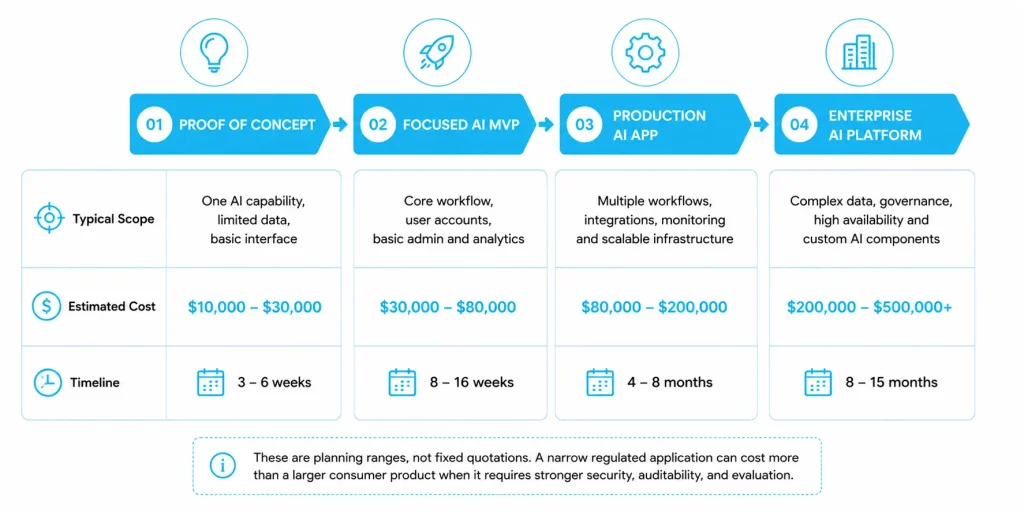
| AI app stage | Typical scope | Estimated cost | Timeline |
| Proof of concept | One AI capability, limited data, basic interface | $10,000 to $30,000 | 3 to 6 weeks |
| Focused AI MVP | Core workflow, user accounts, basic admin and analytics | $30,000 to $80,000 | 8 to 16 weeks |
| Production AI app | Multiple workflows, integrations, monitoring and scalable infrastructure | $80,000 to $200,000 | 4 to 8 months |
| Enterprise AI platform | Complex data, governance, high availability and custom AI components | $200,000 to $500,000+ | 8 to 15 months |
These are planning ranges, not fixed quotations. A narrow regulated application can cost more than a larger consumer product when it requires stronger security, auditability, and evaluation.
At the validation stage, compare these figures with a broader MVP development cost breakdown.
What Is Included in AI App Development Cost?
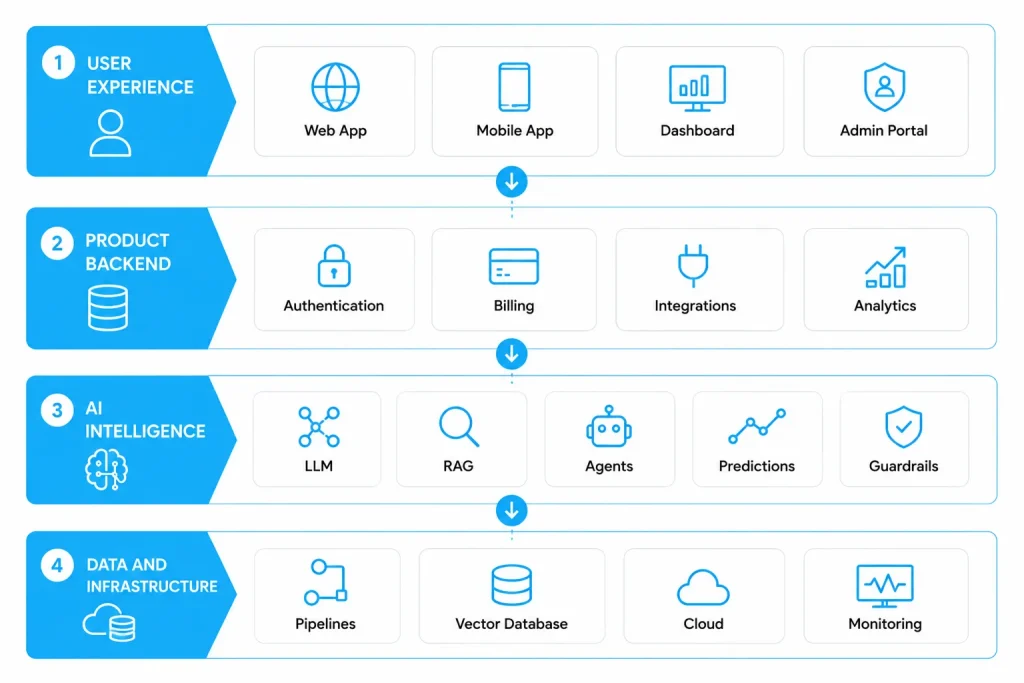
An AI application is more than a model connected to a chat interface. A commercially usable product normally includes four layers.
Product Experience
This user-facing layer may include web or mobile interfaces, authentication, roles, dashboards, notifications, subscriptions, payments, administration, and analytics.
This layer can require as much effort as the AI itself. Browser-based products should also account for the full web application development cost, including backend engineering, QA, and deployment.
AI Intelligence
This layer determines how the app generates predictions, recommendations, content, or actions. It may include model APIs, prompt engineering, RAG, agents, tool calling, routing, fine-tuning, custom ML models, and guardrails.
A text-generation feature is usually less expensive than an agent that retrieves data, uses tools, and performs actions. Review AI agent development cost when orchestration, memory, permissions, and recovery are required.
Data and Integrations
AI quality depends on the underlying data. Work may include cleaning, document ingestion, labelling, embeddings, vector databases, knowledge-base updates, integrations, permission filtering, and retention controls.
Poorly structured or inaccessible data can increase cost before model development even begins.
Reliability and Governance
A demonstration can tolerate occasional failures. A production AI product cannot.
Production requirements may include automated evaluation, hallucination and prompt injection testing, moderation, audit logs, human approval, model fallback, monitoring, and incident handling.
What Factors Affect AI App Development Cost?
1. Product Scope
A single-purpose AI app costs less than a platform with multiple user types, workflows, dashboards, subscriptions, languages, and administrative features.
Each platform increases design and testing effort. Compare iOS versus Android development cost before deciding whether to launch on one platform first.
2. AI Model Approach
The main approaches are:
- External AI API
- Retrieval-augmented generation
- Fine-tuning
- Hosted open-source model
- Custom model training
Using an established API is usually fastest. Custom training requires specialist talent, data, infrastructure, evaluation, and MLOps.
3. Data Readiness
Costs rise when data needs collection, labelling, normalisation, anonymisation, or synchronisation. Complete a data-readiness assessment before final estimation.
4. Integrations
Integrations become expensive when APIs have limited documentation, complex authentication, strict rate limits, inconsistent data, or unreliable error handling.
5. Accuracy and Evaluation
High-stakes applications need representative test datasets, expert review, confidence thresholds, citation checks, human escalation, and continuous quality monitoring.
6. Voice, Image, and Video
Text-only apps are generally simpler. Voice and multimodal products may require speech recognition, streaming, media storage, moderation, and low-latency infrastructure.
7. Security and Compliance
Encryption, role-based access, private networking, regional hosting, consent management, audit logs, penetration testing, and compliance documentation can materially affect the budget.
8. Scale and Expected Usage
The estimate should account for active users, requests per user, input and output size, concurrency, file processing, peak traffic, response time, and geographic availability.
Plan Your AI App Budget
Use our free Web Application Budget Planner to estimate development, integration, maintenance, and first-year costs.

How Much Do Different Types of AI Apps Cost?
| AI application | Typical capabilities | Estimated cost |
| AI chatbot or knowledge assistant | Question answering, document search, chat history | $25,000 to $70,000 |
| AI personal assistant | Memory, scheduling, tools, voice and notifications | $40,000 to $120,000 |
| Generative content app | Text, image, audio or editing workflows | $35,000 to $120,000 |
| Recommendation engine | User profiling and personalised suggestions | $50,000 to $150,000 |
| Predictive analytics app | Forecasting, anomaly detection and dashboards | $60,000 to $180,000 |
| Speech or computer vision app | Audio, image or real-time inference | $70,000 to $200,000 |
| AI agent platform | Tool use, workflow automation, memory and integrations | $75,000 to $250,000+ |
| Enterprise multimodal platform | Multiple models, governance and high scale | $150,000 to $500,000+ |
How Much Does an AI Personal Assistant App Cost?
AI personal assistant app development generally costs $40,000 to $120,000.
A basic assistant may answer questions and set reminders. Advanced assistants may use voice, memory, calendars, email, external tools, and approval workflows.
How Does the Model Strategy Affect Pricing?
| Model strategy | Best suited for | Initial cost impact | Ongoing cost impact |
| External AI API | Fast validation and general AI capabilities | Low | Usage-based |
| RAG | Private documents and knowledge bases | Low to medium | API, embeddings and search |
| Fine-tuning | Consistent specialised behaviour | Medium to high | Training and hosting |
| Hosted open-source model | Greater infrastructure control | High | Compute and MLOps |
| Custom model | Highly specialised or proprietary use cases | Very high | Training, hosting and specialist team |
External APIs
External APIs reduce model infrastructure work, but the app still needs product engineering, integrations, data controls, evaluation, and monitoring.
Retrieval-Augmented Generation
RAG connects models to approved private information through extraction, chunking, embeddings, vector storage, retrieval, permission filtering, and re-indexing.
Fine-Tuning and Custom Models
Fine-tuning may improve consistency for a narrow task, but it should not replace clean data, retrieval, prompting, or evaluation.
Custom model training should be considered only when existing models cannot meet a validated requirement.
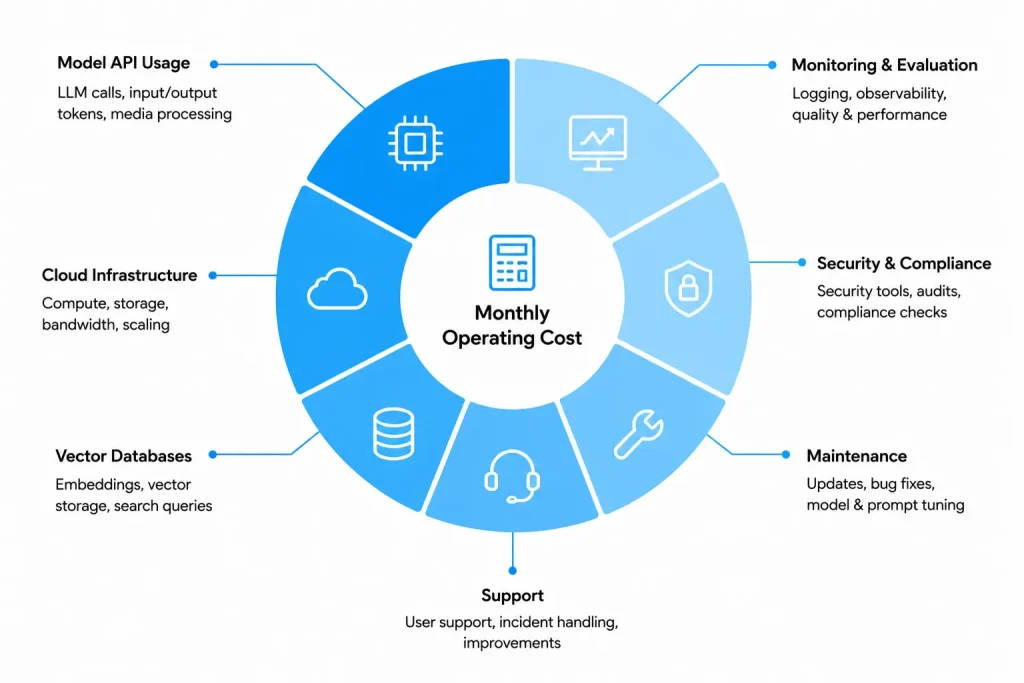
What Are the Ongoing Costs of an AI App?
Post-launch costs should be separated from the initial development budget.
Monthly AI Operating Cost Formula
Monthly AI Cost =
Model Input and Output Usage
+ Tool or Search Charges
+ Embeddings and Vector Storage
+ Cloud Infrastructure
+ Monitoring
+ Maintenance and Support
Typical expenses include model APIs, cloud hosting, databases, vector search, monitoring, security, evaluation, maintenance, and support.
| Application stage | Approximate monthly operating cost |
| Limited pilot | $500 to $3,000 |
| Growing commercial product | $3,000 to $20,000 |
| High-volume enterprise platform | $20,000+ |
Actual costs depend on model choice, traffic, response length, media processing, infrastructure, and support. Plan these expenses before launch.
What Have We Learned From AI Product Delivery?
First-Hand Experience: The Model Is Only One Part of the Product
In practical AI product delivery, connecting to a model is rarely the largest challenge.
More effort is usually required to prepare data, design workflows, manage permissions, integrate systems, evaluate responses, handle failures, monitor usage, control inference cost, and build administration tools.
A proof of concept shows that the AI works. A production app must show that users can trust it and complete a valuable task.
Practical Implementation Lessons
Validate the workflow before optimising the model, create an evaluation dataset during the MVP stage, measure cost per completed task, keep models replaceable, add human review for sensitive actions, and track quality, latency, errors, and cost from launch.
How Can You Estimate AI App Development Cost?
Use this eight-step framework.
Step 1: Define the Business Outcome
Identify the measurable result, such as reducing support workload, accelerating document processing, improving recommendations, or automating scheduling.
Step 2: Map the Core Workflow
Document what the user does, what the AI processes, what output is generated, and what happens when the output is uncertain.
Step 3: Select the AI Approach
Choose between an API, RAG, predictive ML, computer vision, speech processing, an AI agent, or a custom model.
Step 4: Audit the Data
Check availability, quality, permissions, formats, sensitive information, update frequency, and labelling requirements.
Step 5: Map Integrations
List every system the product must read from or write to, including authentication, rate limits, data structure, and error handling.
Step 6: Estimate Usage
Define users, requests, token volume, files, concurrency, and media processing assumptions.
Step 7: Set Quality and Security Requirements
Specify accuracy, response time, human approval, data retention, access controls, auditability, and availability targets.
Step 8: Divide Delivery Into Phases
Estimate discovery, proof of concept, MVP, production hardening, and scale separately.
How Can You Reduce AI App Development Cost?
Start with one high-value workflow, use an existing model before custom training, test RAG before fine-tuning, use smaller models for simple tasks, launch on one platform, create an evaluation dataset early, cache repeated responses, use batch processing where appropriate, track usage, and build security into the architecture.
A disciplined scope usually saves more than selecting the lowest-cost development team. This guide to reducing app development costs explains how feature prioritisation, architecture, platform selection, and phased delivery can lower the total budget without weakening the product.
What Budget Should You Set?
| Available budget | Suitable objective |
| Under $30,000 | Validate one technical assumption through a proof of concept |
| $30,000 to $80,000 | Launch a focused MVP for early users |
| $80,000 to $200,000 | Build a production-ready commercial AI product |
| Above $200,000 | Develop an enterprise, regulated, multimodal, or high-scale platform |
The final estimate should include product, AI, data, integrations, security, evaluation, deployment, and operating costs.
Calculate Your AI App Budget
Describe your AI idea, target users, features, integrations, data sources, and expected usage to receive a requirement-based estimate.

Frequently Asked Questions
How Much Does It Cost to Develop an AI App?
AI app development generally costs between $20,000 and $500,000 or more. A focused MVP may cost $30,000 to $80,000, while a production-ready product commonly costs $80,000 to $200,000.
What Is the Cost of an AI App MVP?
An AI app MVP usually costs $30,000 to $80,000. The estimate depends on user roles, platforms, AI workflows, data sources, integrations, administrative tools, and evaluation requirements.
How Long Does It Take to Build an AI App?
A proof of concept may take three to six weeks. A focused MVP usually takes eight to sixteen weeks. A production product may require four to eight months.
Is It Cheaper to Use an AI API or Build a Custom Model?
Using an existing AI API is usually faster and less expensive. Custom models require training data, specialist engineers, infrastructure, evaluation, hosting, and ongoing MLOps.
What Are the Main AI App Development Cost Factors?
The main factors are product scope, model strategy, data quality, integrations, platforms, accuracy requirements, security, compliance, expected usage, scalability, and post-launch maintenance.
Can AI Be Added to an Existing App?
Yes. AI can be added through model APIs, RAG, predictive models, recommendation systems, computer vision, speech services, or agent workflows. The cost depends on the existing architecture and data accessibility.
What Are the Ongoing Costs of an AI App?
Ongoing costs include model APIs, cloud hosting, databases, vector search, monitoring, evaluation, maintenance, security, and support. Early products may spend $500 to $3,000 per month, while high-volume systems can spend substantially more.









 30 mins free Consulting
 13 min read






 Love we get from the world